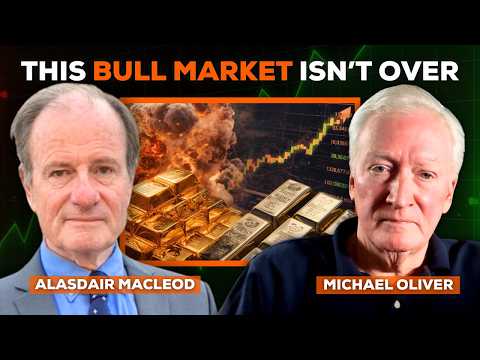
A panel on VRIC Media argues the Iran war is less the root cause than a catalyst exposing a pre-existing fiat debasement and bond-market stress problem. Michael Oliver and Alistair Mloud both say gold, silver, oil, copper and other real assets should eventually benefit, while cash and government bonds look increasingly vulnerable.
Watch on YouTube ›Get the market thesis, key claims, assets, contradictions, and follow-up questions from any financial video — then unlock a version personalized to your portfolio, watchlist, and favorite speakers.
This episode is a three-way market panel hosted by Jesse Day with Michael Oliver and Alistair Mloud focused on the selloff in gold and silver during the Iran war and what it says about the broader monetary regime. The speakers reject the idea that war itself is the durable driver of precious metals. Instead, they argue the core force is ongoing fiat debasement, rising bond yields, and the buildup of stress in the financial system. The immediate weakness in metals is framed as a liquidity-driven “vacuum” or temporary interruption rather than a structural top. Michael Oliver’s core thesis is that gold and silver should not be understood as simple war hedges. He says the real driver is the long-run degradation of the dollar measured through money supply growth, especially M2, and that cash is not a reliable store of value. …
Near term, the key setup is whether gold/silver finish this liquidation phase and reclaim momentum while bond yields keep trending up. If yields continue breaking higher or financials weaken further, the market may quickly rotate back into precious metals and real assets.
Over the next few months, the base case is a tug-of-war between headline-driven liquidations and a broader debasement trade. Confirmation would come from sustained yield pressure, renewed weakness in banks/financials, and commodities holding gains rather than giving them back; a meaningful de-escalation or yield reversal would soften the view.
Structurally, the panel’s thesis is that fiat currencies are being debased faster than markets want to admit, and that gold is the durable hedge against that regime. If that regime persists, nominal prices of real assets should trend higher over time while cash and long-duration paper claims lose purchasing power.
The war with Iran has brought forward the collapse of the fiat currency system, and the key indicator to watch is bond yields of highly indebted G6 nations.
Alistair argues that the fiscal strain of war accelerates the existing debasement trend, and rising bond yields of indebted nations signal the system's stress.
The current gold/silver price action is a congestion zone, not a top — this is not the 2011 top repeating.
The speaker contrasts the current momentum/trend structure with clear signals at the 2011 top and 2015 bottom, arguing the current price action lacks those signals.
The financial sector (XLF) is in a potentially disastrous technical position, more vulnerable than the S&P, and a single credit problem at a major bank could trigger a crisis.
Speaker cites technical analysis of the XLF financial sector ETF and notes several major banks look technically vulnerable, warning that just one credit story could cause panic and force central bank intervention.
Why are gold and silver falling despite the war, and what does that mean if the conflict continues?
Michael says war is not a reliable long-term bullish driver for gold and that the selloff is more of a noise event tied to liquidity and headlines. Alistair agrees, arguing the real driver is fiat currency degradation; he thinks the conflict could accelerate inflation, weaken the dollar, and ultimately support much higher precious-metal prices.
Do you agree that this is more noise than signal, with investors focusing too much on geopolitics instead of fundamentals?
Alistair agrees and says gold mainly reflects fiat currency degradation, while war shifts attention away from that reality. He adds that many investors react first by moving into dollars for liquidity, but later begin to consider gold once they focus on the longer-term effects.
What data led you to conclude that cash is losing real value and is not a good place to preserve capital?
He points to M2 growth charts from the Federal Reserve, arguing the money supply has risen in a near-parabolic way over time. He says consumer and producer price moves are reflections of monetary inflation, and that many real-world assets remain cheap versus both history and gold.
Unlock the full claims, asset map, scores, related transcripts, follow-up questions, and AI chat — shaped around your portfolio, watchlist, favorite speakers, and risks.