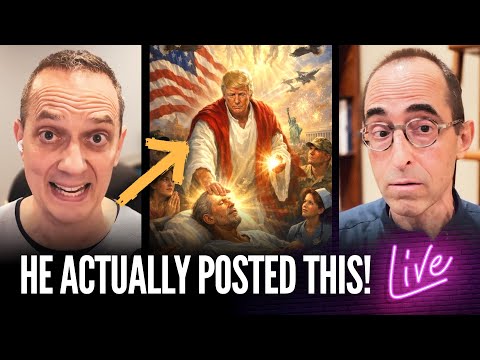
JVL and Will Saletan react to Donald Trump’s deleted Truth Social post showing himself as Jesus, using it as a case study in narcissism, blasphemy, and his habit of turning every institution into a personal loyalty test. They argue the earlier attack on Pope Leo and the AI Jesus image reveal Trump’s worldview: politics as a zero-sum fight where even religion is reduced to whether it is for or against him.
Watch on YouTube ›Get the market thesis, key claims, assets, contradictions, and follow-up questions from any financial video — then unlock a version personalized to your portfolio, watchlist, and favorite speakers.
This episode is a rapid, highly opinionated breakdown of Trump’s deleted Truth Social post depicting himself as Jesus, framed by the prior attack he posted on Pope Leo. The speakers treat the sequence as shocking not because Trump is merely insulting the pope, but because he is collapsing religion into personal politics: the pope is cast as another adversary in a conventional campaign-style fight, and then Trump’s own image is elevated into quasi-divine imagery. Their core thesis is that Trump’s narcissism is so total that he interprets criticism of his actions as criticism of himself, even when the issue is a pope’s stance against war or a Christian ethic centered on mercy. A large part of the discussion is devoted to the political logic Trump seems to be using. …
Immediate risk is reputational and political: Trump’s deleted Jesus image and attack on the pope are likely to keep generating backlash, mockery, and fresh clips from his press remarks. The near-term setup is about whether Catholic reaction hardens or dissipates after the deletion.
Over weeks to months, this looks like another episode that either reinforces Trump’s ability to absorb outrage or marks a small boundary he cannot cross without cost. The key confirmation will be whether Catholic institutions and voters treat it as a one-off stunt or as part of a broader pattern of disrespect.
Structurally, the transcript argues that Trumpism keeps dissolving the boundary between spiritual authority and political loyalty. The long-run implication is a further weakening of institutional religion as an independent moral check, with Christian nationalism growing in the vacuum.
Donald Trump does not understand or genuinely conceive of religious liberty — he merely treats evangelical Christians as a client group to be placated.
The speaker points to Trump's proposed Muslim ban as evidence that he cannot truly believe in religious liberty, which would require defending religions he dislikes.
Trump's team is being outclassed in political acumen by the staff of the president of Iran.
The speaker notes that Iran's staff is more aware of how to play to the crowd by defending the Pope's honor, while Trump's advisors failed to counsel him against insulting the Pope.
How does Trump's attack on the Pope and subsequent Jesus-themed post strike you as a political observer?
Will says every time he thinks he has an extreme notion of what Trump would do, Trump goes and literally posts an attack on the Pope followed by the Jesus imagery. He interprets Trump as thinking he can mount a conventional political attack on the Pope as though the Pope is another politician - pitting him against Catholics, smearing him as soft on crime, and boasting about his own electoral mandate.
As a non-Catholic, who are the popes that Republicans really love?
Will names John Paul II and Benedict. JVL then adds that John Paul II was vehemently against the Iraq War before it was launched, sending a cardinal to meet with President Bush, yet he is still considered the conservative Republican pope. JVL's point is that all popes oppose wars of choice and Trump narcissistically thinks the Pope's opposition is personal TDS.
How can a narcissist who thinks he's responsible for the Pope's election truly understand the idea of religious liberty?
The guest says Trump doesn't understand religious liberty at all — he views evangelical Christians as client groups he wants to give things to, but that doesn't constitute religious liberty because religious liberty requires granting liberty to religions he doesn't like and groups that aren't his friends, which Trump has no interest in doing.
Unlock the full claims, asset map, scores, related transcripts, follow-up questions, and AI chat — shaped around your portfolio, watchlist, favorite speakers, and risks.