
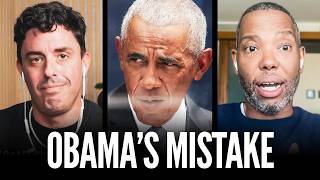
A wide-ranging Bulwark interview with Ta-Nehisi Coates centered on Obama’s legacy, the fragility of liberal democratic gains, U.S. foreign policy, and Coates’s Vanity Fair piece on Gaza and the 2024 election. Coates argued that Obama represented a singular historical possibility for a Black president, but that the administration underestimated how easily progress can be reversed and how deeply the opposition would mobilize against it.
Watch on YouTube ›Get the market thesis, key claims, assets, contradictions, and follow-up questions from any financial video — then unlock a version personalized to your portfolio, watchlist, and favorite speakers.
This episode is structured as a long interview between Tim Miller and Ta-Nehisi Coates, with the conversation anchored by Obama’s library opening, Coates’s new Vanity Fair article, and a broader debate about politics, narrative, and American power. Coates’s core thesis about Obama is that he was uniquely positioned to become the first Black president because of his life history and interracial upbringing, which gave him a perspective that could reach a broad electorate. But Coates also argued that Obama did not fully grasp the vulnerability of what he had built: it is much easier to destroy than to construct, and the opposition’s hatred and capacity to reverse gains were underappreciated. On domestic politics, Coates repeatedly emphasized that the past 10 years broke the old assumptions that enabled Obama-era rhetoric. …
Near-term, this is a narrative-heavy political setup rather than a tradable market catalyst: the immediate risk is continued Democratic infighting over Gaza, coalition messaging, and how much moral language the party can sustain. For markets, the actionable takeaway is mostly sentiment-aware positioning around U.S. political volatility, not a direct asset call.
Over weeks and months, the base case is continued erosion of the old post-Obama consensus on U.S. exceptionalism, with domestic politics increasingly shaped by distrust of institutions and foreign-policy narratives. The view changes if Democrats can pair moral credibility with a clearer governing story that voters believe.
Longer term, the structural implication is that U.S. political legitimacy will depend less on patriotic narrative and more on whether institutions can deliver visible fairness and restraint. If that fails, the regime risk is not one election but a lasting collapse in trust in the old bipartisan script.
Only someone like Barack Obama — with a white parent, white grandparents who treated him as equal, raised in Hawaii — could have become the first Black president of the United States.
Coats argues Obama's unique family background and upbringing in Hawaii gave him a perspective that allowed him to connect with the largest voting population, making his historic election possible.
Obama never fully understood how deeply he was loathed by the opposition party and how powerful that hatred was.
Coats argues Obama consistently sought compromise and nominees acceptable to his opponents rather than forcing through progressive picks like Ketanji Brown Jackson, because he underestimated GOP animosity.
Obama could not have imagined Trump winning in 2016, and that lack of imagination left his presidency poorer by not seeing the vulnerability of his achievements.
Coats argues Obama's temperament and worldview prevented him from foreseeing how easily his legacy could be rolled back, citing Obama's own statement that Trump couldn't win.
What comes to mind today on the opening of the Obama library, given that you wrote the book on his legacy and there's been more time to stew in the aftermath?
Coates says his view remains that only someone like Barack Obama could have been the first black president — someone raised in intimate spaces with white family and in Hawaii, which gave him a very different perspective and allowed him to see the best in the largest voting population. But Coates says the downside is that Obama could not have imagined the past 10 years, including Trump winning, and that lack of imagination left his presidency poorer.
How did that lack of imagination leave his presidency poorer or reflect in his presidency?
Coates says Obama did not see the vulnerability of his achievements — how easily things can be rolled back. He thinks Obama did not appreciate that it is much harder to build things than to destroy them, citing Obamacare as an example of something really hard to build and hold together.
What types of things would you have done differently if you had that appreciation of how easily things can be rolled back?
Coates says he does not know, but speculates that instead of Merrick Garland, Obama could have nominated Ketanji Brown Jackson and forced it through, using it as a rallying cry even if it did not pass. Coates argues Obama never understood the extent to which he was loathed by the opposition party and how powerful that hatred was.
Unlock the full claims, asset map, scores, related transcripts, follow-up questions, and AI chat — shaped around your portfolio, watchlist, favorite speakers, and risks.
