TranscriptAgent
Try it free
TRANSCRIPTAGENT.AI · transcript analysis

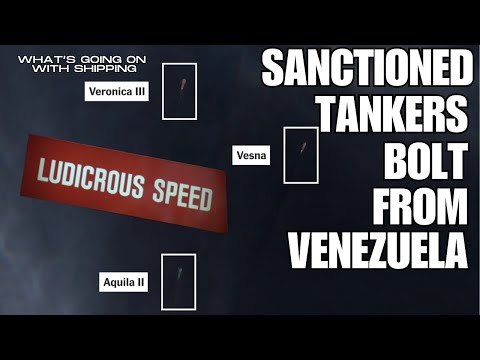
Sanctioned Tankers Sail from Venezuela and Run the US "Blockade"

Channel: What's Going on With Shipping? Published: 2026-01-05 13:06
What's Going on With Shipping?

The speaker argues that a large group of sanctioned oil tankers has broken out of Venezuelan ports under heavy U.S. pressure, and that this creates a live operational test for U.S. naval and special operations forces. He says the ships are using AIS spoofing, false flags, and saturation tactics to evade interception, and he believes the U.S. now has to decide whether to board some, all, or none of the vessels.

Watch on YouTube ›

Get the market thesis, key claims, assets, contradictions, and follow-up questions from any financial video — then unlock a version personalized to your portfolio, watchlist, and favorite speakers.

Detailed summary

The core thesis is straightforward: the speaker believes a mass departure of sanctioned oil tankers from Venezuela is a deliberate attempt to defeat the U.S. naval blockade and that it immediately creates a difficult enforcement problem for the United States. He says at least 16 tankers have left Venezuelan ports, including four he names specifically, and that these ships are using deception tools such as AIS masking, spoofed identities, and reflagging to escape interception. He grounds that view in reporting from the New York Times and in tracking work from TankerTrackers. He says TankerTrackers had 86 tankers under observation around Venezuela on January 3, with 77 sanctioned violators and 46 laden with crude or fuel oil. …

🔒 The full detailed summary continues — read all of it free with an account. Read the full summary →

Main takeaways

  1. The speaker’s main claim is that sanctioned Venezuelan tankers are actively fleeing and trying to evade U.S. interdiction.
  2. He thinks the ships are using AIS spoofing, false flags, and coordinated dispersal tactics.
  3. He sees the situation as a test of U.S. naval, Coast Guard, and special-operations bandwidth.
  4. He does not expect kinetic attacks on tankers because of spill risk.
  5. The broader implication is that sanctions enforcement may be harder than the blockade narrative suggests.

Market read by horizon

Short term

Near term, the key tradeable risk is whether the U.S. intercepts or publicly boards any outbound tanker; that would instantly validate blockade pressure and could disrupt sentiment around Venezuelan crude flows. If the ships keep slipping away, the tactical read is that enforcement is leaky and the blockade is more theater than containment.

  • The immediate focus is whether U.S. forces board any of the tankers already leaving Venezuelan waters.
Show more
  • At least four vessels are named as visible examples, while others are unaccounted for, which raises near-term tracking risk.
  • AIS spoofing and false-location signals are the key tactics to watch over the next few days.
Mid term

Over the next few weeks, the base case is a messy enforcement contest: some vessels may be stopped, others may escape, and the market will focus on whether Venezuelan exports are meaningfully constrained. The setup improves for the U.S. only if boarding operations become repeatable and visible; otherwise sanctions leakage remains the dominant narrative.

  • Over the next several weeks, the question is whether the U.S. can sustain pressure on Venezuelan oil logistics without overextending naval assets.
Show more
  • If departures continue despite the blockade, the market narrative shifts toward sanctions leakage rather than effective suppression.
  • Confirmation would come from continued tanker movement, repeated spoofing, and evidence that more ships are reflagging or rerouting.
Long term

Structurally, the video argues that maritime sanctions are only as strong as the intelligence, naval logistics, and legal boarding capacity behind them. The long-run implication is that sanctioned crude can keep moving through registry arbitrage and AIS deception unless enforcement becomes a sustained global effort.

  • Structurally, the transcript argues that maritime sanctions enforcement is a persistent cat-and-mouse problem, not a one-off operation.
Show more
  • The broader regime implication is that offshore oil logistics can keep functioning through deception, registry arbitrage, and operational saturation.
  • If this pattern holds, it weakens the credibility of blockades as a clean tool for controlling sanctioned crude exports.
Unlock the full horizon read See the full short-term, mid-term, and long-term implications with confirmation and invalidation signals. Unlock horizon read

Key claims (2)

BEARISH oil sanctions enforcement

At least 16 sanctioned oil tankers have departed Venezuelan ports following Maduro's capture, using deceptive tactics to evade US naval forces.

The New York Times story, corroborated by Tanker Trackers and satellite imagery, shows these tankers have left port and are masking their locations.

NEUTRAL dark fleet deceptive practices

These fleeing tankers are using 'zombie signals' — broadcasting old AIS registries of non-existent or dead ships — to spoof their true locations.

The speaker notes specific tankers (e.g., Bertha) show positions in the Baltic or off West Africa while actually underway in the Caribbean.

Assets discussed (9)

Venezuela
BEARISH other

The speaker says sanctioned tankers are fleeing Venezuelan ports, implying pressure on export logistics and oil shipments.

Aquila 2
BEARISH other

Named as one of the outbound tankers trying to evade tracking and interception.

Unlock the full asset map (7 more) See all assets mentioned, their directional bias, and the exact reasoning. Unlock asset map

Interview (2 Q&A)

US military response

How is the US military positioned to respond to these fleeing tankers?

The US Navy's position is just north of Venezuela with an amphibious ready group including the USS Euima, San Antonio, and Fort Lauderdale, plus the special operations carrier Ocean Trader. The 22nd Marine Expeditionary Unit is well-suited for boarding operations, but boarding requires Coast Guard detachments since the military is not law enforcement. The key challenge is bandwidth — whether the US can handle 16 vessels sailing simultaneously. The host notes nobody wants to shoot out engines of fully loaded oil tankers carrying over a million barrels of fuel due to environmental disaster risk.

naval capability test

Why is this situation a test of US naval capabilities?

The situation tests whether the US can handle 16 tankers departing simultaneously, which stretches naval bandwidth. The host highlights the utility of amphibious ready groups, the need for new patrol frigates capable of extended deployments with helicopters, and the value of converted commercial vessels like the Ocean Trader for operations that don't require a destroyer.

Where this transcript pushes against consensus

  • The speaker treats the New York Times and TankerTrackers reporting as effectively settled fact, but provides no independent corroboration inside the video for the exact count of tankers or their current locations.
  • He asserts that the ships are coordinated in a quasi-saturation breakout, but the transcript does not show direct evidence of coordination beyond timing and shared tactics.
  • He states that a ship is in U.S. custody and that Maduro has been captured, which is an extraordinary claim and appears highly questionable without supporting proof in the video.
  • The idea that some vessels have been reflagged to Russia or are using zombie signals is plausible, but the transcript offers anecdotal examples rather than systematic evidence.
  • The military discussion sometimes blurs law-enforcement boarding, naval interdiction, and special-operations raid concepts, which makes the operational picture less precise than the certainty of the rhetoric suggests.

Topics

Venezuela oil exportsU.S. blockadesanctioned tankersAIS spoofingdark fleetmaritime interdictionU.S. Navy deploymentCoast Guard boardingshipping intelligenceenvironmental spill risk

Create your free research agent

Unlock the full claims, asset map, scores, related transcripts, follow-up questions, and AI chat — shaped around your portfolio, watchlist, favorite speakers, and risks.

  • Full claims and asset map
  • Personalized relevance to your watchlist
  • Follow-up questions you can track
  • Related transcripts from your workspace
  • AI chat about this video
Create your free research agent
TRANSCRIPTAGENT.AI