TranscriptAgent
Try it free
TRANSCRIPTAGENT.AI · transcript analysis

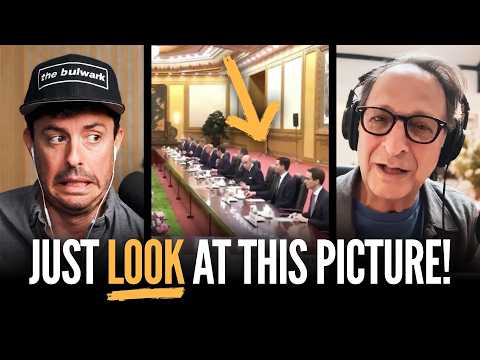
Trump is the Revenge of the Mediocre | The Bulwark Podcast

Channel: The Bulwark Published: 2026-05-15 16:36
The Bulwark

Tim Miller and Andrew Weissmann use the podcast to argue that Trump-era corruption is now so brazen it looks like theft: from a reported $1.7 billion settlement channeling taxpayer money to allies, to the broader pattern of whitewashing January 6 and using institutions for personal and political payoff. The conversation then broadens into voting-rights gerrymandering, FBI misconduct under Cash Patel, media-law strategy, abortion litigation, and Weissmann’s new book about lying in politics.

Watch on YouTube ›

Get the market thesis, key claims, assets, contradictions, and follow-up questions from any financial video — then unlock a version personalized to your portfolio, watchlist, and favorite speakers.

Detailed summary

This episode is largely a political and legal attack on the Trump administration’s behavior, framed by Tim Miller and Andrew Weissmann as a collapse of basic institutional norms. The first major topic is a reported plan for Trump to drop a $10 billion IRS/tax-return lawsuit and instead settle in a way that could direct roughly $1.7 billion to allies and favored January 6 figures. Weissmann and Miller describe this as corruption on an unprecedented scale, with Miller repeatedly comparing it to outright theft and asking why this should be treated differently from simply taking money from the government. Weissmann’s legal framing is that there may not even be a real case or controversy, because the same president is effectively both plaintiff and beneficiary. …

🔒 The full detailed summary continues — read all of it free with an account. Read the full summary →

Main takeaways

  1. Miller and Weissmann portray Trump-era corruption as a direct transfer of public money and power to allies, not just ethical drift.
  2. They think the legal system has been hollowed out in key areas, especially voting rights, where the Supreme Court has largely eliminated practical remedies.
  3. Their model of current politics is that institutions are being used to whitewash January 6 and normalize lying, while accountability mechanisms lag behind.
  4. They see Cash Patel as emblematic of an unserious FBI leadership culture, especially when contrasted with prior directors and internal standards.
  5. Weissmann’s book advances a broader thesis: political lies should be harder to excuse as protected speech when they are material, provable, and repeated at scale.

Market read by horizon

Short term

Near term, the market-relevant read is mainly risk to political headlines rather than tradable macro. The immediate catalyst set is scandal, litigation, and pre-midterm maneuvering; the tactical risk is that fresh Trump corruption or abortion/voting stories can quickly shift media tone and voter attention.

  • The reported Trump/IRS settlement is the immediate flashpoint and could become a major corruption scandal if the $1.7B figure and distribution mechanism are confirmed.
Show more
  • Redistricting fights in places like Louisiana, Tennessee, Alabama, and Virginia are still in motion, but some state timelines may limit how much immediate damage can be done before the next election.
  • Cash Patel’s Honolulu trip and related leak investigations may generate more headlines, especially if the Atlantic chooses to litigate aggressively.
Mid term

Over weeks to months, the base case is continued institutional conflict with limited legal repair: courts may narrow remedies, while politics and turnout do the heavy lifting. The setup changes if a scandal breaks through the information bubble or if litigation like the Atlantic/Patel fight creates an embarrassing public record.

  • Over the next several weeks or months, the base case in their telling is continued escalation: more lawsuits, more institutional fights, and more attempts to reinterpret corruption or violence as victimhood.
Show more
  • Voting-rights litigation will probably stay constrained by the Court’s current posture, leaving politics and turnout as the main defense against map manipulation.
  • If the Atlantic pushes the Patel case to trial, it could set a template for how media organizations respond when Trump-aligned officials sue over reporting they call false.
Long term

Structurally, the conversation points to a regime where truth, law, and enforcement are increasingly politicized and where institutions are less able to self-correct. The lasting implication is that accountability may depend more on elections and rule redesign than on existing legal doctrine.

  • The structural thesis is that American institutions are now being stress-tested by actors who understand where the law is weak and where public accountability is fragmented.
Show more
  • Weissmann argues the country has no durable, general-purpose mechanism for punishing political lying at the federal level, and that gap may be one of the regime’s central vulnerabilities.
  • The Court’s treatment of voting rights suggests a lasting move toward a world where partisan advantage can often masquerade as race-neutral law.
Unlock the full horizon read See the full short-term, mid-term, and long-term implications with confirmation and invalidation signals. Unlock horizon read

Key claims (12)

BEARISH government corruption / fiscal policy

The Trump administration is settling a $10 billion lawsuit Trump filed against the IRS by taking $1.7 billion of taxpayer money and putting it into a slush fund to give to Trump allies who were 'targeted' by the Biden administration.

The speaker cites an ABC News report as evidence for the settlement structure and amount.

BEARISH government corruption / rule of law

The Trump administration can avoid judicial scrutiny by settling the IRS lawsuit on its own terms without ever involving the court, effectively writing themselves a check with taxpayer money.

The speaker notes the judge questioned whether there was a genuine case or controversy, and argues the administration can bypass the court entirely.

BEARISH Voting Rights / Redistricting

There is no legal path forward for redistricting challenges given what the Supreme Court has done.

The speaker argues the Supreme Court summarily vacated a case not based on the Voting Rights Act and has signaled it will not find intentional discrimination.

Unlock 9 more claims See the full bullish, bearish, and counter-consensus argument map extracted from the transcript. Unlock all claims

Assets discussed (10)

Trump $10 billion IRS lawsuit / settlement
BEARISH other

Discussed as a vehicle for corrupt self-dealing and taxpayer-funded payouts to allies.

Taxpayer dollars
BEARISH other

The speakers frame the proposed settlement as direct misuse of public money.

Unlock the full asset map (8 more) See all assets mentioned, their directional bias, and the exact reasoning. Unlock asset map

Interview (22 Q&A)

Trump IRS lawsuit settlement

What is the difference between Trump settling his IRS lawsuit with himself and outright theft?

Weissmann says there is no difference. He explains the judge pointed out there might not even be a case or controversy, so the administration can settle without court involvement, effectively writing themselves a check with taxpayer money.

emoluments clause

Why doesn't Trump just give the IRS settlement money to his campaign or his children, and is this an emoluments clause violation?

Weissmann says emoluments are conceptually close but the clause isn't really followed. He thinks it's closer to theft because there's no good faith basis for the dispute. He notes Jamie Raskin's point that Trump is giving himself over a billion dollars to use as he sees fit, while Epstein victims whose info was leaked by DOJ get nothing.

emoluments clause

Does the domestic emoluments clause in Article 2 prohibit what Trump is doing with this settlement?

Weissmann says this came up in Trump 1.0 with the Post Office and fizzled. Congress has the power to approve even if it qualifies as an emolument, and they could use leverage by withholding approval of nominees, judges, or war funding.

Unlock the full interview (19 more Q&A) Every question, answer summary, and YouTube timestamp. Unlock full Q&A

Where this transcript pushes against consensus

  • The claim that Trump can effectively settle with himself for taxpayer money is presented as self-evidently corrupt, but the exact legal mechanics and whether the settlement structure is permissible are not fully established in the conversation.
  • Weissmann’s proposal to criminalize or sanction political lies is rhetorically forceful, but the transcript does not fully confront First Amendment objections, abuse risk, or administration-by-administration weaponization.
  • The idea that the Atlantic should force a trial against Cash Patel is plausible as a strategy, but the downside risks for plaintiffs and sources are only lightly addressed.
  • On redistricting, Weissmann says there is no legal path forward, yet the transcript also acknowledges small constitutional windows and possible state-level constraints, so the legal picture is not entirely closed.
  • Several factual claims about TrumpWorld payouts, reoffending January 6 defendants, and internal FBI behavior are asserted forcefully, but the discussion relies mostly on commentary rather than documentary proof within the episode.

Topics

Trump corruptionJanuary 6 whitewashingVoting rights and gerrymanderingCash Patel and FBI conductPolitical lying and defamationMifepristone litigationSupreme Court and staysMedia bubbles and accountabilityBook promotion: Liars KingdomAbortion politics

Create your free research agent

Unlock the full claims, asset map, scores, related transcripts, follow-up questions, and AI chat — shaped around your portfolio, watchlist, favorite speakers, and risks.

  • Full claims and asset map
  • Personalized relevance to your watchlist
  • Follow-up questions you can track
  • Related transcripts from your workspace
  • AI chat about this video
Create your free research agent
TRANSCRIPTAGENT.AI