TranscriptAgent
Try it free
TRANSCRIPTAGENT.AI · transcript analysis

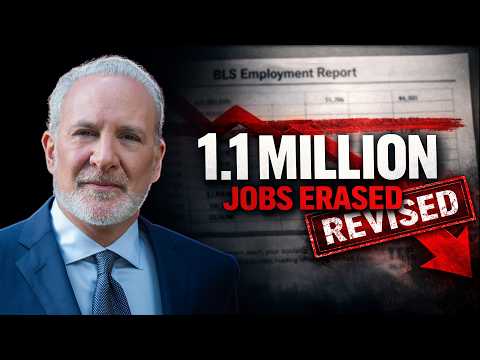
Jobs Report “Beat” Is Another Lie: 1.1 Million Jobs Erased

Channel: Peter Schiff Published: 2026-02-11 21:21
Peter Schiff

Peter Schiff argues the January jobs report and prior labor data are materially misleading because of massive downward revisions, and he uses that to reinforce his broader thesis that U.S. data, policy, and market pricing are all distorted by inflation and government spin. He extends that argument into a bearish view on the dollar, U.S. stocks, crypto, and the U.S. consumer, while staying constructive on gold, silver, miners, foreign equities, and emerging markets.

Watch on YouTube ›

Get the market thesis, key claims, assets, contradictions, and follow-up questions from any financial video — then unlock a version personalized to your portfolio, watchlist, and favorite speakers.

Detailed summary

Schiff’s core thesis is that the latest jobs report is not a real positive signal at all, because the headline beat is overwhelmed by enormous revisions that retroactively erase the strength of prior reports. He says January’s 130,000 jobs was a weak result for the U.S. economy, but the more important point is that roughly 1.1 million jobs were removed from 2025 and more than 800,000 from 2024, making nearly every “beat” in those years look like a miss in hindsight. He frames this as proof that the labor data are persistently unreliable, especially because the Bureau of Labor Statistics’ birth-death model assumed new businesses and hiring that did not actually exist. He argues that this is not just a technical statistical issue but part of a larger pattern of false official narratives. …

🔒 The full detailed summary continues — read all of it free with an account. Read the full summary →

Main takeaways

  1. The jobs report headline beat is, in Schiff’s view, invalidated by huge downward revisions to prior years.
  2. He sees weak official data, especially labor and inflation, as part of a broader government-spin problem.
  3. The dollar, U.S. stocks, and crypto are all framed as vulnerable bubble assets.
  4. Gold, silver, miners, and foreign equities are the preferred beneficiaries of de-dollarization.
  5. He thinks inflation will erase debt but also erode real wages, savings, and U.S. living standards.

Market read by horizon

Short term

Near term, the setup is bearish for the dollar and cautious on U.S. risk assets if traders start focusing on revisions and slowing domestic demand. Schiff expects the next data prints to reinforce the rotation into gold, silver, and foreign equities.

  • The immediate catalyst is the January jobs report and the market’s reaction to it, which Schiff says was the wrong reaction.
Show more
  • He expects the dollar to weaken quickly; he specifically says DXY could move toward 90 by the end of March.
  • He thinks gold and silver have already stopped reacting to weak-report/strong-dollar patterns the way they did in 2024.
Mid term

Over the next few months, the base case is continued de-rating of the U.S. growth narrative, with weaker dollar dynamics supporting non-U.S. assets and precious metals. The view weakens if labor, inflation, and rates stop validating the de-dollarization trade.

  • Over the next several weeks to months, Schiff’s base case is continued rotation out of U.S. assets and into foreign markets, emerging markets, and precious metals.
Show more
  • He expects the weak labor picture and flat consumer spending to become harder to hide as more data are revised or soften.
  • He thinks the dollar’s decline will help drive relative outperformance abroad and reinforce the case for non-U.S. allocations.
Long term

Structurally, Schiff is arguing that the reserve-currency regime is slowly unwinding and that U.S. financial dominance will erode as the world rebalances toward hard assets and foreign production. If he is right, the long-run winners are gold-linked stores of value and non-U.S. productive assets, not U.S. consumption and speculative growth.

  • Schiff’s structural thesis is that the dollar’s reserve-currency role is eroding, which will lower U.S. influence and raise the cost of financing deficits and military power.
Show more
  • He believes U.S. prosperity has been overstated because it is built on external savings financing consumption rather than domestic production and investment.
  • He sees a long-run reallocation of global capital away from overpriced U.S. assets and toward foreign productive economies.
Unlock the full horizon read See the full short-term, mid-term, and long-term implications with confirmation and invalidation signals. Unlock horizon read

Key claims (12)

BEARISH Labor market weakness / Data reliability

The government's cumulative downward revisions of about 2.5 million jobs since 2019 prove that prior jobs reports were all misses, not beats.

Speaker notes BLS revised away 1.1M jobs for 2025 and 800K for 2024, meaning every monthly beat was actually a miss.

BEARISH dollar weakness DXY (US Dollar Index)

The US dollar index will make a swift move down to about 90 by the end of March (end of the quarter).

Speaker cites dollar index chart looking weak, trading around 96.80, and that better-than-expected jobs data failed to lift the dollar or push gold down.

BEARISH inflation and living standards

Even if inflation wipes out consumer debt, the average American's standard of living will still decline because the dollar's collapse will eviscerate the purchasing power of their paychecks.

The speaker argues that while debt elimination sounds positive, the erosion of wage purchasing power via inflation will more than offset any benefit, leaving Americans poorer.

Unlock 9 more claims See the full bullish, bearish, and counter-consensus argument map extracted from the transcript. Unlock all claims

Assets discussed (10)

Gold
BULLISH commodity

He says gold should keep rising, miners can outrun bullion, and gold is a key hedge against dollar weakness and inflation.

Silver
BULLISH commodity

He expects silver to make new highs this year and says silver stocks are also strong.

Unlock the full asset map (8 more) See all assets mentioned, their directional bias, and the exact reasoning. Unlock asset map

Interview (3 Q&A)

dollar weakness

If the economy is so strong, why isn't money coming into the US and why is the dollar falling?

The guest argues that the dollar's decline proves the promised foreign investments aren't real. Foreign leaders tell Trump what he wants to hear, but money is actually leaving the US. The world is de-dollarizing, and the dollar will lose considerable value, costing the US influence and military strength.

inflation & debt

Isn't wiping out debt through inflation a net positive since it reduces wealth inequality?

The guest argues it's not a net positive. While the rich become less rich on paper, the poor and middle class become even poorer. Their debt may be wiped out but they still have no assets, and inflation eviscerates their paychecks so their standard of living drops even without the debt. Inflation makes everything less affordable.

US economic role

Does the US being the world's customer make it the most important part of the global economy?

The guest argues this view is wrong because the world loans the US money to buy their stuff. Supply creates demand, not the other way around. Countries are poor due to lack of supply, not lack of demand. Abundance comes from savings, investment, and production — not from being a buyer with borrowed money.

Where this transcript pushes against consensus

  • The claim that the corrected labor data make every prior beat a miss is directionally plausible, but Schiff does not separate statistical revision error from a full macro collapse.
  • He assumes the labor revisions imply a much weaker economy without addressing whether some revisions reflect normal data-collection lag rather than outright falsification.
  • His forecast that DXY could drop to 90 by quarter-end is specific but not backed by a detailed rate/differential or flow model.
  • The argument that foreign investment into the U.S. is fake because the dollar is not rising is suggestive but not conclusive; cross-border flows can lag headlines.
  • His Bitcoin critique relies heavily on price action and leverage vulnerability, but he does not engage much with adoption, network, or institutional demand counterarguments.
  • The view that tokenized gold will be a major replacement for Bitcoin is asserted more than demonstrated, especially on adoption and distribution channels.

Topics

jobs report revisionslabor-market data credibilityinflationdollar weaknessforeign stocksgold and silvergold minersBitcoin and crypto bubblede-dollarizationU.S. debt and consumption

Create your free research agent

Unlock the full claims, asset map, scores, related transcripts, follow-up questions, and AI chat — shaped around your portfolio, watchlist, favorite speakers, and risks.

  • Full claims and asset map
  • Personalized relevance to your watchlist
  • Follow-up questions you can track
  • Related transcripts from your workspace
  • AI chat about this video
Create your free research agent
TRANSCRIPTAGENT.AI