
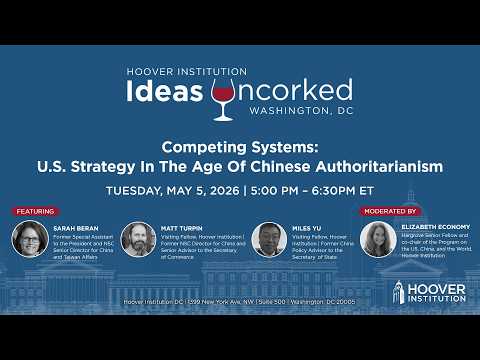
A Hoover Institution panel argues that US-China ties are best understood as a long-term, tense rivalry that can be managed at the margins but not fundamentally reset by one summit or one administration. The speakers expect the upcoming Trump-Xi meeting to produce limited, mostly transactional outcomes — likely tariff relief, symbolic trade commitments, and perhaps some military communication — while the deeper strategic, ideological, and security conflicts remain unresolved.
Watch on YouTube ›Get the market thesis, key claims, assets, contradictions, and follow-up questions from any financial video — then unlock a version personalized to your portfolio, watchlist, and favorite speakers.
This is an interview/panel discussion, not a market-call video in the usual sense. Liz Economy opens by framing the event around the future of US-China relations and introducing three panelists with long government and policy experience: Sarah Baron, Matt Turpin, and Miles Yu. The panel’s core thesis is consistent throughout: the relationship is structurally difficult, tension-filled, and unlikely to be “fixed” by leader diplomacy alone. The speakers differ in tone, but all agree that the relationship is now defined by rivalry, risk management, and a need for stronger US resilience. Sarah Baron describes the relationship as complicated and “tension-filled,” arguing that both Washington and Beijing now see the need to manage downside risk. …
Near term, this looks like a headline-driven summit trade: modest tariff and purchase headlines are possible, but the setup is prone to disappointment if the deal is mostly optics. The main tactical risk is that positive rhetoric gets priced as substance before the harder tech and security issues are addressed.
Over the next few months, expect managed rivalry with sporadic transactional agreements and recurring friction over chips, exports, and military signaling. The key validation is whether the two sides build repeatable channels for risk reduction; without that, each summit just resets the cycle of frustration.
The durable regime implication is that US-China competition is now a structural feature of geopolitics and technology policy, not a temporary policy dispute. The long-run edge for the US will come less from summit diplomacy and more from domestic capacity, alliances, and economic statecraft.
The US-China relationship is a hostile rivalry with deep suspicion on both sides, locked into competition spanning all domains.
Matt describes the relationship as a comprehensive adversarial competition.
The US-China relationship suffers from a fundamental systemic incompatibility between two different systems that may not be fixable.
Miles compares the relationship to a broken AC system needing full replacement, arguing the systemic issues are deeper than fixable problems.
President Trump wants the summit with China to be a ceremonial moment of glory to sign agreements, but none of the issues have been agreed to, making the visit more symbolic than substantive.
The speaker notes seven rounds of talks between Bessent and his counterpart yielded no agreement, so the visit will be symbolic rather than substantive.
What does success look like for the upcoming U.S.-China summit, and what does each side want from it?
Miles says Trump wants a visible win and that China likely wants to avoid direct confrontation, but he thinks the visit is more symbolic than substantive. Matt adds that Trump wants a favorable trade-and-investment agreement, though major trade-balance changes are unrealistic, while Sarah says Beijing may accept tariff adjustments tied to agriculture purchases and expects a similar pattern to the first Trump summit.
How is the administration dealing with Iran, cross-strait stability, regional stability, and Chinese pressure on Japan?
The speaker says these hard strategic issues are not being adequately addressed in the prep channels and that the downside risk lies there. They think the summit may produce more military-to-military communication, but beyond that they do not see much happening in the strategic space.
What is the Chinese side likely seeking in the summit, especially on tariffs and export controls?
The response says China likely wants tariff relief and is also likely pushing for export-control relaxation, especially around Nvidia chips and possibly tooling equipment. The speaker adds that China can still manage through transshipment and depreciation, but would prefer broader relief.
Unlock the full claims, asset map, scores, related transcripts, follow-up questions, and AI chat — shaped around your portfolio, watchlist, favorite speakers, and risks.
