TranscriptAgent
Try it free
TRANSCRIPTAGENT.AI · transcript analysis

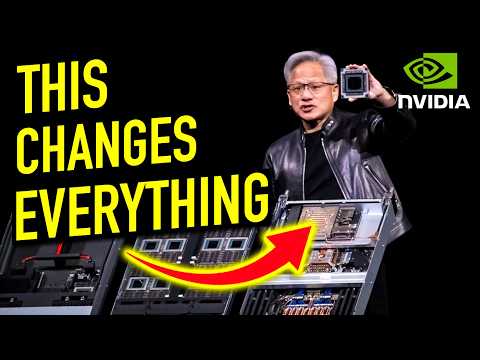
Jensen Huang's Biggest AI Announcements at NVIDIA GTC 2026 (Supercut)

Channel: Ticker Symbol: YOU Published: 2026-03-17 10:20
Ticker Symbol: YOU

Jensen Huang uses this supercut to frame NVIDIA as shifting from a chip vendor to the builder of full AI factories. The core message is that Vera Rubin, Kyber, MVLink 72/576, co-packaged optics, and the Dynamo/Open Claw software stack are meant to push AI throughput, latency, and system-level efficiency far beyond Hopper and Blackwell, while opening new revenue tiers and use cases.

Watch on YouTube ›

Get the market thesis, key claims, assets, contradictions, and follow-up questions from any financial video — then unlock a version personalized to your portfolio, watchlist, and favorite speakers.

Detailed summary

This transcript is essentially a Jensen Huang keynote supercut centered on NVIDIA’s GTC 2026 platform story. His core thesis is that AI infrastructure is moving from discrete chips to fully integrated “AI factories,” and NVIDIA is trying to own the entire stack: silicon, networking, racks, cooling, software, orchestration, and even virtual design. The headline products are the Vera Rubin platform, Vera Rubin Ultra, Kyber racks, next-gen MVLink scaling, Spectrum X/co-packaged optics, and NVIDIA’s broader systems approach for data centers and agentic AI. Huang argues that the new systems dramatically raise throughput, lower installation friction, and increase power efficiency. He repeatedly emphasizes liquid cooling, hot-water cooling, elimination of cabling complexity, and faster deployment cycles. …

🔒 The full detailed summary continues — read all of it free with an account. Read the full summary →

Main takeaways

  1. NVIDIA’s narrative is shifting from GPU supplier to end-to-end AI factory platform owner.
  2. Vera Rubin is pitched as a major throughput and efficiency leap over Hopper and Blackwell.
  3. The company is emphasizing system design, not just chip speed: cooling, cabling, racks, networking, and software all matter.
  4. Disaggregated inference with Grok and Dynamo is presented as a way to extend performance for agentic, token-heavy workloads.
  5. Open Claw is framed as the enterprise operating system for agents, but security is a major constraint.
  6. NVIDIA is signaling both copper and optical scaling paths, not an either/or choice.
  7. The long-run goal is to make NVIDIA the default infrastructure layer for AI factories and frontier models.

Market read by horizon

Short term

Tactically, this is bullish NVIDIA narrative fuel: GTC announcements can keep attention on the next AI capex cycle, but the stock may need follow-through from actual customer orders and production milestones.

  • Near-term catalyst is GTC-style product reveal momentum around Vera Rubin, Rubin Ultra, and Open Claw.
Show more
  • The market will likely focus on whether the announced systems translate into real production ramps and customer demand, not just demo language.
  • Watch the capital-spending implication: Jensen is explicitly selling a bigger, more power-dense AI factory buildout.
Mid term

Over the next few months, the setup is a transition from hype around Blackwell to validation of Rubin, Rubin Ultra, and enterprise software adoption. If deployments and order flow confirm the keynote claims, the market can re-rate the platform story; if not, the narrative may compress back toward execution risk.

  • Over the next several quarters, the base case is continued narrative rotation from Blackwell to Rubin as the next major AI infrastructure cycle.
Show more
  • Validation would come from actual rack-scale deployments, enterprise adoption of Open Claw, and evidence that disaggregated inference improves economics for customers.
  • If throughput and latency gains show up in real workloads, NVIDIA can defend premium pricing across multiple tiers of the AI stack.
Long term

The structural read is that AI infrastructure is consolidating into a vertically integrated stack, and NVIDIA is trying to become the default operating system for AI factories and agents. If this regime holds, future competition will be less about single-chip benchmarks and more about integrated power, networking, software, and model ecosystems.

  • The structural thesis is that AI infrastructure is becoming vertically integrated, and NVIDIA wants to own that layered stack rather than only the accelerator.
Show more
  • If Huang is right, the durable regime is one where AI factories are designed holistically around energy, cooling, networking, software, and orchestration.
  • The lasting implication is that the competitive battleground shifts from raw chip count to end-to-end system efficiency and software control.
Unlock the full horizon read See the full short-term, mid-term, and long-term implications with confirmation and invalidation signals. Unlock horizon read

Key claims (7)

BULLISH AI infrastructure NVDA

Nvidia's single gigawatt AI factory will increase token generation rate from 2 million to 700 million in two years, a 350x improvement.

Jensen presents this as the result of extreme co-design and vertical integration of Nvidia's full-stack architecture.

BULLISH AI infrastructure NVDA

Nvidia's Vera Rubin system can generate 5x more revenue than Blackwell in a one-gigawatt data center.

Jensen walks through a four-tier power allocation example and concludes revenues for Vera Rubin would be 5x over Blackwell.

BULLISH AI infrastructure NVDA

Nvidia's Vera Rubin system delivers twice the performance per watt of any CPUs in the world today.

Jensen directly states this performance-per-watt advantage during the Vera Rubin system overview.

Unlock 4 more claims See the full bullish, bearish, and counter-consensus argument map extracted from the transcript. Unlock all claims

Assets discussed (10)

Vera Rubin
BULLISH other

Presented as NVIDIA’s next major platform leap with higher throughput, better efficiency, and new rack-scale architecture.

NVLink
BULLISH other

Described as the key sixth-generation scale-up interconnect enabling NVIDIA’s tightly coupled rack systems.

Unlock the full asset map (8 more) See all assets mentioned, their directional bias, and the exact reasoning. Unlock asset map

Speakers

SPEAKER Alex Divinsky GUEST Jensen Huang

Where this transcript pushes against consensus

  • The presentation is highly promotional and makes many performance claims without independent verification in the transcript.
  • Several roadmap elements and product names are announced as if production-ready, but timing, customer adoption, and manufacturing feasibility are not substantiated here.
  • The claim that Open Claw is the most popular open-source project in human history is extraordinary and unsupported in the transcript.
  • The revenue uplift math is illustrative, but it relies on simplifying assumptions about power allocation, tier mix, and customer behavior.
  • The idea that one architecture can cleanly dominate both throughput and latency-sensitive workloads may be overstated; Huang partially addresses this by splitting workloads, which itself implies tradeoffs.

Topics

Vera RubinAI factoriesagentic AIdisaggregated inferenceGrok integrationMVLinkco-packaged opticsOmniverse DSXOpen ClawNVIDIA model stack

Create your free research agent

Unlock the full claims, asset map, scores, related transcripts, follow-up questions, and AI chat — shaped around your portfolio, watchlist, favorite speakers, and risks.

  • Full claims and asset map
  • Personalized relevance to your watchlist
  • Follow-up questions you can track
  • Related transcripts from your workspace
  • AI chat about this video
Create your free research agent
TRANSCRIPTAGENT.AI