
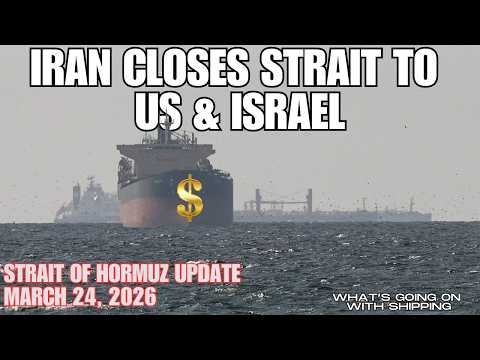
The host argues that Iran is effectively asserting control over the Strait of Hormuz by restricting passage, charging transit fees, and redirecting ships, which he says is already disrupting global oil and shipping flows. He frames the situation as a major risk to world trade, tanker capacity, and U.S. and allied military options, with the main near-term danger being escalation in a confined waterway where ships and warships can be hit.
Watch on YouTube ›Get the market thesis, key claims, assets, contradictions, and follow-up questions from any financial video — then unlock a version personalized to your portfolio, watchlist, and favorite speakers.
This episode is a forceful geopolitical-and-shipping read on the Strait of Hormuz crisis. The host, Sal Maglaniano, says Iran has told the UN that the strait is closed to the U.S. and Israel and that other vessels may pass only under Iranian security requirements. He then argues that, whatever the legal wording, Iran is functionally controlling traffic by forcing ships off the main traffic separation scheme, routing them through areas he identifies as Iranian territorial waters, and using that leverage to impose costs on commercial shipping. A major part of the argument is operational: he walks through MarineTraffic and JMIC-style vessel data to show tankers and cargo ships diverting, attacks occurring in and around the strait, and transits continuing but under stress. …
Hormuz looks like a live tactical risk premium: shipping is already rerouting, and any new attack, boarding, or fee demand could lift oil, freight, and insurance quickly. Near-term positioning should assume volatility and escalation risk rather than smooth passage.
Over the next few weeks to months, the likely path is a constrained strait with intermittent access rather than a clean closure or clean reopening. That keeps a durable premium in energy and shipping unless a ceasefire or enforcement action restores predictable transit.
The structural implication is that maritime chokepoints remain a core geopolitical pricing mechanism for energy and global trade. If Hormuz becomes partially privatized by force, the long-run regime shifts toward higher transport costs, more naval involvement, and more fragile commodity flows.
The only real solution to the Strait of Hormuz crisis is a ceasefire between the US, Israel, and Iran — a military forced opening will fail.
The speaker argues that military operations in confined waters with modern drones and missiles are extremely costly and cannot guarantee 100% safety, citing historical analogy to Gallipoli.
Iran has started charging transit fees of up to $2 million per voyage on commercial vessels passing through the Strait of Hormuz.
The speaker cites a Bloomberg story about Iran charging up to $2 million per voyage on an ad hoc basis.
Iran has formally notified the UN that the Strait of Hormuz is closed to the United States and Israel, and to any aggressor nations.
The speaker reads Iran's UN communication and analyzes its language about restricting passage.
Unlock the full claims, asset map, scores, related transcripts, follow-up questions, and AI chat — shaped around your portfolio, watchlist, favorite speakers, and risks.

