TranscriptAgent
Try it free
TRANSCRIPTAGENT.AI · transcript analysis

Something VERY Strange is Happening Just Happened Global Markets

Channel: Eurodollar University Published: 2026-06-20 17:14
Eurodollar University

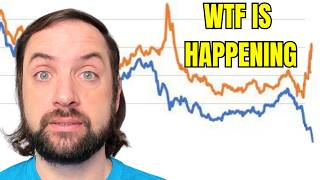
The speaker argues that a major warning signal is emerging from Hong Kong and China: Hong Kong’s Hang Seng is weakening while US and global tech risk assets surge, and in China bond financing has overtaken bank loans for new credit. He interprets that shift not as healthy financial modernization but as a sign that bank lending is retreating, private-sector demand is weak, and government bond issuance is increasingly acting as a backstop in a broader credit slowdown.

Watch on YouTube ›

Get the market thesis, key claims, assets, contradictions, and follow-up questions from any financial video — then unlock a version personalized to your portfolio, watchlist, and favorite speakers.

Detailed summary

The core thesis is that markets are misreading China’s credit shift. The speaker says Hong Kong’s equity weakness, especially the Hang Seng’s divergence from the global tech/semiconductor rally, is a meaningful signal because Hong Kong is a major money center linking mainland China, Asia, and the rest of the world. In his view, if China were entering a healthier phase of growth, Hong Kong should be participating in the optimism. Instead, its underperformance is presented as a warning that credit conditions, risk appetite, and confidence in China are deteriorating. He then ties that signal to Chinese credit data. According to the speaker, bond financing in China has reached a record share of the credit stock and has recently surpassed bank lending in new credit creation. He stresses that this is not a benign sign of capital-market deepening. …

🔒 The full detailed summary continues — read all of it free with an account. Read the full summary →

Main takeaways

  1. Hong Kong’s weak Hang Seng is presented as a warning signal on China credit and risk appetite.
  2. China’s new credit is shifting from bank loans toward bonds, which the speaker views as defensive rather than healthy.
  3. The speaker argues bond issuance cannot replace the money-creation function of bank lending.
  4. He sees China moving into a post-2008-style “depression economics” regime.
  5. Household debt stress, property weakness, and local-government strain reinforce the bearish credit view.
  6. Global investors focused on US tech may be missing a broader liquidity and credit slowdown.

Market read by horizon

Short term

Near term, the setup is bearish for Hong Kong and China-linked risk assets as long as US tech euphoria masks deteriorating Chinese credit data. The immediate tactical risk is that the market keeps ignoring the warning until a sharper break in Hong Kong or Chinese credit confirms it.

  • The immediate setup is a clear divergence: US tech and semiconductors are strong while the Hang Seng is falling hard.
Show more
  • The speaker treats that divergence as a near-term warning that China-related money flows are not confirming global risk appetite.
  • Bond financing overtaking loans in China is the key data point to watch for further confirmation or worsening.
Mid term

Over the next few months, the likely path is continued Chinese credit strain unless bank lending and household demand stabilize. The view improves only if property, consumer credit, and private borrowing stop deteriorating; otherwise government bond issuance remains a stopgap rather than a fix.

  • Over the next several weeks or months, the base case is continued weakness in China-linked assets if bank lending stays soft and households remain defensive.
Show more
  • The speaker expects the bond-led credit mix to keep widening unless private credit demand improves.
  • A shift in narrative would require stronger consumer demand, stabilization in property, and better bank loan growth rather than just more government borrowing.
Long term

Structurally, the video argues China is entering a regime where bank credit can no longer drive growth the way it once did. That implies a longer period of balance-sheet repair, weaker domestic demand, and a more fragile global liquidity backdrop than the market currently prices in.

  • Structurally, the video argues China is moving from a bank-and-property growth model toward a state-backed bond and balance-sheet repair regime.
Show more
  • The durable implication is that capital markets can cushion but not fully replace broad bank credit creation in a bank-centric economy.
  • He treats post-2008 US and Europe as the template for a long period of weak growth after credit retreat.
Unlock the full horizon read See the full short-term, mid-term, and long-term implications with confirmation and invalidation signals. Unlock horizon read

Key claims (3)

BEARISH China credit structure

Bonds have surpassed bank loans as a share of new credit in China — but this is a sign of weakness, not healthy market development.

The speaker says bonds are gaining share because bank lending is collapsing, not because the economy is strong, and that this mirrors the post-2008 US pattern of depression economics.

BEARISH Global depression economics

China's economy is completing a transition into depression economics, analogous to the post-2008 US 'silent depression' where banks retreated and bond markets only partially cushioned the damage.

The speaker draws a direct historical analogy: bank retreat + rising government bond issuance = depression economics, as seen in the US after 2008 and now repeating in China.

BEARISH Chinese household debt crisis

Chinese household non-performing debt has surged to record levels, with nearly 11% of China's adult population behind on debt payments by end of 2025.

The speaker cites estimates from Bloomberg and Zhejiang University about rising consumer credit stress, including credit cards, mortgages, and personal loans.

Assets discussed (5)

Hang Seng Index
BEARISH index

The speaker says Hong Kong’s main stock index is falling hard and not confirming the global risk rally.

US stocks
BULLISH index

Used as the example of the global equity rally the speaker says is ongoing.

Unlock the full asset map (3 more) See all assets mentioned, their directional bias, and the exact reasoning. Unlock asset map

Where this transcript pushes against consensus

  • The argument relies heavily on an analogy to post-2008 US and Europe, which may not map cleanly onto China’s institutionally different system.
  • The speaker treats bond-financing share as inherently bearish, but a larger bond market can also reflect financial deepening or policy development.
  • Some claims about household debt stress and hidden delinquency rely on reported estimates rather than transparent aggregate data.
  • The video assumes Hong Kong equity weakness is primarily a macro-credit signal; sector composition, valuation, and China policy expectations could also matter.
  • The conclusion that the system is entering depression economics is strong relative to the evidence presented in a YouTube macro commentary.

Topics

Hong Kong Hang Seng weaknessChina credit marketsbond financing vs bank lendingdepression economicspost-2008 analogyhousehold debt stressproperty sector weaknesslocal government debtglobal risk appetiteEurodollar network

Create your free research agent

Unlock the full claims, asset map, scores, related transcripts, follow-up questions, and AI chat — shaped around your portfolio, watchlist, favorite speakers, and risks.

  • Full claims and asset map
  • Personalized relevance to your watchlist
  • Follow-up questions you can track
  • Related transcripts from your workspace
  • AI chat about this video
Create your free research agent
TRANSCRIPTAGENT.AI