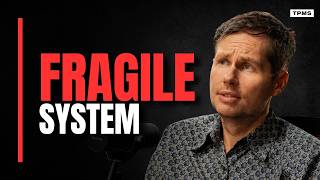
Jeff Booth argues that AI is accelerating a long-running clash between deflationary productivity and a debt-based monetary system that must force inflation, surveillance, and centralization to survive. His answer is not political reform but opting into Bitcoin as an open, decentralized, energy-bounded protocol that can preserve the gains from technology.
Watch on YouTube ›Get the market thesis, key claims, assets, contradictions, and follow-up questions from any financial video — then unlock a version personalized to your portfolio, watchlist, and favorite speakers.
This interview is built around Jeff Booth’s core thesis from The Price of Tomorrow: the natural state of a free market is deflation, because entrepreneurs and technology keep creating more value at lower cost, but the existing debt-based monetary system cannot tolerate that outcome. Booth argues that AI intensifies the contradiction because it should make goods and services cheaper and more abundant, yet the current system requires perpetual money creation, higher asset prices, and greater control to keep debt serviceable. In his framing, we are not approaching a new problem so much as seeing an old structural conflict become harder to hide. A large part of the discussion is Booth restating the mechanics of that conflict in simple terms. …
Tactically, Booth’s setup favors Bitcoin as the cleanest expression of the AI/deflation trade while the legacy system leans harder on policy, surveillance, and narrative management. The immediate risk is that most participants still treat Bitcoin as speculation, so the trade can remain crowded, misunderstood, and volatile.
Over weeks to months, his base case is that AI keeps widening the gap between real productivity and debt service, forcing more visible strain in the current system. If Bitcoin keeps behaving as a non-manipulable monetary network, more people may begin to shift savings and activity into it rather than trying to fix the old regime from inside.
Booth’s structural view is that deflationary technology and debt-based money cannot coexist indefinitely, so a new monetary regime must eventually dominate. In that regime, Bitcoin is the candidate money layer that preserves abundance instead of centralizing it, provided it stays decentralized and secure.
The debt-based system and technology-driven deflation are on a collision course, and the debt system cannot resolve this conflict because it is a structural system problem, not a political one.
The speaker posits that a debt-based system needing perpetual expansion is fundamentally incompatible with exponential productivity gains that drive prices to zero, and no politician or individual within the system can fix it.
A debt-based monetary system cannot coexist with deflation, making the current system unsustainable and inevitably prone to collapse.
The speaker argues that because a debt-based system cannot permit deflation, but free markets naturally tend toward deflation, the system is fundamentally broken and unfixable.
Bitcoin is a protocol, not just an asset or technology, and protocols are winner-take-all like the internet — there is no second internet.
The speaker argues that understanding Bitcoin as a protocol (rather than a scam, technology, or asset) is the correct framing, and that protocols are winner-take-all with no second-place equivalent.
If we're going to have incredible levels of productivity from AI, how is everything still going to be more expensive?
The guest explains that the natural state of the free market is deflation, but because we live in a debt-based system where money is lent into existence with interest, that system must expand money forever. This debt-based system stops productivity from flowing to the 8 billion people on the planet and concentrates wealth into very few hands. The two systems (free market deflation and debt-based inflation) are clashing.
Is AI exposing the conflict between exponential abundance and exponential debt even more?
The guest says the clash has been happening for a long time and people are measuring it through the old system. The debt has been insolvent for probably forever because if the free market worked properly, productivity flowing to people would have collapsed the debt immediately. Deflation cannot be allowed in a debt-based system. The two systems are almost inverse images of each other - one drives prices down, the other must create scarcity to push prices up.
Is the problem having digital money controlled by government? Would a free market for money prevent this?
The guest says it would be messy on the way through, but points out that gold also centralizes and governments manipulate gold via derivatives to allow inflation. He argues this cycle repeats with global conflict and resets, and that the core issue is that the natural state of the free market is deflation, which a debt-based system cannot allow.
Unlock the full claims, asset map, scores, related transcripts, follow-up questions, and AI chat — shaped around your portfolio, watchlist, favorite speakers, and risks.