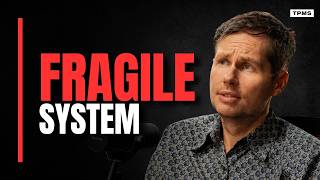
Peter McCormack and Izabella Kaminska argue that the UK is moving toward a Soviet-style collapse: institutional trust is breaking, the middle class is being squeezed, and state interference is distorting markets and daily life. The discussion ranges from Poland’s post-communist transition, to UK housing and business costs, to China’s quota-driven model, to crypto, Bitcoin, and the idea that the real political currency is compromat and controlled information.
Watch on YouTube ›Get the market thesis, key claims, assets, contradictions, and follow-up questions from any financial video — then unlock a version personalized to your portfolio, watchlist, and favorite speakers.
The core thesis is that the UK increasingly resembles a late-stage collapsing system: not a literal Soviet Union, but a country where institutions feel hollow, prices and regulation squeeze the middle class, public trust is eroding, and people are starting to behave as if the old order no longer works. Both speakers repeatedly return to the idea that when systems become too centralized, bureaucratic, and detached from reality, shortages, lying, and improvisation replace normal market and civic functioning. The speaker framework is less about one specific policy and more about a broad civilizational diagnosis: the UK is drifting toward stagnation unless it radically re-engineers the state, restores free speech and market freedom, and creates room for entrepreneurship. Kaminska’s main historical comparison is Poland and the broader post-Soviet transition. …
Tactically, the setup is bearish for UK domestic assets tied to middle-class spending, leveraged housing, and regulated small business, while more favorable to liquid stores of value and capital that can move quickly. The immediate risk is policy intervention in housing or speech that may intensify volatility rather than restore confidence.
Over the next few months, the most likely path in their view is more visible UK stagnation unless a credible reform bloc proves it can cut regulation and restore market confidence. Confirmation would come from better business formation, easier capital access, and stabilization in housing; failure would show up as more intervention, more layoffs, and deeper capital flight.
The structural thesis is that the UK is losing the institutional features that support a broad middle class and may need a new governance model to remain competitive. Long term, the winners are likely to be jurisdictions that combine strong property rights, speech freedom, and scalable capital access, while the UK risks drifting into managed decline if it cannot reset.
The UK is starting to resemble a Soviet-style collapse.
The speaker argues that the UK shows the same atmosphere of institutional decay, economic deterioration, and loss of trust she remembers from the Soviet collapse.
The UK is in a collapse of confidence in its system and needs a new, freedom-oriented anti-establishment political movement that stops money printing.
The speaker argues that British institutions have lost legitimacy and that the solution is a broad pro-freedom political movement that shrinks government and ends deficit finance.
Current economic conditions are eroding the middle class and could leave society split between very wealthy people and working-class people.
The speaker says wage compression, tax cliffs, and rising costs make middle-class life unsustainable and imply an ongoing squeeze toward a two-tier society.
Is the UK starting to resemble a Soviet-style collapse, and are we watching the regime collapse in real time?
She says it certainly feels that way. She describes the UK as resembling the atmosphere of late Soviet Poland and the Soviet Union, with a sudden paradigm shift, economic breakdown, and institutions no longer functioning.
What did Poland get right in its transition that the UK got wrong?
She argues Poland handled the shift more gradually and preserved more continuity. She credits entrepreneurial culture, tolerance for small business, slower privatization, and integrating former regime structures instead of collapsing everything at once.
What is your diagnosis of the UK's current social and political mood?
The guest says people are bewildered and confused by the Epstein revelations, and that many normie friends are realizing things they thought were true are not. They frame the situation as a slow-drip epistemic shock because the network appears to cut across the political spectrum.
Unlock the full claims, asset map, scores, related transcripts, follow-up questions, and AI chat — shaped around your portfolio, watchlist, favorite speakers, and risks.