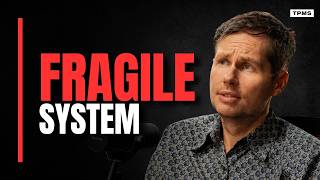
Rupert Lowe argues the British state has become hostile to ordinary voters, fiscally reckless, and increasingly unaccountable. He links waste, contracting failures, money printing, mass immigration, and weak border control into a broader thesis that the UK is sliding toward a Vimar-like collapse unless there is radical political change by 2029.
Watch on YouTube ›Get the market thesis, key claims, assets, contradictions, and follow-up questions from any financial video — then unlock a version personalized to your portfolio, watchlist, and favorite speakers.
This conversation is a long political and macro-economic interview, but the core thesis is consistent: Rupert Lowe believes Britain’s governing system has become structurally hostile to the electorate, economically unsound, and possibly corrupted beyond ordinary incompetence. He repeatedly says the state has “become the enemy of the electorate,” and frames the problem as a combined failure of Whitehall, Parliament, quangos, regulators, and party politics. His argument is not simply that Labour is bad or the Conservatives failed; it is that the whole postwar governing model has hollowed out accountability and left the private sector carrying the burden while the state expands. A major strand of the discussion is fiscal and institutional waste. …
Near term, the setup is bearish on UK policy credibility: more tax, more bureaucracy, and more public waste are likely to keep pressuring business sentiment and sterling confidence. The immediate risk is that political rhetoric outruns deliverability while the rape-gangs inquiry and border debate keep the issue profile hot.
Over the next few months, the base case is continued institutional stress rather than a clean reset. If growth weakens, business exits accelerate, or fiscal numbers deteriorate, the market could start to price a more explicit UK credibility problem and a stronger reaction in the currency.
Structurally, Lowe is arguing the UK is drifting into a low-trust, overextended regime where the state suppresses productivity and legitimacy. His long-run thesis is that only a decisive shrinkage of the state and a new anti-establishment political vehicle can reverse the decay.
The British state has become the enemy of the electorate.
Speaker asserts based on experience on the public accounts committee uncovering waste, incompetence, and lack of respect for taxpayers' money.
Britain is heading for a massive currency crisis because the economy cannot sustain the deficits being run.
The speaker argues that with no economy running and all the deficits being run, the currency is overvalued and will eventually correct to a level reflecting poor productivity.
The British state now penalizes honest people and benefits those who live dishonestly.
Speaker offers a generalized observation about the incentive structure created by the state and regulators.
Is the incompetence from the state actually the state actively working against the British people?
Robert confirms he thinks the British state has become the enemy of the electorate, detailing his experience on the public accounts committee uncovering waste, incompetence, and lack of respect for taxpayers' money. He argues the state has grown bigger with less respect for the electorate, citing the 2016 Brexit result being frustrated by bureaucrats.
Do you think the British state has become the enemy of the electorate?
Robert states that yes, the British state has become the enemy of the electorate. He cites his work on the public accounts committee uncovering waste and incompetence, argues that both Labour and Tories have contributed to a state that has grown too large and has no respect for taxpayers' money, and points to the undermining of MP sovereignty through legislation like Blairite reforms and the ICGS.
Should the public always treat the state like the enemy anyway?
Robert references the American Constitution as designed to throw power back to states and individuals away from federal government, but says Roosevelt undermined the 9th and 10th amendments. He argues for individualism and self-reliance over collectivism and welfareism, criticizing COVID as a lesson in how meek the British people were and urging them to grow a backbone.
Unlock the full claims, asset map, scores, related transcripts, follow-up questions, and AI chat — shaped around your portfolio, watchlist, favorite speakers, and risks.