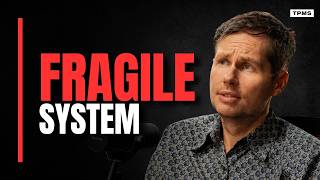
Peter McCormack interviews former UK MP Steve Baker about why Britain feels politically and economically broken. Baker argues the core problem is long-running managerialism, state expansion, fiat money, and weak constraints on power; he repeatedly says the public and politicians have normalized higher spending, higher taxes, and currency debasement.
Watch on YouTube ›Get the market thesis, key claims, assets, contradictions, and follow-up questions from any financial video — then unlock a version personalized to your portfolio, watchlist, and favorite speakers.
This is a long-form interview centered on Baker’s broad thesis that modern government no longer works because it has escaped effective constraints. He frames the post–World War II era as a long drift into managerialism, where voters accepted more state power, more intervention, and eventually chronic borrowing and money creation. In his telling, the UK now faces a “crisis of control by the state,” not a failure of markets, and the practical symptoms are visible in taxation, regulation, housing costs, and living standards. A major strand of the conversation is Baker’s claim that political incentives are broken. He says ministers are often incompetent or disinterested, civil servants are structured to cope with that, and elected politicians mostly optimize for reelection rather than governing well. …
Near term, the actionable setup is political/fiscal rather than tradeable macro: Baker expects more spending strain, more tax pressure, and more public frustration, with little immediate relief from the current government structure. The short-term risk is that policymakers keep kicking the can while markets and voters normalize deterioration.
Over the next few months, the base case in Baker’s framing is continued living-standard pressure unless there is a visible political shift toward spending cuts, tighter accountability, and better candidate selection. If public opinion does not move, he expects the same fiscal and currency pressures to persist.
Structurally, Baker is calling a regime shift away from state discretion and fiat-era management toward harder constraints on money and power. His long-run thesis is that societies function better when coercion is limited, monetary power is separated from the state, and liberty is treated as the default rather than the exception.
The biggest mistake in the US Constitution was the lack of constraints on money creation, and if money could not be constitutionally created, that would have effectively constrained government power.
The speaker contrasts Federalists vs Anti-Federalists, arguing the Anti-Federalists have been proven right because the Constitution failed to constrain the government's ability to create money, which is the root of broken governance.
Fiat money allowed politicians to create money unconstrained since 1971, which is the root cause of inflation and societal division.
The speaker traces the problem to the 1971 end of Bretton Woods, claiming it removed constraints on politicians' ability to create money, causing inflation and social division.
The UK public wants higher spending and lower taxes, which forces politicians to borrow and debase the currency to get reelected.
The speaker observes over 14 years that politicians seeking reelection respond to public demand for both higher spending and lower taxes by turning to borrowing and currency debasement, leading to fiscal problems.
Why is the country not working anymore?
Steve argues the country is suffering from the end of a long period of managerialism. He says postwar politics embraced more state power and intervention, and that over decades this has produced chronic spending beyond means, currency debasement, and a system that blames the wrong causes.
What is really like in Westminster, and why doesn't it work?
He says incompetence is a central feature of government. In his view, the civil service is built to keep things running even with disinterested ministers, but what the country really needs is ministers who actively govern rather than focus on ambition and internal status games.
What is the one unifying goal politicians have?
The transcript cuts off just as the answer is about to be stated, but the discussion points to politicians primarily aiming to get re-elected rather than serve the public.
Unlock the full claims, asset map, scores, related transcripts, follow-up questions, and AI chat — shaped around your portfolio, watchlist, favorite speakers, and risks.