TranscriptAgent
Try it free
TRANSCRIPTAGENT.AI · transcript analysis

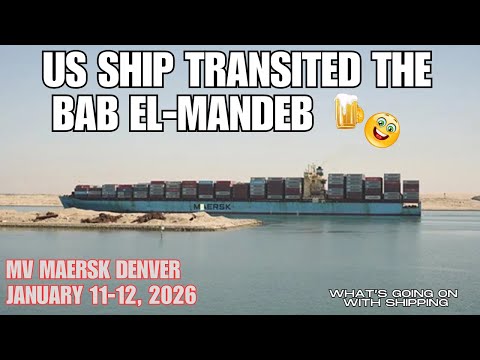
MV Maersk Denver is the First American Commercial Ship to Transit the Bab el-Mandeb in Two Years

Channel: What's Going on With Shipping? Published: 2026-01-15 11:03
What's Going on With Shipping?

The host says the first U.S.-flag commercial ship in nearly two years has transited the Bab el-Mandeb/Red Sea corridor, and he treats that as an important but still tentative sign of reopening. He argues the key issue is not just physical passage but whether war-risk insurance, security arrangements, and Houthi behavior have improved enough for larger-scale commercial traffic to return.

Watch on YouTube ›

Get the market thesis, key claims, assets, contradictions, and follow-up questions from any financial video — then unlock a version personalized to your portfolio, watchlist, and favorite speakers.

Detailed summary

This episode centers on a single shipping-development thesis: the U.S.-flag container ship Maersk Denver’s successful transit through the Bab el-Mandeb and into the Red Sea is a meaningful signal that the corridor may be cautiously reopening after a long shutdown. The host frames the event as historic because it is the first U.S.-flag commercial vessel able to make that passage in nearly two years, and he ties it directly to the broader collapse in Suez/Red Sea traffic after Houthi attacks began in late 2023 and early 2024. He spends much of the video reconstructing the earlier security crisis. He recalls that U.S. and British naval escorts were deployed, communications between military and commercial ships were poor, and the environment was chaotic for mariners. …

🔒 The full detailed summary continues — read all of it free with an account. Read the full summary →

Main takeaways

  1. The Maersk Denver transit is presented as a real but tentative reopening signal for the Red Sea route.
  2. The host thinks insurance, not just military presence, will determine how fast traffic returns.
  3. He expects smaller and midsize ships to return before the largest vessels.
  4. The route may improve gradually rather than snap back all at once.
  5. The video blends operational shipping analysis with geopolitical risk around the Houthis, Israel, and Spain.

Market read by horizon

Short term

Tactically, this is a cautious bullish sign for Red Sea transits, but the move is too small to chase as a full normalization call. The near-term risk is that the passage proves symbolic rather than repeatable, especially if war-risk insurance or security conditions stay tight.

  • The immediate catalyst is the successful U.S.-flag Maersk Denver transit through Bab el-Mandeb into the Red Sea.
Show more
  • Watch whether this was a one-off protected passage or the start of repeated commercial transits.
  • War-risk insurance pricing is the key near-term gating factor for broader carrier participation.
Mid term

Over the next few weeks or months, the likely path is a slow ramp in Red Sea traffic led by smaller ships and select carriers testing the corridor. The setup improves only if repeated crossings occur without incident and if insurers start pricing the route as sustainable.

  • Over the next several weeks or months, the base case is a cautious, incremental return of traffic rather than a full normalization.
Show more
  • The host expects midsize vessels to come back first while mega-ships continue rerouting around Africa.
  • Confirmation would come from rising weekly Suez crossings, especially by larger carriers and larger TEU classes.
Long term

Structurally, the episode reinforces that global shipping remains vulnerable to chokepoint disruption, where conflict and insurance can reroute trade for long periods. Even if the Red Sea reopens, the lasting lesson is that maritime chokepoints now carry a permanent geopolitical risk premium.

  • Structurally, the episode argues the Red Sea/Suez corridor remains one of the most important global trade lanes and a durable geopolitical chokepoint.
Show more
  • The longer-run implication is that maritime routing can be reshaped for extended periods by asymmetric security threats and insurance economics.
  • Even after the current scare fades, carriers may keep a higher risk premium and be slower to return than before 2023.
Unlock the full horizon read See the full short-term, mid-term, and long-term implications with confirmation and invalidation signals. Unlock horizon read

Key claims (4)

NEUTRAL Marine insurance / Red Sea shipping

War risk insurance is the key constraint on a broader return of shipping through the Red Sea and Suez route.

He repeatedly says the main issue is getting war risk insurance down before larger-scale commercial traffic can return.

BULLISH Red Sea shipping disruption / Suez diversion Maris Denver

A US-flag commercial vessel has successfully transited the Bab el-Mandeb and Red Sea after nearly two years of disruption.

The speaker says the Mars Denver completed the transit and frames it as the first US-flag vessel to do so in nearly two years.

BULLISH Red Sea shipping disruption / Suez diversion

The successful transit suggests other commercial vessels should also be able to pass through the Red Sea corridor again.

He argues that a US-flag vessel getting through is a clear indication that other vessels should be able to go through as well.

Unlock 1 more claim See the full bullish, bearish, and counter-consensus argument map extracted from the transcript. Unlock all claims

Assets discussed (6)

Maersk Denver
BULLISH other

Its successful Bab el-Mandeb transit is presented as a positive sign that commercial shipping may be cautiously returning to the Red Sea route.

Suez Canal
BULLISH other

More transits through the canal would indicate reopening of the Red Sea lane and normalization of routing.

Unlock the full asset map (4 more) See all assets mentioned, their directional bias, and the exact reasoning. Unlock asset map

Where this transcript pushes against consensus

  • The host infers that because a U.S.-flag vessel passed, other vessels should be able to go through, but that conclusion is not fully established.
  • He speculates that the U.S. Navy likely escorted the ship, but says there is no confirmation from CENTCOM.
  • He treats the passage as evidence of reopening, yet the sample size is one vessel and a smaller one at that.
  • He assumes insurance is the primary barrier, but the transcript does not provide direct evidence on current pricing or underwriter behavior.
  • The claim that the route will probably reopen only in a trickle is plausible, but it is still an expectation rather than demonstrated market data.

Topics

Bab el-Mandeb transitRed Sea shippingSuez Canal trafficHouthi attackswar-risk insuranceMaersk DenverUS Navy escortshipping diversionscontainer vessel sizingSpain port restrictions

Create your free research agent

Unlock the full claims, asset map, scores, related transcripts, follow-up questions, and AI chat — shaped around your portfolio, watchlist, favorite speakers, and risks.

  • Full claims and asset map
  • Personalized relevance to your watchlist
  • Follow-up questions you can track
  • Related transcripts from your workspace
  • AI chat about this video
Create your free research agent
TRANSCRIPTAGENT.AI