TranscriptAgent
Try it free
TRANSCRIPTAGENT.AI · transcript analysis

Companies are Falling for Phishing Scams in the Strait of Hormuz

Channel: Tony Bell Published: 2026-04-25 08:01
Tony Bell

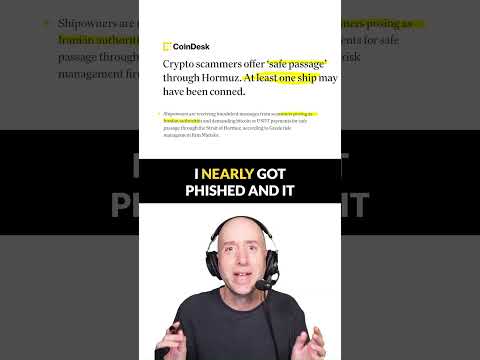
Tony Bell says a crypto phishing scam is targeting shipping companies in the Strait of Hormuz: scammers impersonate the Iranian government, ask for crypto payments, and may have fooled at least one ship. He frames it as an internal-controls failure and relates it to personal phishing experiences.

Watch on YouTube ›

Get the market thesis, key claims, assets, contradictions, and follow-up questions from any financial video — then unlock a version personalized to your portfolio, watchlist, and favorite speakers.

Detailed summary

Tony Bell’s core point is straightforward: there is an active phishing scam tied to shipping through the Strait of Hormuz, where attackers are posing as the Iranian government and soliciting crypto payments in exchange for “safe passage.” He says at least one ship may have fallen for it, and he treats the incident as a practical example of how fraud can exploit weak controls rather than as a complex geopolitical development. He spends much of the clip explaining why the story feels relatable. He describes receiving a fake urgent email from his department chair, almost acting on it, and then realizing he had nearly been phished. That anecdote is used to normalize how convincing scams can be and to make the shipping-company example feel less absurd. …

🔒 The full detailed summary continues — read all of it free with an account. Read the full summary →

Main takeaways

  1. The video centers on a Strait of Hormuz phishing scam involving fake Iranian-government emails and crypto payments.
  2. Bell interprets the incident as an internal-controls failure rather than a sophisticated market or macro signal.
  3. He uses a personal near-phishing story to show how plausible scams can feel.
  4. The Strait of Hormuz matters because it is a critical shipping chokepoint, so even a scam there has geopolitical relevance.

Market read by horizon

Short term

Tactically, this is an operational-security story more than a trade setup; the immediate watch item is whether more ships are targeted or confirmed as victims. No direct market position is implied, though the Hormuz backdrop keeps shipping-risk headlines live.

  • Immediate focus is on whether any ships actually paid the scam and whether more vessels are targeted.
Show more
  • The key risk is operational: shipping firms may need to tighten email verification and payment controls now.
  • Near-term attention likely stays on security alerts and any follow-up reporting about vessels in the strait.
Mid term

Over coming weeks, the incident matters if it proves to be part of a broader pattern of maritime fraud or disruption in the Strait of Hormuz. Absent escalation, the story is likely to fade into a controls-and-compliance lesson rather than a market-moving theme.

  • Over the next several weeks, the issue becomes whether this is an isolated fraud or part of a broader pattern of attacks on maritime logistics.
Show more
  • The base case is continued scrutiny of shipping-company controls and heightened caution around payment requests tied to Hormuz transit.
  • If more vessels are reported affected, the story could evolve from a scam anecdote into a wider shipping-security concern.
Long term

Longer term, the clip points to a durable truth: chokepoint logistics are vulnerable to both geopolitical pressure and simple social engineering. The lasting regime implication is that verification and internal controls are a core part of infrastructure resilience.

  • Structurally, the clip underscores how critical infrastructure can be undermined by low-tech social engineering, not just physical force.
Show more
  • It reinforces that chokepoint regions like the Strait of Hormuz carry persistent operational and geopolitical fragility.
  • The lasting implication is that internal controls and verification processes are as important as external security in modern logistics.

Key claims (2)

NEUTRAL geopolitics

Crypto scammers are impersonating the Iranian government to solicit crypto payments from shipping companies for safe passage through the Strait of Hormuz.

The speaker says scammers are posing as the Iranian government and emailing shipping companies with an offer of safe passage for crypto payment.

NEUTRAL geopolitics

At least one ship may have fallen victim to the scam.

The speaker explicitly says it looks like at least one ship might have fallen for the scam.

Assets discussed (2)

Strait of Hormuz
NEUTRAL other

Mentioned as the location of the scam and a critical shipping chokepoint; not a tradable asset itself.

crypto
NEUTRAL crypto

Referenced as the payment medium demanded by scammers; no bullish or bearish thesis on crypto prices.

Speakers

SPEAKER Tony Bell

Interview (1 Q&A)

scams

Have your own internal controls ever failed, like when you almost fell for a scam or did fall for one?

Where this transcript pushes against consensus

  • The speaker assumes the ship story is accurate but does not provide direct evidence or sourcing in the clip.
  • He presents the event as a clear internal-controls failure without discussing whether the scam could have succeeded through more than one failure mode.
  • No market or price implication is substantiated, so any broader financial interpretation would be speculative.

Topics

Strait of Hormuzphishing scamcrypto paymentsshipping companiesinternal controlsIranian impersonationmaritime security

Create your free research agent

Unlock the full claims, asset map, scores, related transcripts, follow-up questions, and AI chat — shaped around your portfolio, watchlist, favorite speakers, and risks.

  • Full claims and asset map
  • Personalized relevance to your watchlist
  • Follow-up questions you can track
  • Related transcripts from your workspace
  • AI chat about this video
Create your free research agent
TRANSCRIPTAGENT.AI