TranscriptAgent
Try it free
TRANSCRIPTAGENT.AI · transcript analysis

What to do when AI thinks your Professor is Wrong

Channel: Tony Bell Published: 2026-04-16 08:01
Tony Bell

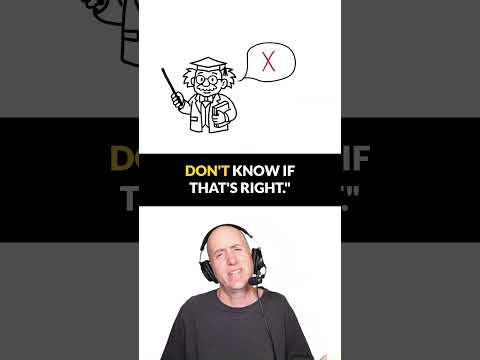
The speaker argues that if ChatGPT disagrees with a professor, students should not confront the professor by citing the chatbot directly. Instead, they should ask a thoughtful follow-up question that keeps the discussion academic rather than turning it into a showdown with AI.

Watch on YouTube ›

Get the market thesis, key claims, assets, contradictions, and follow-up questions from any financial video — then unlock a version personalized to your portfolio, watchlist, and favorite speakers.

Detailed summary

The core thesis is simple: ChatGPT can be useful as a check on a professor’s explanation, but it is poor form to walk into class and tell the professor, “ChatGPT said you’re wrong.” The speaker frames this as a practical social rule rather than a technical one: even when the chatbot is right, citing it bluntly tends to put the professor on the defensive and turns the exchange into a status contest instead of a learning moment. He supports the point with a personal example from comments on his channel. A commenter told him that if ChatGPT gives different calculations, then he must be teaching incorrectly. …

🔒 The full detailed summary continues — read all of it free with an account. Read the full summary →

Main takeaways

  1. Do not cite ChatGPT to publicly contradict a professor in class.
  2. Use AI as a private check, then ask a question in a neutral way.
  3. Framing matters: “Why didn’t we do Y?” is better than “ChatGPT said Y.”
  4. The speaker says AI can hallucinate and be wrong.
  5. The real goal is to keep the professor engaged rather than defensive.

Market read by horizon

Short term

No actionable market setup is present; the immediate takeaway is only about using AI as a private check rather than a public cudgel.

  • Immediate takeaway: if you are using AI in class, keep it in the background and phrase disagreements as questions.
Show more
  • The practical risk is social backlash or a defensive reaction from the professor if you lead with “ChatGPT said so.”
  • The speaker’s preferred tactic is to ask for the reasoning behind the professor’s approach rather than cite the chatbot directly.
Mid term

No medium-term market thesis is expressed. The clip is about evolving classroom norms around AI, not asset direction or positioning.

  • Over time, the suggested norm is a more productive classroom dynamic where AI is a research aid, not an authority weapon.
Show more
  • If students adopt the speaker’s framing, the likely outcome is more dialogue and fewer AI-versus-professor confrontations.
  • The main condition is that the AI output must still be checked; the speaker notes that chatbots can hallucinate and be wrong.
Long term

No structural market regime call is made. The only enduring theme is that AI tools may assist reasoning, but human expertise still anchors public discussion.

  • Structurally, the video argues for human expertise retaining conversational primacy even in an AI-assisted learning environment.
Show more
  • The lasting implication is that AI may change how students prepare, but not the etiquette of challenging claims in a classroom setting.
  • The deeper norm shift is toward using AI as a silent assistant rather than as a public adjudicator of truth.

Key claims (1)

NEUTRAL

It is appropriate for students to verify a professor's statement with ChatGPT or Gemini, but they should not tell the professor that the chatbot said the professor was wrong.

The speaker argues that checking an answer with an AI assistant is fine, but confronting the professor with 'ChatGPT said Y' is the wrong approach because it makes the professor feel challenged by an AI rather than engaged by a student.

Assets discussed (2)

ChatGPT
NEUTRAL other

Mentioned as the AI tool students may consult; used as a comparison point, not an investable asset.

Gemini
NEUTRAL other

Mentioned alongside ChatGPT as another AI assistant students might use for fact-checking.

Speakers

SPEAKER Tony Bell

Interview (2 Q&A)

student advice

Should you challenge a professor by citing ChatGPT as the authority that disagrees with them?

No. The speaker says that directly confronting a professor with “ChatGPT said Y” is a mistake because it makes the professor feel like they are defending themselves to an AI chatbot.

student advice

What is the better way to raise a disagreement with a professor after checking ChatGPT?

The recommended approach is to ask why a different method or answer was not used, rather than citing ChatGPT directly. This frames the student as curious and engaged instead of adversarial.

Where this transcript pushes against consensus

  • The speaker treats the social rule as broadly applicable, but some professors may welcome direct AI-based challenges if evidence is strong.
  • The claim that GPT was “provably wrong” is asserted, not demonstrated in the transcript.
  • The advice is practical, but it assumes the professor is open to discussion once the question is rephrased.

Topics

AI in educationChatGPT hallucinationsstudent etiquetteclassroom dynamicsprofessor-student communicationGeminihuman expertise

Create your free research agent

Unlock the full claims, asset map, scores, related transcripts, follow-up questions, and AI chat — shaped around your portfolio, watchlist, favorite speakers, and risks.

  • Full claims and asset map
  • Personalized relevance to your watchlist
  • Follow-up questions you can track
  • Related transcripts from your workspace
  • AI chat about this video
Create your free research agent
TRANSCRIPTAGENT.AI