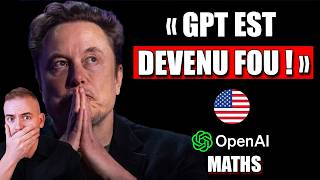
A French-language video argues that AI has crossed a qualitative threshold in mathematics: in recent weeks, multiple long-open problems were reportedly solved, several by AI systems, and Terence Tao is cited as validating that this reflects real progress rather than hype. The speaker uses these examples to claim AI is becoming a genuine discovery engine, with implications far beyond math into law, engineering, medicine, and automation.
Watch on YouTube ›Get the market thesis, key claims, assets, contradictions, and follow-up questions from any financial video — then unlock a version personalized to your portfolio, watchlist, and favorite speakers.
The core thesis is that AI has reached a “WTF moment” in mathematics: systems like GPT-5.2 Pro and Google DeepMind’s AlphaEvolve are no longer just assisting humans, but are now beginning to produce valid, autonomous mathematical discoveries. The speaker frames this as a step-change, not a marginal improvement, and repeatedly emphasizes the word “autonomous” as the key distinction from earlier, overhyped claims that merely scraped the web for existing solutions. To support that claim, the video cites several concrete examples. It says 15 math problems moved from unsolved to solved since Christmas, with 11 credited to AI systems. It highlights GPT-5.2 Pro allegedly solving Erdős problem #728 autonomously on January 7, 2026, and later solving Erdős problem #397 in 15 minutes, a number-theory problem involving central binomial coefficients that had stood for 30 years. …
Tactically, the near-term setup is a fresh AI-capability narrative driven by headline-friendly math breakthroughs; the risk is that it gets crowded quickly or retraced if the examples are not replicated. Any new autonomous proof or formal-verification win would keep the story hot.
Over the next few months, the base case in the video is continued progress on structured reasoning tasks, with AI moving from isolated demos toward a repeatable proof-and-check workflow. The view is invalidated if gains stay confined to easier problems and fail to spread to genuinely open research.
The structural thesis is that formal reasoning is becoming machine-amplified infrastructure, not just a research curiosity. If durable, that implies a lasting productivity regime shift across mathematics and any field built on rigorous symbolic verification.
Since December, 15 math problems have gone from unsolved to solved, and 11 were credited to AI systems.
The speaker cites a recent count of solved problems and attributes most of them to artificial intelligence.
GPT-5.2 Pro autonomously solved Erdős problem 728 on January 7, 2026.
The speaker says the model independently solved a specific named open problem on that date.
Google DeepMind's AlphaEvolve has been involved in more than 50 open problems across several branches of mathematics.
The speaker states that the agent has been applied to many open problems in multiple mathematical fields.
Unlock the full claims, asset map, scores, related transcripts, follow-up questions, and AI chat — shaped around your portfolio, watchlist, favorite speakers, and risks.