TranscriptAgent
Try it free
TRANSCRIPTAGENT.AI · transcript analysis

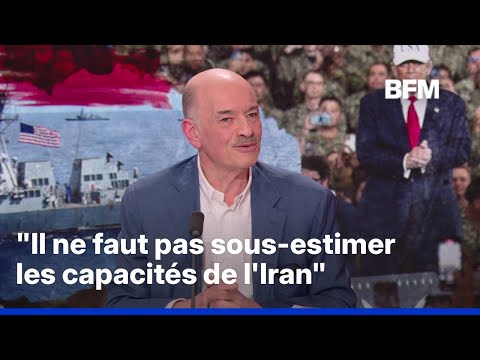
Blocus du détroit d'Ormuz: le décryptage d'Alain Bauer, auteur de "Trump, le pouvoir des mots"

Channel: BFMTV Published: 2026-04-14 13:07
BFMTV

Interview on BFMTV with criminologist Alain Bauer about the Strait of Hormuz, Iran, and Donald Trump. Bauer argues the U.S. is effectively running a filtered blockade from the Gulf rather than the strait itself, that the move is legally arguable under maritime law, and that the immediate danger is a potential confrontation if a Chinese tanker tries to force passage. He then broadens into a political reading of Trump as a strategist who uses words, provocation, and ambiguity as tools, not as random erratic behavior.

Watch on YouTube ›

Get the market thesis, key claims, assets, contradictions, and follow-up questions from any financial video — then unlock a version personalized to your portfolio, watchlist, and favorite speakers.

Detailed summary

This BFMTV segment is an interview, centered first on the reported “blocus du détroit d’Ormuz” and then on Alain Bauer’s book about Donald Trump. Bauer’s core thesis on Hormuz is that the U.S. is not literally blockading the narrow strait in the most exposed sense, but positioning forces in the Gulf to create a filtering barrier with lower military risk. In his view, this is a pragmatic military setup designed to buy time, sort traffic, and deter escalation, especially around vessels with difficult flags or sensitive nationalities such as Chinese or Indian ships. He leans heavily on maritime-law arguments, saying the legal situation is less clear-cut than the headline “illegal blockade” suggests. …

🔒 The full detailed summary continues — read all of it free with an account. Read the full summary →

Main takeaways

  1. Bauer sees the Hormuz operation as a pragmatic filtered blockade, not a literal exposed blockade at the narrowest point.
  2. He argues the legal status is complicated under maritime law and not as straightforward as “illegal” headlines suggest.
  3. The biggest immediate risk is a direct confrontation if a Chinese tanker tries to force passage.
  4. He reads Trump as a strategic operator who uses ambiguity, timing, and provocation deliberately.
  5. He thinks Trump’s deadlines, travel plans, and domestic calendar shape tactical decisions.
  6. On Iran, he treats 60% enrichment as a near-weapon threshold and says the stockpile question matters most.
  7. He believes the real strategic issue is Iran’s future capability, not just a temporary freeze.
  8. He places the whole episode inside a broader contest over maritime chokepoints and spheres of influence.

Market read by horizon

Short term

Near term, the market risk is an escalation headline out of Hormuz, especially if a Chinese-linked tanker tests the screening posture. The setup is tactically fragile: any boarding, standoff, or forced turnback could reprice oil and shipping risk quickly.

  • Watch for a live test if a Chinese-flagged or China-linked tanker tries to challenge the U.S. screening posture near Hormuz.
Show more
  • The operational setup is designed to slow traffic and reduce U.S. exposure rather than force a direct fight at the narrowest point.
  • China’s public condemnation increases the odds that any boarding attempt becomes a diplomatic crisis.
Mid term

Over weeks to months, the base case is a bargaining-heavy stand-off rather than an all-out shootout, with the key variable being whether the filtering posture becomes a durable de facto chokepoint. Confirmation would come from disciplined command-chain behavior and continued, if uneasy, negotiation rather than an incident-driven spiral.

  • Over the coming weeks, the key question is whether the filtering posture becomes normalized or triggers an actual confrontation.
Show more
  • A sustained stand-off would support Bauer’s idea that the crisis is about leverage and bargaining, not immediate war.
  • If negotiations with Iran restart, the market will focus less on rhetoric and more on uranium stockpile control and monitoring.
Long term

Structurally, the transcript argues for a world where control of maritime chokepoints, nuclear latency, and political signaling matter more than formal declarations. The durable regime implication is persistent great-power competition around sea lanes and leverage, not a clean return to stable postwar trade norms.

  • Bauer’s structural view is that maritime chokepoints are central to global power, alongside a broader contest over routes, bases, and access.
Show more
  • He sees Trump’s method as a durable political-strategic style: words as weapons, uncertainty as leverage, and victory as a branding exercise.
  • On Iran, the lasting issue is not one negotiation round but whether the country achieves a survivable nuclear capability.
Unlock the full horizon read See the full short-term, mid-term, and long-term implications with confirmation and invalidation signals. Unlock horizon read

Key claims (12)

NEUTRAL geopolitics

The U.S. is effectively implementing a filtering blockade in the Gulf rather than at the Strait of Hormuz itself.

The speaker says the Americans are not blocking the strait directly but positioning forces in the Gulf to control and inspect traffic more safely.

NEUTRAL nuclear proliferation Iran's enriched uranium stockpile

The main issue is the 440 kilograms of enriched uranium, not future enrichment.

The speaker says the challenge is already the existing 440 kilos because recovering them would save a lot of time.

NEUTRAL

Trump's handling of disputes is often strategically rational rather than erratic, and that rationality is being underestimated by observers.

The speaker argues that what looks like chaos is actually a deliberate way to disorient opponents and achieve strategic goals.

Unlock 9 more claims See the full bullish, bearish, and counter-consensus argument map extracted from the transcript. Unlock all claims

Assets discussed (8)

Strait of Hormuz
BULLISH other

Mentioned as the central chokepoint where the blockade/filtering posture could affect trade and provoke escalation.

U.S. Navy
NEUTRAL other

Discussed as the force positioned to inspect, deter, or confront ships near the Gulf.

Unlock the full asset map (6 more) See all assets mentioned, their directional bias, and the exact reasoning. Unlock asset map

Speakers

GUEST Alain Bauer INTERVIEWER Raphaël Grably

Interview (21 Q&A)

blockade

Is this a real blockade, or not?

He says it is a blockade, but not at the strait itself; it is positioned in the Gulf to create a filtering zone with less risk. He argues the placement is pragmatic and intended to buy time and manage vessels intelligently rather than confront them head-on.

tactics

How should the fact that the ships are hundreds of kilometers from the strait be interpreted?

He interprets it as a pragmatic military choice: the Americans are avoiding unnecessary risk to sailors and ships while keeping the option to stop or inspect vessels in a safer location. He also says the move reflects legal and operational flexibility under international law.

china tanker

What would happen if a Chinese tanker tried to pass the American blockade?

He says that would be the real test, comparable to the Cuban missile crisis, where a passage attempt could trigger a dangerous confrontation but might still be defused by last-minute diplomacy. He expects higher-level decision-makers to intervene rather than leaving the choice to the ship's captain.

Unlock the full interview (18 more Q&A) Every question, answer summary, and YouTube timestamp. Unlock full Q&A

Where this transcript pushes against consensus

  • Bauer’s legal reading of the Hormuz situation is asserted confidently but not fully demonstrated in the transcript.
  • He treats the U.S. posture as a quasi-blockade/barrage filtrant, but the operational details remain somewhat unclear.
  • His claim that 60% enrichment essentially means weapons intent is strong but presented without direct technical proof in the segment.
  • He suggests Iran may be close to a bomb, yet also says nobody really knows where the enriched material is.
  • The comparison between Trump’s strategy and deliberate rational play is plausible but rests on interpretive judgment, not hard evidence.
  • Some of the geopolitical links between Trump’s calendar, China, and the Hormuz situation feel associative rather than causally established.

Topics

Hormuz blockademaritime lawChina-Iran tensionsTrump strategypoker-style negotiationIran nuclear programU.S.-China rivalryregional ceasefirecommand chain escalation

Create your free research agent

Unlock the full claims, asset map, scores, related transcripts, follow-up questions, and AI chat — shaped around your portfolio, watchlist, favorite speakers, and risks.

  • Full claims and asset map
  • Personalized relevance to your watchlist
  • Follow-up questions you can track
  • Related transcripts from your workspace
  • AI chat about this video
Create your free research agent
TRANSCRIPTAGENT.AI