
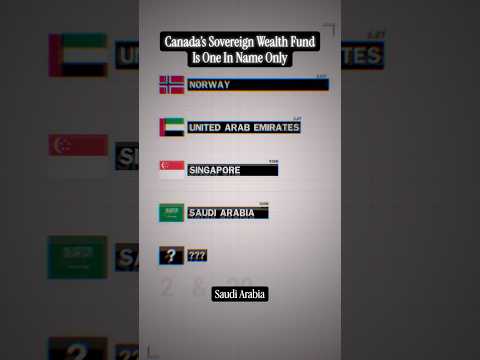
The speaker argues Canada’s new "Canada Strong Fund" is being mislabeled as a sovereign wealth fund. Their core point is that true sovereign wealth funds are usually built from oil revenue or long-running budget surpluses, whereas Canada is funding this one with borrowed money, making it more like a "sovereign debt fund" or domestic spending vehicle.
Watch on YouTube ›Get the market thesis, key claims, assets, contradictions, and follow-up questions from any financial video — then unlock a version personalized to your portfolio, watchlist, and favorite speakers.
The speaker’s main thesis is straightforward: Canada’s Canada Strong Fund should not be called a sovereign wealth fund because the funding source and investment model do not match the classic examples. They open by naming Norway, the UAE, Singapore, and Saudi Arabia as countries with genuine sovereign wealth funds, then argue those funds were built either from decades of oil money or persistent budget surpluses. Canada, by contrast, does not have that revenue base at the federal level, since resource royalties go to provinces and Ottawa has been running large deficits. A big part of the argument is about balance-sheet reality. The speaker says the federal government is carrying more than $1.4 trillion in debt, with debt service costs above $50 billion per year, and that Carney is seeding the new fund with $25 billion of borrowed money. …
Tactically, the setup is about skepticism: the market should treat the Canada Strong Fund as a policy vehicle funded by debt, not as a classic wealth fund. The near-term risk is reputational and political rather than tradable.
Over the next few months, the key question is whether the fund can show credible return discipline or whether it becomes another domestically directed government program. If the latter, the "sovereign debt fund" critique will likely harden.
Structurally, the piece argues Canada does not have the surplus- or resource-rent-backed regime that makes sovereign wealth funds durable. The long-run implication is that state capital allocation will remain constrained by deficits and political goals rather than compounding logic.
The Canada Strong Fund is better characterized as a sovereign debt fund than a sovereign wealth fund because it is funded by borrowing.
The speaker's reasoning is that a sovereign wealth fund is usually built from surplus wealth, whereas this fund starts with borrowed federal money.
Canada does not fit the usual pattern for sovereign wealth funds because its federal government has neither resource royalty income nor decades of budget surpluses.
The speaker says resource royalties go to provinces and notes Ottawa has not run surpluses for many years, unlike countries that historically built sovereign wealth funds.
Canada's new Canada Strong Fund is being funded with 25 billion dollars of borrowed money rather than accumulated surplus or resource royalty cash.
The speaker argues Canada lacks the oil revenue and long-running budget surpluses that typically seed sovereign wealth funds, so the federal government is using debt instead.
Unlock the full claims, asset map, scores, related transcripts, follow-up questions, and AI chat — shaped around your portfolio, watchlist, favorite speakers, and risks.
