TranscriptAgent
Try it free
TRANSCRIPTAGENT.AI · transcript analysis

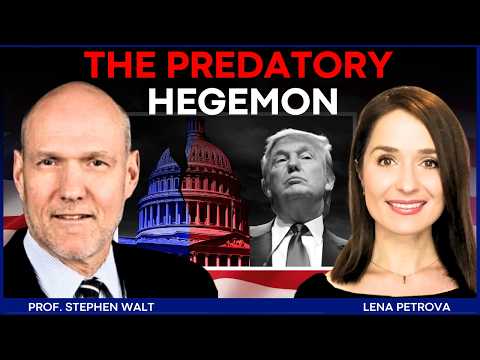
The PREDATORY HEGEMON - How Trump Wields American Power | Prof. Stephen Walt

Channel: World Affairs In Context Published: 2026-06-21 06:00
World Affairs In Context

Stephen Walt argues that Trump’s foreign policy is best understood as “predatory hegemony”: using U.S. power not just against adversaries but also to squeeze allies, extract concessions, and force compliance. He says this can work briefly, but it corrodes trust, pushes partners away, and ultimately weakens American leverage.

Watch on YouTube ›

Get the market thesis, key claims, assets, contradictions, and follow-up questions from any financial video — then unlock a version personalized to your portfolio, watchlist, and favorite speakers.

Detailed summary

This interview centers on Stephen Walt’s Foreign Affairs thesis that the Trump administration is practicing a more coercive, extractive style of American power that he calls “predatory hegemony.” Walt defines it as a zero-sum approach in which the United States tries to take the lion’s share of every deal and applies pressure not only to rivals but also to allies. He contrasts this with earlier U.S. behavior, which could be hard-nosed toward adversaries but still generally aimed at keeping allies prosperous and dependable. In his view, Trump’s second term marks a sharper break because it treats partners as targets for exploitation rather than as assets to preserve.

Main takeaways

  1. Walt’s core claim is that Trump is converting U.S. primacy into a transactional, coercive system aimed at extracting tribute and submission.
  2. He argues this policy can succeed briefly because the U.S. has real leverage, but overuse makes others build alternatives and distance themselves.
  3. The Iran war, in his view, exposed the limits of military coercion and the danger of assuming weaker states will simply fold.
  4. Ukraine shows that even a powerful state cannot dictate outcomes when the adversary is a nuclear-armed great power and the local state is highly motivated.
  5. Europe is being pushed toward greater autonomy because Trump has made the U.S. look less reliable and more predatory.
  6. Economic coercion via tariffs, sanctions, and dollar control is powerful but not absolute; it creates incentives for rival payment systems and trade rerouting.
  7. Walt sees multipolarity as overstated: the U.S. remains first, China second, Russia a distant third, with few true peer competitors.
  8. A restraint-oriented grand strategy would shift focus toward China, reduce Middle East entanglement, and devolve more European security burden to Europeans.

Market read by horizon

Short term

Near term, the immediate risk is more geopolitical volatility: a bad Middle East headline, renewed tariff threats, or another alliance shock could jolt energy, defense, and FX markets quickly. The actionable setup is to treat Trump-era unpredictability as a catalyst for abrupt repricing rather than a stable policy regime.

  • The immediate market/policy risk is that Trump’s coercive style keeps generating sudden shocks: tariffs, sanctions, military escalation, and unpredictable deal changes.
Show more
  • Iran is the closest live catalyst in the transcript: Walt says Trump already had to stop the conflict because the Strait of Hormuz risked major damage to oil and gas flows.
  • The next near-term risk is renewed instability in the Middle East if the 60-day negotiation window fails and the administration gets pulled back into confrontation.
Mid term

Over weeks to months, the base case is a slow erosion of U.S. credibility if coercive tactics keep recurring, which encourages allies to hedge via trade diversification, defense autonomy, and payment alternatives. The key invalidation would be a sustained pivot back to predictable alliance management and fewer self-inflicted shocks.

  • Over the next several weeks or months, Walt’s base case is that predatory behavior erodes U.S. leverage rather than compounding it.
Show more
  • Allies may keep complying tactically, but the medium-term trend is toward hedging: alternative trade links, alternative payment rails, and more independent security planning.
  • In Europe, the likely path is a gradual push toward more unified defense coordination and less confidence in automatic U.S. protection.
Long term

Structurally, Walt’s view implies a U.S.-led order that remains dominant but becomes less trusted and less efficient, with China as the main counterweight. The long-run issue is not immediate replacement of American primacy, but a world in which coercion produces durable resistance and weaker U.S. rule-setting power.

  • Structurally, Walt argues predatory hegemony contains the seeds of its own destruction because it incentivizes other states to reduce dependence on the United States.
Show more
  • The durable implication is a less trusted America: allies may no longer assume U.S. protection is stable or benevolent, even if they still need it.
  • He sees no clean multipolar order yet; the more lasting regime is a lopsided system with U.S.-China competition at the core.
Unlock the full horizon read See the full short-term, mid-term, and long-term implications with confirmation and invalidation signals. Unlock horizon read

Key claims (12)

BEARISH US foreign policy

Trump's foreign policy is a departure from traditional U.S. leadership because it tries to extract concessions from allies as well as adversaries.

Walt argues that the administration treats all bilateral relationships as zero-sum and seeks the lion's share even from partners, unlike prior U.S. behavior that mostly pressured adversaries more than allies.

NEUTRAL US grand strategy

A restraint-oriented U.S. foreign policy should reduce involvement in Europe, disengage from the Middle East, and concentrate on balancing China while strengthening domestic scientific and industrial capacity.

He lays out a strategic framework: devolve European security to Europeans, adopt a balance-of-power approach in the Middle East, and focus U.S. resources on competition with China rather than weakening universities or science.

NEUTRAL geopolitics

The United States has only limited leverage over Russia in Ukraine because Russia is a major nuclear-armed power and Ukraine sees its existence at stake.

The speaker argues that Russia cannot be pushed around easily and that direct military threats are off the table, so U.S. coercive leverage is not absolute.

Unlock 9 more claims See the full bullish, bearish, and counter-consensus argument map extracted from the transcript. Unlock all claims

Assets discussed (9)

United States
MIXED other

Not a tradable asset, but the discussion centers on U.S. power, leverage, and credibility.

China
UNCLEAR other

Central geopolitical counterpart in the power competition discussion.

Unlock the full asset map (7 more) See all assets mentioned, their directional bias, and the exact reasoning. Unlock asset map

Speakers

SPEAKER Lena Petrova

Interview (13 Q&A)

predatory hegemony

What are the core principles of predatory hegemony, and how does it differ from earlier U.S. approaches to global leadership?

Walt says predatory hegemony means using a dominant position to extract concessions and improve one’s standing, treating all bilateral relations as zero-sum. He argues the key difference from prior U.S. practice is that the Trump administration applied hardball not just to adversaries but to allies as well, which is a major departure from the more partnership-oriented approach of the past.

Trump foreign policy

How has Trump’s foreign policy changed how the world views the United States and its role in the world?

Walt says the United States now looks more like a problem for allies than a reliable partner. He says many countries see the Trump administration as fundamentally hostile, and that its unpredictability pushes others to seek more stable and reliable relationships elsewhere.

Iran war

What does it mean when predatory hegemony fails to force Iran into Washington’s preferred outcome?

Walt says the Iran episode shows the limits of American and military power. He explains that Iran had meaningful leverage through the Strait of Hormuz, and that Trump effectively backed down because continuing the war would have caused severe economic damage.

Unlock the full interview (10 more Q&A) Every question, answer summary, and YouTube timestamp. Unlock full Q&A

Where this transcript pushes against consensus

  • Walt is confident the Iran war already demonstrated the limits of U.S. power, but the transcript offers limited concrete evidence beyond the strategic narrative and Strait of Hormuz risk.
  • His claim that the U.S. has essentially “surrendered” to Iran is rhetorically strong and may overstate the completeness of the MOU’s effect.
  • He argues Trump is less pro-Putin than before and faces internal divisions, but this is inferential and not directly evidenced beyond observed behavior.
  • The assertion that multipolarity is mostly aspirational may underweight how quickly regional balances can shift if U.S. credibility keeps degrading.
  • The Ukraine framing assumes a workable pro-Ukrainian mediation path was available; the transcript does not fully demonstrate that such a path would have been accepted by either side.

Topics

predatory hegemonyTrump foreign policyUS-Iran warUkraine warEurope and NATOsanctions and dollar powermultipolarityUS-China competitionIsrael lobbyrestraint strategy

Create your free research agent

Unlock the full claims, asset map, scores, related transcripts, follow-up questions, and AI chat — shaped around your portfolio, watchlist, favorite speakers, and risks.

  • Full claims and asset map
  • Personalized relevance to your watchlist
  • Follow-up questions you can track
  • Related transcripts from your workspace
  • AI chat about this video
Create your free research agent
TRANSCRIPTAGENT.AI