
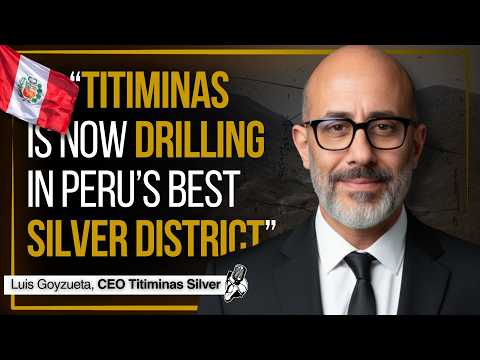
Interview with Titu Minas CEO Louie about a Peru-based silver, copper, gold, lead, zinc development story centered on a historical brownfield mine plus newly identified satellite zones. The core debate is whether high grades, existing underground development, and strong infrastructure can outweigh capex, execution, and Peru political/capital-market risk.
Watch on YouTube ›Get the market thesis, key claims, assets, contradictions, and follow-up questions from any financial video — then unlock a version personalized to your portfolio, watchlist, and favorite speakers.
This is a CEO interview focused on Titu Minas (TSXV: TITI) and its Madre Sierra project in central Peru, framed as a brownfield redevelopment with a large historical footprint rather than a grassroots exploration story. Louie argues the company’s edge is that it inherits a past-producing, infrastructure-rich system with underground workings, historical engineering, and a known community relationship, then layers new drilling, metallurgy, and permitting work on top. The thesis is that the asset can be re-rated from a historical ~1.2 Mt resource base into a much larger standalone operation if drilling confirms continuity and grade. Louie repeatedly emphasizes the project’s high-grade nature and the upside from the broader land package. …
Near term, this is a catalyst-driven junior mining setup: assays, metallurgy, and any early production/offtake announcement will likely drive the stock more than fundamentals. The main tactical risk is that thin liquidity and financing uncertainty can dominate price action before the drill story is proven.
Over the next few months, the base case is a stepwise de-risking if drilling confirms historical grades/widths and engineering keeps up with the stated FID schedule. If the resource grows and capital options remain open, the market may start pricing a phased move to production; if not, the stock likely stays trapped in financing/assay mode.
Structurally, the interview argues for a Peru brownfield mining builder that can convert historical underground assets into a portfolio of cash-flowing projects. The long-term regime question is whether this is a repeatable operational edge or just a one-off asset re-rating in a capital-intensive sector.
The project can be built for approximately $35 million to $45 million in capex and would take about 12 to 14 months to construct.
The speaker gives a direct construction budget range and timeline, noting potential long-lead items may affect the schedule.
The biggest risk to the story is access to capital, more than geology or permitting.
He explicitly says the mine is permitted and the key uncertainty is financing, with Peru politics and silver-market sentiment also affecting funding.
The biggest risk to the project is access to capital markets rather than permitting or social opposition.
He explicitly says the biggest single risk is not permitting or social issues, but the ability to access capital markets for development.
What is TTM's overall business strategy?
Louie says TTM wants to become a producing mining company, ultimately aiming for 10 million ounces of silver-equivalent production. He explains the flagship Madrecita project is a past-producing, high-grade silver-dominant system with historical resources that they plan to redrill and expand through underground exploration.
How many ounces of silver equivalent does TTM ultimately want to produce?
Louie states the company's long-term target is 10 million ounces of silver-equivalent production. He adds that the current flagship project would only get them part of the way there.
What does the historical resource look like?
He says the historical resource is 1.2 million tons grading about 4 ounces of silver, with some lead, copper, gold, and zinc. He describes it as a silver-dominant, high-grade epithermal deposit and says the equivalency was just under 20 million ounces at the time of calculation.
Unlock the full claims, asset map, scores, related transcripts, follow-up questions, and AI chat — shaped around your portfolio, watchlist, favorite speakers, and risks.
