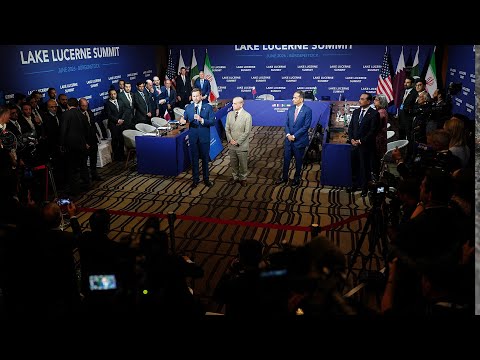
Bloomberg reports on tense, last-minute summit diplomacy in Switzerland involving the U.S., Iran, Pakistan, Qatar, and Swiss mediators. The immediate flashpoint was Iran reportedly refusing a shared photo with the Americans, but after the cameras left, all four parties reportedly moved into talks.
Watch on YouTube ›Get the market thesis, key claims, assets, contradictions, and follow-up questions from any financial video — then unlock a version personalized to your portfolio, watchlist, and favorite speakers.
This segment is a live, event-driven update on fraught diplomacy at a Switzerland-hosted summit. The core point is that the meeting process itself is politically delicate: the Iranian delegation reportedly objected to a shared photo with the Americans, underscoring how symbolic optics are contentious even as substantive talks continue. The host frames the story around Vice President J. D. Vance’s presence in Switzerland meeting with delegates from Iran, Pakistan, and Qatar, while Trump’s Truth Social post threatens Iran over its proxies in Lebanon and adds pressure to the mediators. Bastian Benrath-Wright explains that the public picture was improvised and visibly awkward: the delegations from Qatar, Pakistan, and the U.S. were in the room, the microphone was passed around, and the Iranian envoy only entered briefly before leaving again. …
Near term, the setup is headline-sensitive: Trump’s rhetoric and any further summit optics could interrupt or overshadow the talks. The actionable risk is that public snags create sudden volatility even if private negotiations continue.
Over the coming weeks, the base case is incremental, mediator-led diplomacy rather than a clean breakthrough. Watch for whether the memorandum turns into concrete steps; repeated bilateral engagement would validate the process, while visible breakdowns would argue the talks are not advancing.
Structurally, the clip points to a persistent U.S.-Iran negotiation model built on back channels and third-country mediation. Until formal relations exist, summit choreography and intermediary states like Switzerland will remain central to the regime.
After the cameras were off, all four parties, including Iran, proceeded to substantive talks.
The speaker explicitly says that once the cameras and reporters left, all four parties went to talks and the Iranian side was included.
The Iranian delegation initially refused to participate in a shared photo with the Americans, which made the photo-op politically contentious.
The speaker says the Iranians did not want a shared photo and that the public picture is highly contentious, with wrangling behind the scenes.
Switzerland is actively involved in the Iran-US process because it runs the back channel between the two countries.
The speaker explains that Switzerland has been involved from the start and operates the back channel since Iran and the US lack formal diplomatic relations.
What happened with the photo op and why was the Iranian delegation not in the room at first?
The delegate says the Pakistani, Qatari, and US delegations were present and passing the microphone, while the Iranian envoy only entered briefly and then left again. He says it did not look planned and reflects contentious wrangling over the public picture.
Unlock the full claims, asset map, scores, related transcripts, follow-up questions, and AI chat — shaped around your portfolio, watchlist, favorite speakers, and risks.