TranscriptAgent
Try it free
TRANSCRIPTAGENT.AI · transcript analysis

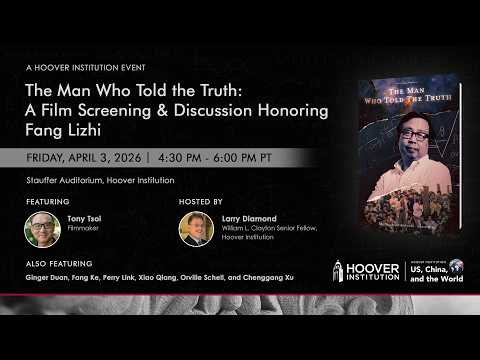
The Man Who Told The Truth: A Film Screening & Discussion Honoring Fang Lizhi | Hoover Institution

Channel: Hoover Institution Published: 2026-04-21 05:38
Hoover Institution

A Hoover Institution event screened and discussed a documentary about Fang Lizhi, portraying him as a physicist whose scientific rationalism and moral clarity led him to become an accidental dissident and enduring human-rights symbol. The conversation centered on his exile years, his influence on Chinese democracy and human rights, and the claim that his opposition to Communist ideology grew naturally out of scientific thinking rather than conventional political organizing.

Watch on YouTube ›

Get the market thesis, key claims, assets, contradictions, and follow-up questions from any financial video — then unlock a version personalized to your portfolio, watchlist, and favorite speakers.

Detailed summary

This transcript is a film screening and panel discussion honoring Fang Lizhi, not a market debate in the usual sense. The main thesis across the event is that Fang was both a foundational Chinese astrophysicist and a uniquely truthful dissident whose scientific method, personal integrity, and moral courage made him a lasting symbol for democracy and human rights. Larry Diamond’s opening remarks frame Fang as someone whose scientific career and political repression were inseparable, while repeatedly likening him to Andrei Sakharov as a scientist whose conscience made him a dissident. Tony Choy, the filmmaker, explains that he was drawn not just to Fang’s 1980s activism but to the totality of his life, especially the exile years. He says those years mattered to him personally because he is also in exile, and he presents Fang as a kind of life guide. …

🔒 The full detailed summary continues — read all of it free with an account. Read the full summary →

Main takeaways

  1. Fang Lizhi is presented as a scientist whose scientific method led directly into dissent and human-rights advocacy.
  2. The film and discussion stress his exile years as a defining part of the story, not just the 1980s activism.
  3. Multiple speakers argue Fang’s courage came from intellectual clarity and moral certainty rather than political ambition.
  4. The event frames Fang as a model for younger Chinese dissidents and a largely erased figure inside China.
  5. Several panelists connect Fang’s ideas to universal principles: scientific law, individual mind, free expression, and human rights.

Market read by horizon

Short term

No immediate trade setup is present. The only near-term read is reputational: this is a high-signal cultural-history event about China’s dissident tradition, not a market-moving catalyst.

  • The immediate focus is the film, the panel discussion, and audience Q&A; there is no near-term market catalyst here.
Show more
  • The most actionable short-term dynamic is reputational and historical: the event seeks to reintroduce Fang’s story to a live audience and broader viewers.
  • The discussion briefly touches on contemporary China under Xi Jinping, but only as context for the panel’s present-day concern about repression.
Mid term

Over the next several months, the transcript points to a continued revival of Fang Lizhi as a symbolic reference point for Chinese intellectual dissent, especially among exile communities and China scholars. The narrative strengthens if the film circulates and if younger activists keep rediscovering him.

  • Over the coming weeks and months, the transcript’s base case is that the documentary and discussion will be used to reinforce Fang as a touchstone for democratic and intellectual dissent in China.
Show more
  • The panel implies Fang’s influence will persist through archives, screenings, and human-rights networks even if his name is suppressed in mainland China.
  • A key confirmation signal would be whether the film circulates among students, activists, and China-watchers as a canonical reference for the link between science and dissent.
Long term

The long-run thesis is that scientific rationality and liberal political values can reinforce each other, creating dissident traditions that survive censorship and exile. The event implies China’s democratic memory may outlast the current regime’s control over historical narrative.

  • Structurally, the transcript argues that scientific rationalism can generate a durable moral and political ethic, not just technical expertise.
Show more
  • Fang is cast as part of a broader Chinese enlightenment tradition in which truth-seeking, individual conscience, and public reason challenge authoritarian ideology.
  • The long-run implication is that Chinese democracy and human-rights thought may be sustained by cultural and intellectual undercurrents even after prolonged repression.
Unlock the full horizon read See the full short-term, mid-term, and long-term implications with confirmation and invalidation signals. Unlock horizon read

Key claims (12)

NEUTRAL

Fang Lizhi was an accidental dissident and political figure whose scientific rationality made him incapable of hiding what he believed.

The speaker says Fang's simplicity and rationality compelled him to see and state the world directly, which made him truthful in a revolutionary environment.

BULLISH

The subject's life was fundamentally shaped by exile, but exile did not silence him.

Tony argues that Fong endured exile yet remained active and outspoken, especially through teaching, truth-seeking, and human-rights work.

NEUTRAL human rights

He learned human rights from science rather than from the European political tradition.

The speaker contrasts his view with the May Fourth-era framing and says he derived human rights from scientific thinking.

Unlock 9 more claims See the full bullish, bearish, and counter-consensus argument map extracted from the transcript. Unlock all claims

Speakers

GUEST Tony Choy GUEST Fish/Fong K GUEST Perry Link GUEST Orville Schell GUEST Shai Jang GUEST Ginger Duan HOST Larry Diamond HOST Francis Hisgen

Interview (16 Q&A)

film inspiration

What inspired you to make this film, and why make it now?

Tony Choy says he came to admire Fang Liuzhi relatively late, but for the totality of his life rather than only the 1980s. He wanted the film to include the exile years because he identifies with exile himself and sees Fang’s conduct there as a life guide.

production process

Can you describe the process of making your first documentary?

He says the project initially seemed impossible because he had never made a film and did not know anyone in the film world. The hardest part was not technical but figuring out how to start and assemble the right people around the project.

father image

Why did the image of your father from 30 years earlier stand out to you?

The speaker says the image clicked because it matched his memory of his father as a deeply focused researcher. He explains that his father was often away because of turmoil and relocation, so the visit to Tucson brought back a vivid memory of him writing calculations in Beijing.

Unlock the full interview (13 more Q&A) Every question, answer summary, and YouTube timestamp. Unlock full Q&A

Where this transcript pushes against consensus

  • The transcript contains repeated name/translation errors, making some attribution and factual details less reliable than the speakers intend.
  • Claims that Fang learned human rights directly from science are philosophically strong but not rigorously demonstrated; they are more interpretive than evidentiary.
  • The link between Fang and the Tiananmen movement is presented as spiritually central but practically indirect; the panel itself notes there was no conspiracy.
  • Some historical details in the opening remarks appear muddled or imprecise in delivery, including dates and transliterations.
  • The optimism about China’s long-term democratic future is asserted more than evidenced.

Topics

Fang Lizhi biographyChinese democracyhuman rightsastrophysics and cosmologyexile and dissidenceTiananmen crackdownscience and ideologyTibetan rightsSakharov analogyuniversity repression in China

Create your free research agent

Unlock the full claims, asset map, scores, related transcripts, follow-up questions, and AI chat — shaped around your portfolio, watchlist, favorite speakers, and risks.

  • Full claims and asset map
  • Personalized relevance to your watchlist
  • Follow-up questions you can track
  • Related transcripts from your workspace
  • AI chat about this video
Create your free research agent
TRANSCRIPTAGENT.AI