
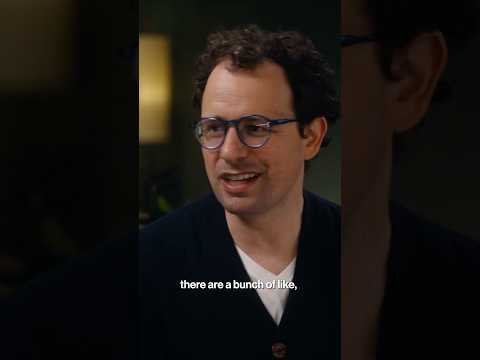
Anthropic CEO Dario Amodei argues AI poses a non-zero civilizational risk, but says Anthropic’s testing, safeguards, and release process are designed to reduce—not increase—that probability. He rejects a heroic-Oppenheimer model and instead emphasizes distributed checks and balances among companies, countries, and institutions.
Watch on YouTube ›Get the market thesis, key claims, assets, contradictions, and follow-up questions from any financial video — then unlock a version personalized to your portfolio, watchlist, and favorite speakers.
The speaker’s core thesis is that frontier AI carries a real civilizational-collapse risk, but the right response is not to centralize power around one “larger-than-life” figure. Instead, he argues for a system of checks and balances across companies, countries, and institutions, with Anthropic trying to reduce danger through testing, iterative release, and layered defenses. He explicitly says he sees Oppenheimer as “a failure case” in this context and identifies more with Leo Szilard, who helped recognize the chain-reaction logic of nuclear technology. A major part of the reasoning is that AI is inherently unpredictable and exists in a competitive environment. He says the risk comes from the “straightforward recipe” of the technology plus multiple countries, multiple companies, and new entrants appearing if gaps are left unfilled. …
Immediate read: this is a headline-risk clip for AI names, because it reinforces extreme downside narratives even while defending Anthropic’s process. The near-term tradeable issue is sentiment and regulatory attention, not a specific valuation catalyst.
Over the next few months, the market will likely keep oscillating between fear of AI risk and enthusiasm for deployment; the key question is whether safety-first messaging slows adoption or becomes a moat. If Anthropic can show credible controls without losing pace, it may strengthen trust rather than suppress the sector narrative.
Longer term, the clip supports a regime where frontier AI is treated like a tightly governed, high-consequence technology. That would favor firms with credible safety infrastructure and raise the structural bar for fast movers that cannot prove control.
Anthropic's actions lower the probability of civilizational collapse rather than increase it.
The speaker says the company is trying to reduce that probability and believes its actions lower it more than they raise it.
The probability of civilizational collapse from AI cannot be guaranteed to be zero even with extensive safety measures.
He argues that because of the technology's unpredictability and the impossibility of guaranteeing safety, the risk can be reduced but not eliminated.
The current models Anthropic releases are not dangerous outside of cyber risk.
He qualifies the claim by saying the released models are not dangerous, or at least not really dangerous, except perhaps in cyber.
Do you see parallels between yourself and Oppenheimer?
He says he identifies more with Leo Szilard than Oppenheimer. He argues that progress should not depend on larger-than-life figures, but on a balance of power and checks and balances among many actors; he even describes Oppenheimer as a failure case for what should not happen.
Could something Anthropic built cause civilizational collapse?
He says he certainly hopes not, and believes Anthropic's actions lower the probability of catastrophe rather than increase it. He adds that the technology is inherently unpredictable, so the company tests extensively, adds many defense mechanisms, and tries to reduce risk even though it can never be zero.
If there were a 25% chance of an airplane crashing, would you get on that plane?
He replies that 25% is too high and says the goal is to make the probability much, much lower. This follows his comparison of AI risk management to making an airline safer without being able to guarantee zero crashes.
Unlock the full claims, asset map, scores, related transcripts, follow-up questions, and AI chat — shaped around your portfolio, watchlist, favorite speakers, and risks.

