TranscriptAgent
Try it free
TRANSCRIPTAGENT.AI · transcript analysis

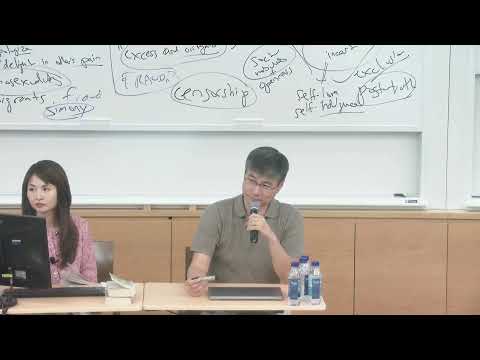
Dante Livestream #7 (Monday, June 22 10AM)

Channel: Predictive History Published: 2026-06-22 02:14
Predictive History

A long Dante class lecture arguing that the Divine Comedy is a prophetic social critique of Florence and, by extension, modern society. The speaker frames hell as a moral map of social decay: factionalism, meritocracy, fraud, censorship, elite incest/homosexuality-as-narcissism, greed, and loss of faith/hope/love.

Watch on YouTube ›

Get the market thesis, key claims, assets, contradictions, and follow-up questions from any financial video — then unlock a version personalized to your portfolio, watchlist, and favorite speakers.

Detailed summary

This livestream is a dense, classroom-style reading of Dante’s Inferno and related passages, but the speaker’s core thesis is broader: Dante should be read as a prophet and social critic, not as a merely literary monument. The lecture repeatedly argues that the Divine Comedy is a complete moral cosmology built around faith, hope, and love, and that Inferno functions as a critique of corrupted society rather than simple punishment fantasy. The speaker also explicitly maps Dante’s Florence onto contemporary life, suggesting that many of the same pathologies—meritocratic competition, factionalism, censorship, fraud, elite self-indulgence, and declining trust—still define the present. A major throughline is the re-interpretation of sin. …

🔒 The full detailed summary continues — read all of it free with an account. Read the full summary →

Main takeaways

  1. Dante is presented as a prophet of social collapse, not just a poet.
  2. Inferno is interpreted as social critique: sins expose what modern society has become.
  3. Fraud, treachery, and censorship are treated as especially destructive because they break trust and imagination.
  4. The speaker argues that meritocracy can produce cruelty, envy, and apology-deficit behavior.
  5. Modern universities, media, and elite culture are framed as parallel to Dante’s declining Florence.
  6. The lecture repeatedly links sin to social structure, not just individual morality.
  7. The speaker uses contemporary examples—AI, fake news, campus politics—to make Dante feel current.
  8. Hell’s punishments are read as symbolic mirrors of each sin’s inner logic.

Market read by horizon

Short term

Near term, the setup is all about recognizing the speaker’s immediate read-through of Inferno’s punishment logic: fraud, censorship, and social distrust are the active risks he thinks matter now. The tactical lens is less tradeable market timing than a live warning that institutions and narratives are already broken.

  • Immediate focus is on the remaining Inferno cantos and how each punishment symbolically matches its sin.
Show more
  • The speaker’s near-term setup is the transition from violence to fraud to treachery, which he treats as the most important stretch of the poem.
  • He flags censorship, media manipulation, and fraud as live modern analogues to Dante’s fortune-tellers and simonists.
Mid term

Over weeks to months, the base case in the speaker’s frame is further institutional erosion unless society restores trust, truth-telling, and a broader standard of purpose. He would likely say the narrative remains bearish on elite culture and social cohesion unless those incentives change.

  • Over the next several classes, the speaker expects the Inferno to increasingly function as an anatomy of Florence’s civic decay.
Show more
  • The base-case interpretive path is that Dante’s poem is a warning about what happens when competition, faction, and self-indulgence replace civic virtue.
  • He suggests the audience should keep checking whether modern institutions—universities, media, churches, governments—show the same loss of trust and authority.
Long term

The structural thesis is that civilizations decay when they replace shared moral order with self-celebration, status competition, and manipulated reality. In the long run, the enduring regime risk is not one bad policy but the collapse of trust, imagination, and civic responsibility.

  • The structural thesis is that Dante offers a durable map of how civilizations decay when they lose faith, shared truth, and moral purpose.
Show more
  • The long-run implication is that institutions live or die by whether they preserve trust, humility, and a common standard of reality.
  • The speaker sees meritocracy, identity-based self-celebration, and institutional credentialism as secular replacements for older moral order, and thus as symptoms of decline.
Unlock the full horizon read See the full short-term, mid-term, and long-term implications with confirmation and invalidation signals. Unlock horizon read

Key claims (12)

NEUTRAL

Treachery is the worst sin because it alters society's fabric by creating a vicious cycle of betrayal.

The speaker says betrayal spreads through society by prompting others to betray in turn, making it more destructive than lesser sins.

NEUTRAL

Fraud is worse than violence because it destroys trust and undermines the bonds that make love and social order possible.

The speaker argues that violence harms bodies, but fraud corrupts perception and trust, which damages the foundations of faith and human relation more deeply.

BEARISH social decay

The speaker claims society has become so corrupt that ordinary people can no longer live a life of faith, hope, and love without divine intervention.

He says the social order is so sinful that God must intervene to give people the opportunity to live rightly.

Unlock 9 more claims See the full bullish, bearish, and counter-consensus argument map extracted from the transcript. Unlock all claims

Assets discussed (9)

Divine Comedy
NEUTRAL other

The central text of the lecture; not a market asset but the main object of analysis.

Inferno
NEUTRAL other

The speaker repeatedly analyzes Inferno as the main section of the poem under discussion.

Unlock the full asset map (7 more) See all assets mentioned, their directional bias, and the exact reasoning. Unlock asset map

Interview (72 Q&A)

lust symmetry

What explains the symmetry between lust in Hell and Picarda in Paradise?

The guest says the key is the symmetry in the Divine Comedy and the totality of Dante's vision. Lust, along with other sins, reflects a lack of will and desire, while Paradise shows the positive fullness of faith, hope, and love.

lust ranking

Which of the three lust examples is worst in Dante's view?

A student begins ranking the examples, suggesting the AI wife is worst, then the celebrity letters, and the prostitute least severe. The response is cut off, so the instructor's intended answer is not captured in this chunk.

prostitution example

How is the prostitute example defended as less bad than the other two?

Another student says the prostitute scenario is not as bad because it can still involve free will and, in some cases, a normal marital relationship might even emerge. The instructor also notes that if coercion were involved, this would change the ranking and make it much worse.

Unlock the full interview (69 more Q&A) Every question, answer summary, and YouTube timestamp. Unlock full Q&A

Where this transcript pushes against consensus

  • The lecture often moves from Dante text to modern political commentary without clearly separating interpretation from analogy.
  • The speaker presents highly debatable claims about homosexuality, incest, and elite decline as if they are Dante’s logic, but the reasoning is heavily interpretive and culturally loaded.
  • The claim that modern universities or media are the direct equivalent of Dante’s fortune-tellers or simoniacal clergy is suggestive but not rigorously established.
  • The assertion that immigration causes cultural decline is argued polemically and is not grounded in textual evidence from Dante.
  • The speaker sometimes treats speculative historical generalizations as settled fact, especially around elite sexual behavior, meritocracy, and social collapse.
  • Several explanations rely on projecting a single moral framework onto all of Dante’s categories, which flattens alternative readings.

Topics

Dante and prophecyInferno as social critiqueFaith hope and loveFlorence and factionalismMeritocracy and competitionFraud and treacheryChurch corruption and simonyFortune-tellers and backward visionModern media and censorshipElite decline and social mobility

Create your free research agent

Unlock the full claims, asset map, scores, related transcripts, follow-up questions, and AI chat — shaped around your portfolio, watchlist, favorite speakers, and risks.

  • Full claims and asset map
  • Personalized relevance to your watchlist
  • Follow-up questions you can track
  • Related transcripts from your workspace
  • AI chat about this video
Create your free research agent
TRANSCRIPTAGENT.AI