TranscriptAgent
Try it free
TRANSCRIPTAGENT.AI · transcript analysis

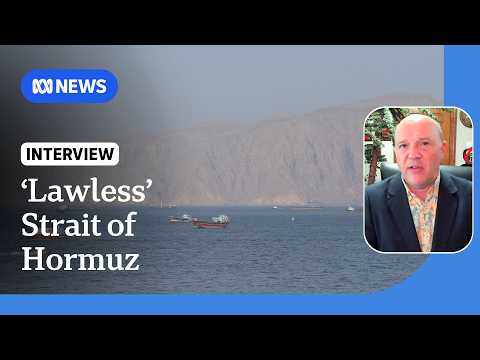
'Lawless' Strait as Iran and US view it as neutral zone for attacks: maritime expert | ABC NEWS

Channel: ABC News (Australia) Published: 2026-04-19 20:12
ABC News (Australia)

A maritime expert argues the Strait of Hormuz has become a lawless, escalation-prone neutral zone where both the U.S. and Iran are targeting shipping. He says even if fighting cools, many shippers may permanently reroute to avoid future disruption.

Watch on YouTube ›

Get the market thesis, key claims, assets, contradictions, and follow-up questions from any financial video — then unlock a version personalized to your portfolio, watchlist, and favorite speakers.

Detailed summary

The segment is an ABC News Australia interview with Sal Mogliano, a Campbell University maritime history professor and former merchant mariner, discussing an apparent escalation in the Strait of Hormuz. He says the U.S. Navy firing on an Iranian-flagged cargo ship looks like retaliation for attacks on vessels in the strait, including two Indian tankers and a French container ship. He argues the waterways are being treated by both sides as a kind of neutral zone, but one that is effectively lawless because both the U.S. and Iran are attacking shipping there. Mogliano explains that the ship involved appears to be a routine Iranian container ship on a scheduled route, and notes that the U.S. has issued a contraband list and said it will search vessels heading into Iran. …

🔒 The full detailed summary continues — read all of it free with an account. Read the full summary →

Main takeaways

  1. The interview treats the Strait of Hormuz as an active escalation zone, not a stable ceasefire environment.
  2. The U.S. move against the Iranian-flagged cargo ship is framed as retaliation for earlier attacks on commercial shipping.
  3. The expert thinks the waterway is being used as a quasi-neutral battleground by both sides.
  4. Container ships are operationally harder to search or seize than tankers because cargo offloading is time-consuming.
  5. Even without actual sea mines, fear of mines can disrupt routing and clearance operations.
  6. A ceasefire may not fully restore pre-conflict shipping patterns because firms may permanently diversify routes.

Market read by horizon

Short term

Near term, the setup is fragile: any fresh boarding, strike, or mine scare in the Strait of Hormuz could quickly raise shipping and energy risk premiums again. Traders should focus on transit safety and whether the U.S. presence actually suppresses incidents.

  • Immediate risk is further tit-for-tat incidents around the Strait of Hormuz and nearby shipping lanes.
Show more
  • The U.S. says it will search vessels heading into Iran, which raises friction for any cargo traffic.
  • Crew handling is likely to be managed case by case; repatriation is the base expectation if no charges exist.
Mid term

Over the next few weeks to months, the base case is continued elevated friction even if overt fighting cools, with carriers testing alternative routes and insurers pricing persistent risk. The view improves only if safe passage becomes routine again and no new seizures or attacks occur.

  • Over the next several weeks, the key question is whether shipping traffic can keep moving without additional boarding incidents or attacks.
Show more
  • The expert expects continued mine-sweeping and security patrols to shape the route’s usability.
  • Even if diplomacy reduces direct fighting, shipping firms may begin using alternative routes to avoid renewed disruption.
Long term

Structurally, the episode reinforces the vulnerability of chokepoints like the Strait of Hormuz and the likelihood that shippers diversify away from them after repeated disruptions. The lasting regime implication is a higher geopolitical premium on global logistics and maritime insurance.

  • The interview suggests a structural shift in shipping behavior: once a route is perceived as unreliable, firms may not return quickly even after the crisis passes.
Show more
  • The Strait of Hormuz may emerge from this episode with a lasting risk premium built into global freight and supply-chain planning.
  • A more durable implication is route diversification away from single chokepoints when geopolitical risk rises.
Unlock the full horizon read See the full short-term, mid-term, and long-term implications with confirmation and invalidation signals. Unlock horizon read

Key claims (8)

BEARISH geopolitical shipping risk Strait of Hormuz / Iranian-flagged cargo ship

The U.S. Navy firing on an Iranian-flagged cargo ship is an escalation and a retaliation for attacks on shipping in the Strait of Hormuz.

The speaker directly links the incident to earlier attacks on vessels and calls it an escalation.

BEARISH maritime conflict Shipping lanes in the Strait of Hormuz

Earlier attacks hit two Indian tankers and a French container ship even after public statements that the strait was open.

He cites specific vessels and says attacks still occurred despite announcements.

NEUTRAL trade logistics Iranian container ship

The Iranian ship appears to be a routine container-shipping transit that Iran needs to move cargo.

He explains the vessel as part of a regular schedule and says Iran needs container ships for cargo delivery.

Unlock 5 more claims See the full bullish, bearish, and counter-consensus argument map extracted from the transcript. Unlock all claims

Assets discussed (7)

Strait of Hormuz
BEARISH other

Described as lawless and risky, with attacks, blockade concerns, and possible mine-clearing operations disrupting shipping.

Iranian-flagged cargo ship
BEARISH other

The ship is at the center of the U.S. boarding/fire incident and may have been damaged or seized.

Unlock the full asset map (5 more) See all assets mentioned, their directional bias, and the exact reasoning. Unlock asset map

Speakers

INTERVIEWER Gemma GUEST Sal Mogliano

Interview (6 Q&A)

escalation assessment

What was your reaction to this latest development? Is this another escalation here?

He says it is an escalation and retaliation for attacks in the Strait of Hormuz.

Iranian shipping rationale

Why would Iran have sent this ship through the blockade?

He says it was likely a routine transit because Iran needs container ships to deliver cargo, despite U.S. contraband restrictions and search threats.

ceasefire violation

Have they violated the ceasefire?

He says the ceasefire referred to earlier bombing and retaliation, while the sea is being treated as a lawless neutral zone.

Unlock the full interview (3 more Q&A) Every question, answer summary, and YouTube timestamp. Unlock full Q&A

Where this transcript pushes against consensus

  • The claim that the Strait is effectively a neutral zone is more of a framing judgment than a demonstrated fact.
  • The assertion that the U.S. and Iran are both attacking shipping is broad and not fully substantiated in the interview.
  • The suggestion that the U.S. is concurrently doing mine-clearing operations is presented as an inference, not confirmed evidence.
  • The expectation that crews will be repatriated relies on analogy to prior Venezuelan tanker cases, which may not map cleanly to this incident.

Topics

Strait of Hormuzshipping securityU.S.-Iran escalationblockade and boarding operationssea minessupply chain reroutingcargo ship seizuremaritime law

Create your free research agent

Unlock the full claims, asset map, scores, related transcripts, follow-up questions, and AI chat — shaped around your portfolio, watchlist, favorite speakers, and risks.

  • Full claims and asset map
  • Personalized relevance to your watchlist
  • Follow-up questions you can track
  • Related transcripts from your workspace
  • AI chat about this video
Create your free research agent
TRANSCRIPTAGENT.AI