TranscriptAgent
Try it free
TRANSCRIPTAGENT.AI · transcript analysis

Trump’s Middle East Tightrope, Tucker’s Blind Spot, and Newsom’s Political Theater | VDH

Channel: Victor Davis Hanson Published: 2026-06-23 06:00
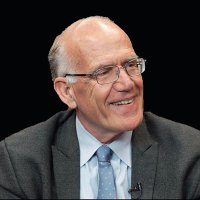
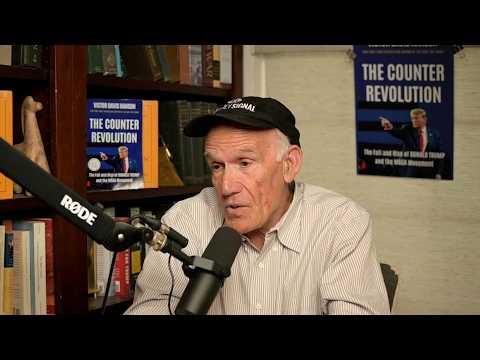
Victor Davis Hanson

Victor Davis Hanson argues that Trump’s Iran policy is about buying time: keep oil flowing, avoid a broader war, preserve political room before the midterms, and then hit Iran disproportionately if it breaks any deal. He also defends Israel’s tactics against Hezbollah, criticizes Tucker Carlson’s defense of Graham Platner, and says Gavin Newsom’s family-finance investigation could become politically damaging.

Watch on YouTube ›

Get the market thesis, key claims, assets, contradictions, and follow-up questions from any financial video — then unlock a version personalized to your portfolio, watchlist, and favorite speakers.

Detailed summary

This episode is mostly a long-form political and geopolitical commentary rather than a market-centric discussion. The core thesis is that Trump’s recent pressure on Iran should be read as a tactical memorandum, not a final peace settlement: Hanson says the goal is to keep the Strait of Hormuz open, push oil prices lower, avoid a recession, and preserve Trump’s political strength through the midterms. He repeatedly frames the approach as “disproportionate” deterrence rather than proportional retaliation, arguing that Iran has been militarily humiliated but not strategically defeated. Hanson supports that view by invoking several historical analogies. …

🔒 The full detailed summary continues — read all of it free with an account. Read the full summary →

Main takeaways

  1. Trump’s Iran posture is framed as tactical deterrence: keep the Strait open, lower oil, avoid recession, preserve political room.
  2. Hanson thinks Israel is acting to prevent persistent rocket/drone threats, not to wage indiscriminate destruction.
  3. He argues Iran has been militarily weakened but not strategically broken.
  4. The deal/memorandum is presented as temporary leverage, not a durable settlement.
  5. He sees the midterms as pivotal because a Trump loss would trigger investigations and policy paralysis.
  6. He believes Tucker Carlson has become fixated on Israel to the point of ignoring broader conservative goals.
  7. He thinks Newsom’s financial investigations could materially weaken his political image.
  8. Europe, especially Italy and others, is portrayed as posturing publicly while depending on U.S. power privately.

Market read by horizon

Short term

Near term, the actionable setup is geopolitical volatility around Iran and the Strait of Hormuz, with oil and inflation the main market transmission. Hanson expects Trump to prioritize calming energy prices while keeping the option for fast, disproportionate retaliation if Iran/proxies escalate.

  • Watch oil and gas prices; Hanson says Trump’s immediate aim is to keep energy flowing and lower inflation pressure.
Show more
  • The key near-term risk is any disruption in the Strait of Hormuz or escalation with Hezbollah/Iran.
  • If Iran or proxies break the deal, Hanson expects quick, disproportionate strikes on missiles, infrastructure, or command sites.
Mid term

Over the next few months, the base case in the transcript is a managed standoff: deterrence, selective strikes, and gradual adaptation by Gulf exporters and allies. The key confirmation signals are whether oil stays contained, Iran’s proxies remain degraded, and Trump avoids a broader war before the midterms.

  • Over the next several weeks to months, Hanson expects pressure on Iran to continue through selective strikes and economic isolation rather than invasion.
Show more
  • His base case is that Iran remains weakened, while Gulf states and alternative pipelines gradually reduce the strategic value of the Strait.
  • He thinks the administration’s credibility depends on keeping oil stable and showing that Iran cannot freely rearm proxies.
Long term

Structurally, Hanson is arguing that U.S. and Israeli power still work when applied asymmetrically and that hostile regimes are weakened by sustained pressure rather than negotiated parity. The longer-term implication is a Western bloc that increasingly relies on energy redundancy, missile-defense networks, and anti-proxy deterrence rather than occupation.

  • Hanson’s structural thesis is that disproportionate force, not proportionality, is what deters hostile regimes in the Middle East.
Show more
  • He thinks Iran’s regime is strategically brittle because it faces internal unrest, degraded proxies, and alternative export routes that weaken leverage.
  • He sees Israel as a long-term security asset for the U.S., both as a democratic ally and as a battlefield testbed for American weapons.
Unlock the full horizon read See the full short-term, mid-term, and long-term implications with confirmation and invalidation signals. Unlock horizon read

Key claims (12)

BULLISH Middle East geopolitics

Israel's military operations against Hezbollah have uncovered an extensive tunnel network and command headquarters, showing they are making inroads.

Speaker cites a specific recent discovery of a command headquarters in a tunnel network as evidence of progress.

BEARISH US politics

If Trump loses the 2026 midterms, Democrats will impeach him and subpoena all Trump family members, creating chaos.

Speaker cites historical midterm pattern (37 of 41) to predict President Trump will lose House/Senate, triggering political retaliation.

BEARISH Energy security / Middle East geopolitics Oil

In 2-3 years, the Strait of Hormuz will become a strategic liability for Iran rather than an asset because alternative pipeline routes will bypass it.

Speaker argues that new pipeline infrastructure will render Iranian control of the strait irrelevant.

Unlock 9 more claims See the full bullish, bearish, and counter-consensus argument map extracted from the transcript. Unlock all claims

Assets discussed (9)

Iran
BEARISH other

Discussed as strategically weakened but still dangerous; Hanson says it faces pressure, proxy degradation, and no good options if the U.S. keeps the Strait open.

Hezbollah
BEARISH other

Presented as an Iranian proxy that is damaged and under pressure, though still capable of rocket and drone attacks.

Unlock the full asset map (7 more) See all assets mentioned, their directional bias, and the exact reasoning. Unlock asset map

Interview (18 Q&A)

Trump statements on Iran/Israel

What do you make of Donald Trump's recent statements about Iran, Hezbollah, and Israel?

Victor argues Trump's statement to Iran to stop interfering in Lebanon is an admission that Hezbollah is Iran's proxy. He explains Israel has adopted a disproportionate response policy similar to how the US has historically responded. He criticizes JD Vance's claim that Israel 'blows up buildings,' noting they use low-payload precision bombs to hit individual floors. Victor says Israel cannot use proportional response against Hezbollah because Hezbollah doesn't care about Lebanese civilians while Israel cares about its own citizens. He also notes that US aid to Israel mostly buys American weapons which Israel battle-tests, providing valuable feedback to the US.

Iran strategy

Why does he think Trump is focused on the Iran deal and energy prices rather than a full-scale war?

He says Trump is worried about inflation, gas prices, and avoiding a recession, and that he does not want a full-scale war in the Middle East. The speaker argues Trump keeps negotiating because he wants the nuclear threat reduced without causing a recession or American casualties.

Iran conflict

What is the difference between military defeat and strategic defeat in Iran?

He says Iran has been militarily humiliated and defeated, but not strategically defeated. In his view, strategic defeat would require either invading and occupying Iran, or bombing it back to the stone age, neither of which he thinks is sustainable or politically viable.

Unlock the full interview (15 more Q&A) Every question, answer summary, and YouTube timestamp. Unlock full Q&A

Where this transcript pushes against consensus

  • Hanson treats the memorandum with Iran as strategically sound, but he gives little evidence that the implied coercive model will actually work without escalation.
  • He repeatedly claims Israel can keep striking “disproportionately” without major blowback, but offers limited evidence on civilian, diplomatic, or operational limits.
  • His argument that the Gulf states and alternate pipelines will make the Strait of Hormuz less important is plausible but presented as near-certain and fast-moving without much support.
  • The claim that Tucker’s views are mainly driven by obsession with Jews/Israel is speculative and psychologically inferential rather than evidenced.
  • His political forecast that Trump has a 40/60 chance of winning the midterms is asserted without methodology.
  • The comments on Platner’s tattoo history rely on disputed personal allegations and strong interpretive leaps about intent.

Topics

Iran policyTrump and the midtermsIsrael-Hezbollah conflictoil prices and Strait of HormuzTucker Carlson and Graham PlatnerGavin Newsom investigationEuropean allies and NATOObama library and Democratic image-makingtattoos and SS symbolismU.S. political polarization

Create your free research agent

Unlock the full claims, asset map, scores, related transcripts, follow-up questions, and AI chat — shaped around your portfolio, watchlist, favorite speakers, and risks.
  • Full claims and asset map
  • Personalized relevance to your watchlist
  • Follow-up questions you can track
  • Related transcripts from your workspace
  • AI chat about this video
Create your free research agent
TRANSCRIPTAGENT.AI