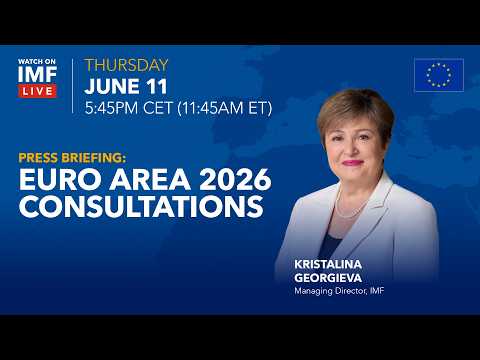
IMF and IMFC leaders said the Middle East conflict has created a persistent global supply shock, with the main market risk hinging on whether the Strait of Hormuz stays open and whether physical oil logistics normalize. They also highlighted new financing needs for vulnerable countries, stronger IMF governance reforms, and renewed IMF engagement with Venezuela.
Watch on YouTube ›Get the market thesis, key claims, assets, contradictions, and follow-up questions from any financial video — then unlock a version personalized to your portfolio, watchlist, and favorite speakers.
This IMFC press briefing was led by the IMF Managing Director Kristalina Georgieva and the IMFC Chair, Saudi Finance Minister Mohammed Al-Jadaan. The opening remarks focused on three broad themes: the global macro fallout from Middle East geopolitical shocks, the IMF’s policy response to rising country financing needs, and governance reform at the Fund. Al-Jadaan said the world economy is facing a “new normal” of persistent uncertainty and emphasized that shock-prone conditions require countries to become more agile, proactive, and reform-oriented. He stressed that any new debt should improve potential output without worsening debt sustainability, and he reiterated support for central bank independence and clear communication to anchor inflation expectations. …
Near term, the market setup stays fragile until physical shipping, insurance, and tanker flow in the Strait of Hormuz are clearly normal again. Headline calm is not enough; if logistics remain constrained, energy and inflation risk can reprice fast.
Over the next few weeks and months, the base case is still elevated global macro volatility with possible IMF program augmentations and new financing packages, especially for weaker economies. Confirmation would come from durable de-escalation and restored physical flows; otherwise the growth/inflation mix likely worsens.
Structurally, the briefing points to a world where geopolitical shocks are a recurring input to macro policy, not an exception. That favors institutions, reserves, fiscal discipline, and credible monetary frameworks over aggressive, untargeted stimulus.
The world economy is operating in a new normal of persistent uncertainty driven by geopolitical developments in the Middle East.
Al-Jadaan said the global economy is being tested again by Middle East developments and called it a persistent uncertainty.
The Middle East conflict poses a serious global supply shock that will affect growth and inflation even if it ends quickly.
Georgieva explicitly said the supply shock remains serious even if the conflict ends tomorrow.
Every day tanker movements are delayed, the economic cost rises and the scenario becomes more adverse.
She linked delay directly to delayed deliveries and worsening macro outcomes.
Can the IMF now ascertain that we are operating in the best-case scenario of a short-lived conflict, or will the fund continue baking significant geopolitical risk into its baseline?
Georgieva agrees with Al-Jadaan that the positive development helps reduce anxiety and uncertainty but does not eliminate it. The IMF retains its outlined scenarios, with the most optimistic (3.1% GDP growth) still possible, but acknowledges sliding beyond that optimistic point is possible, hopefully not too far toward the adverse scenario.
When should Venezuela expect an IMF mission to assess the country's needs and what is the IMF ready to provide to help normalize the economy?
The Venezuelan economy contracted by 2/3, 8 million people left, inflation is in triple digits. The IMF has been approached by Venezuelan authorities and is already in low-level technical contact with the Ministry of Finance, Central Bank, and Statistical Agency. Three priorities: data adequacy (which falls very short), capacity building for institutions, and likely a financial support program. The IMF will move very swiftly, working closely with the World Bank and Inter-American Development Bank.
Unlock the full claims, asset map, scores, related transcripts, follow-up questions, and AI chat — shaped around your portfolio, watchlist, favorite speakers, and risks.