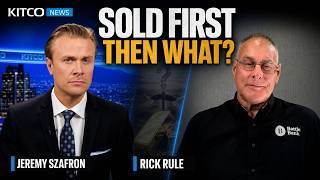
Rick Rule argues the near-term setup for gold is vulnerable because higher U.S. rates would likely strengthen the dollar and pressure dollar-denominated assets, including gold. But he maintains the longer-term thesis remains intact because he expects the U.S. political system to eventually capitulate to debt-service pressure, force rates lower, and monetize deficits, which should be supportive of gold and precious metals.
Watch on YouTube ›Get the market thesis, key claims, assets, contradictions, and follow-up questions from any financial video — then unlock a version personalized to your portfolio, watchlist, and favorite speakers.
Rick Rule’s core message is that gold can correct sharply even inside a long secular bull market, and that the current pullback should be viewed through the lens of policy, real rates, and liquidity rather than simple headline inflation. He says the near term looks negative for gold because U.S. policymakers may allow rates to move higher, which would strengthen the dollar and pressure gold and other dollar-denominated assets. But he argues that higher rates are politically and fiscally unsustainable given the scale of U.S. debt and unfunded liabilities, so he expects eventual capitulation, lower rates, and monetization that would be structurally bullish for gold. He leans heavily on a 1975 analogy. In his view, the key lesson is not just that gold can drop hard during a bull market, but that the political class eventually backs down when the economic pain becomes too high. …
Tactically, gold looks fragile while U.S. rates and the dollar may still grind higher, so the immediate setup is vulnerable to further downside or chop. A sudden liquidity event could force a first-leg selloff in metals, even if it later becomes bullish for them.
Over the next few months, the base case is a volatile precious-metals correction followed by a test of whether policy makers back off rate pressure as debt-service stress builds. If that happens, the trade should shift from fear of higher rates to anticipation of accommodation, which would favor gold, royalty names, and eventually silver.
Structurally, Rule believes the U.S. will keep inflating away its obligations, making precious metals a long-run store of value against currency debasement. In that regime, the durable winners are likely capital-light monetizers of metal exposure, while governments and debtors benefit at savers’ expense.
The real gold trade is not about inflation itself, but about the moment policymakers decide the pain of fighting inflation is worse than inflation.
Jeremy Saffron synthesizes Rick's argument that political capitulation on rate hikes (not inflation levels) drives gold's long-term trajectory.
The US political class will capitulate on interest rate hikes by end of this year, forcing rates down and monetizing debt through quantitative easing.
Rick believes political pain from high rates (debt servicing, housing, consumer credit) will force the Fed to back down and pursue QE.
Negative real yields on the US 10-year Treasury will continue to drive a very strong gold market over time.
Rick explains the 10-year Treasury's nominal yield (~4.5%) minus CPI (~3%) produces a negative real yield, which historically drives gold higher.
Is this a moment to be nervous about gold or a moment to be buying?
Rick Rule says it depends on time preference. Near-term he's pessimistic because US policymakers may allow rates to rise, which would strengthen the dollar and reduce gold quotes. But longer-term he expects the political class will capitulate on rates and monetize debt through QE, which would be very bullish for gold. He is personally looking to increase his gold holdings.
What should investors learn from the 1975 gold correction inside a larger bull market?
Rick Rule explains that in a secular bull market for gold, you can experience cyclical declines of 50% and heavy volatility. In 1975 the political class tackled inflation by raising rates, which crushed gold from $200 to $100, but then they backed down. Those who sold at the bottom missed the subsequent rise from $100 to $850 over six years. The lesson is that the political class eventually capitulates.
Is the real gold trade about the moment policymakers decide the pain of fighting inflation is worse than inflation itself?
Rick Rule agrees, explaining that the key driver is the real interest rate — the gap between nominal yields on the 10-year Treasury and the actual inflation rate. With the 10-year yielding ~4.5% and CPI at ~3%, the real yield is negative. Until that flips to a positive real yield (as Volcker achieved in the early 80s with 16% yields vs 12% inflation), gold will remain very strong over time.
Unlock the full claims, asset map, scores, related transcripts, follow-up questions, and AI chat — shaped around your portfolio, watchlist, favorite speakers, and risks.