TranscriptAgent
Try it free
TRANSCRIPTAGENT.AI · transcript analysis

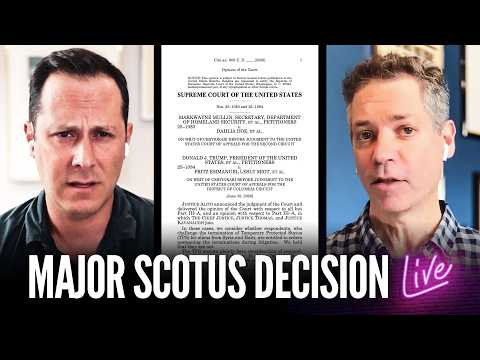
BREAKING: SCOTUS Allows Trump to Deport Hundreds of Thousands of Haitian and Syrian Refugees

Channel: The Bulwark Published: 2026-06-25 11:15
The Bulwark

The Bulwark's Sam Stein and Jonathan Conn discuss the Supreme Court's 6-3 ruling granting the Trump administration authority to end Temporary Protected Status (TPS) for roughly 350,000 Haitians and 6,100 Syrians. Justice Alito's majority held that the statute makes agency determinations non-reviewable by courts, dismissing claims of racial animus. Justice Kagan's dissent catalogued Trump's explicitly racial statements. Conn reports the decision will devastate the elderly care workforce in Florida, Ohio, New York, and Massachusetts, where Haitians are disproportionately caregivers. Congressional action — a House bill passed via discharge petition — is the only remaining recourse but faces a likely Trump veto.

Watch on YouTube ›

Get the market thesis, key claims, assets, contradictions, and follow-up questions from any financial video — then unlock a version personalized to your portfolio, watchlist, and favorite speakers.

Detailed summary

Sam Stein hosts this live reaction with Jonathan Conn, author of "The Breakdown" at The Bulwark, to the Supreme Court's 6-3 ruling in a slate of four decisions. The central case: the conservative majority held that the Trump administration has authority to end Temporary Protected Status for approximately 350,000 Haitians and 6,100 Syrians living and working legally in the U.S. Conn frames the ruling as undercovered because of the pending birthright citizenship case, but calls it "a really big decision." TPS is a designation under the 1990 immigration law allowing nationals from countries deemed lethally dangerous to live and work legally. Haitian TPS was initially granted after the 2010 earthquake and extended repeatedly over the years. The legal dispute had two prongs. First, equal protection: plaintiffs argued revocation was motivated by racial animus. …

🔒 The full detailed summary continues — read all of it free with an account. Read the full summary →

Main takeaways

  1. The Supreme Court ruled 6-3 that the Trump administration can lawfully end TPS for Haitians and Syrians, holding that the statute makes determinations non-reviewable by courts.
  2. Justice Alito's majority opinion dismissed claims of racial animus, calling Trump's statements about Haitians policy views with race-neutral justifications, and declined to quote the statements directly.
  3. Justice Kagan's dissent catalogued Trump's explicitly racial statements — 'shithole countries,' AIDS remarks, 'poisoning the blood of our country' — that Alito omitted from his opinion.
  4. The ruling effectively means DHS can violate the statute's own procedural requirements — such as consulting the State Department — without judicial remedy.
  5. Approximately 350,000 Haitians and 6,100 Syrians face loss of legal work authorization and eventual deportation.
  6. Haitians are disproportionately represented in the elderly care workforce in Florida, Ohio, New York, and Massachusetts; removing them creates an immediate labor crisis in nursing homes and home care.
  7. Congressional action is the only remaining recourse; a House bill passed via discharge petition but faces uncertain Senate prospects and a likely Trump veto.
  8. The administration may delay enforcement until after July 4th to avoid politically damaging scenes, but enforcement is expected thereafter.

Market read by horizon

Short term

Not applicable — this is a legal and policy discussion with no financial market or macro analysis. The transcript contains zero discussion of asset prices, monetary policy, economic indicators, or investment positioning.

  • Enforcement likely delayed until after July 4th as the administration wants to avoid images of ICE raids on elderly care settings before a national holiday.
Show more
  • The Haitian community in Springfield, Ohio, and South Florida is in an 'anxious holding pattern' with no immediate legal recourse available.
  • House Republicans from Florida, Ohio, and New York face immediate political cross-pressure and may push harder after the ruling; Florida senators have not yet taken a position.
Mid term

Not applicable — no market or macro framework is presented. The only economic discussion is sectoral (elderly care labor markets in specific states), not macroeconomic.

  • If enforcement begins post-July 4th, nursing homes and home-care agencies in South Florida face a rapid staffing crisis: workers lose authorization and cannot be replaced quickly at current wages.
Show more
  • Congressional path: the House-passed TPS bill needs Senate action. Florida Senators Rubio and Scott are the key pressure points. If they flip, other Republicans may follow, but Trump's signature remains the bottleneck.
  • The Medicaid cuts of approximately one trillion dollars will compound the long-term care staffing crisis regardless of immigration enforcement, reducing the sector's ability to raise wages to attract native-born workers.
Long term

Not applicable — while the transcript touches on structural tensions between demographics and immigration policy, it does not frame these in terms of investment implications, macro regimes, or asset allocation.

  • The ruling establishes a broad precedent: statutory procedural requirements agencies are supposed to follow before making immigration determinations are essentially unenforceable if the statute contains a 'non-reviewable' clause.
Show more
  • The structural tension between an aging US population requiring more care workers and immigration policy that removes a key caregiving workforce will intensify — demographics cannot be solved by enforcement alone.
  • The decision further consolidates executive power over immigration by reducing judicial checks, a shift that will outlast any single administration.
Unlock the full horizon read See the full short-term, mid-term, and long-term implications with confirmation and invalidation signals. Unlock horizon read

Key claims (6)

BEARISH Immigration policy impact on labor markets

The Supreme Court's 6-3 ruling ending TPS for Haitians and Syrians will create a labor crisis in healthcare, particularly in nursing homes and home care in South Florida.

Speaker notes Haitians make up a disproportionate share of the caregiving workforce in places they've congregated; losing working papers means they cannot work, creating a labor crisis.

BEARISH Immigration policy

The Supreme Court ruling in the TPS case establishes that the administration can violate its own procedural rules and the courts cannot review it.

The speaker summarizes Alito's majority opinion that the statute's 'determinations are not reviewable by the courts' clause means courts cannot second-guess procedural violations.

BEARISH Healthcare labor supply shock

The loss of Haitian TPS workers will ripple through the entire healthcare system as elderly people getting less care end up in hospitals and ERs.

Jonathan argues that reduced home care leads to more falls, infections, and ER visits, straining the broader healthcare system.

Unlock 3 more claims See the full bullish, bearish, and counter-consensus argument map extracted from the transcript. Unlock all claims

Interview (8 Q&A)

TPS ruling impact

Can you walk us through where you see this TPS ruling going now and its impact?

Jonathan explains it's a really big decision that's gotten less coverage due to the birthright citizenship case. He describes that over 300,000 Haitian refugees and Syrian refugees were given TPS after the 2010 earthquake, allowing them to live and work legally. Haitians make up a disproportionate share of the caregiving workforce in South Florida, New York, Massachusetts, and Ohio. Without TPS they can't stay or work, creating a labor crisis in nursing homes and home care, and they face deportation back to countries the State Department designates as among the most dangerous in the world.

Haitians next steps

What comes next for the Haitians after the Supreme Court ruling?

Jonathan notes that House Republicans in Florida did come back and vote for a bill granting TPS status, which could be the only way to keep these people in the country — Congress needs to act. He mentions two Senate Republicans in Florida who know their elderly community will be hit hard, but any bill would also need President Trump's signature, which seems implausible given his commitment to ending TPS for Haitians.

congressional recourse

Is there a way through this for the Haitians through Congress, or is this a done deal?

Jonathan says he doesn't think there's a great outlook but sees two possibilities. A bill already passed the House through a discharge petition with some Republican votes, showing real cross-pressure on Republicans from Florida, New York, and Ohio — not just from senior citizens but from business interests like nursing homes and home care companies. If Florida senators started to flip, other Republicans might follow. Getting Trump to sign it might be hard, but they could squeeze it into legislation he wants, or DHS could reverse or make a special allowance, though that's hard to imagine under a Steven Miller administration.

Unlock the full interview (5 more Q&A) Every question, answer summary, and YouTube timestamp. Unlock full Q&A

Where this transcript pushes against consensus

  • Conn and Stein assume without interrogation that there is no native-born workforce available for these care jobs. While Conn acknowledges low pay as a factor, he does not explore whether wage increases could attract workers, instead asserting immigrants would still be needed regardless. This is an economic claim presented without labor-market elasticity analysis.
  • Conn frames Roberts and Barrett as having 'changed their minds' during deliberation, but this is speculation — the actual reasoning behind their votes is unknown. They may have found the statutory non-reviewability argument compelling on its own terms.
  • The discussion treats 'racial animus' as self-evident from Trump's statements but does not engage with Alito's counter-argument that disparate-impact reasoning (all countries removed were non-white) is insufficient to prove discriminatory intent as a matter of equal protection doctrine.
  • Stein's framing of enforcement delay as motivated by avoiding 'another Minnesota scene' is plausible but unsupported — no administration source is cited. It could equally be standard operational sequencing.
  • The claim that Haiti is 'one of the most violent countries on earth right now' is stated as fact without citation to a specific metric or source, and the State Department warning is invoked anecdotally rather than quoted precisely.

Topics

Supreme Court TPS ruling for Haitians and SyriansRacial animus and equal protection in immigration lawElderly care workforce crisis in Florida and OhioExecutive authority over immigration and judicial reviewCongressional recourse via discharge petitionMedicaid cuts and long-term care fundingTrump statements on Haiti and Springfield OhioProcedural violations by DHS Secretary GnomeKagan dissent versus Alito majority opinionHumanitarian impact of mass deportation on TPS holders

Create your free research agent

Unlock the full claims, asset map, scores, related transcripts, follow-up questions, and AI chat — shaped around your portfolio, watchlist, favorite speakers, and risks.

  • Full claims and asset map
  • Personalized relevance to your watchlist
  • Follow-up questions you can track
  • Related transcripts from your workspace
  • AI chat about this video
Create your free research agent
TRANSCRIPTAGENT.AI