TranscriptAgent
Try it free
TRANSCRIPTAGENT.AI · transcript analysis

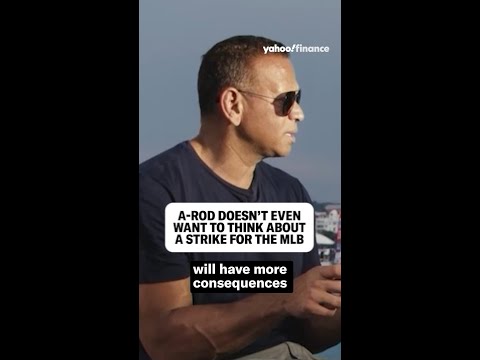
A-Rod doesn't even want to think about a strike for the MLB. ⚾️

Channel: Yahoo Finance Published: 2026-06-25 15:30
Yahoo Finance

Former MLB star Alex Rodriguez discusses the stakes of a potential MLB work stoppage, arguing that the game is at its peak popularity in 10-20 years and that both sides would end up with a worse deal if a strike occurs — because fans may not all return.

Watch on YouTube ›

Get the market thesis, key claims, assets, contradictions, and follow-up questions from any financial video — then unlock a version personalized to your portfolio, watchlist, and favorite speakers.

Detailed summary

Alex Rodriguez (A-Rod) speaks with Yahoo Finance about the risk of an MLB strike and why this season carries more consequences than any in the past century. He draws a contrast with the 1994 strike that wiped out the World Series: back then, fans had few entertainment alternatives, but today's landscape — Netflix, Amazon Prime, Apple TV, Yahoo Sports — means fan attention is far more fragile. Rodriguez, who notes he's been out of the game for about 10 years, argues the league is currently at its "height and the pinnacle" of the past decade or even two decades. His core thesis is straightforward: there's too much momentum to risk crushing it. Both labor and management would walk away with a worse deal than what they left on the table, and the real unknown is how many fans would actually come back after a stoppage. …

🔒 The full detailed summary continues — read all of it free with an account. Read the full summary →

Main takeaways

  1. A potential MLB strike would be more damaging now than in 1994 because fans have far more entertainment alternatives and may not all return
  2. MLB is at its peak popularity in 10-20 years — crushing that momentum would be self-defeating for both sides
  3. The revenue split is heavily skewed: Rodriguez characterizes it as 80% of revenue going to 10% of players, and argues unions should raise the floor
  4. Both labor and management would end up with a worse deal post-strike than the deal they left on the table

Market read by horizon

Short term

No macro market read — this is a sports labor segment with no equities, rates, FX, or commodity content.

  • The immediate takeaway is that Rodríguez sees an active strike risk for this MLB season, and frames the stakes as uniquely high — more consequential than any season in the past century.
Mid term

No macro market read — the transcript contains no discussion of economic data, Fed policy, or asset markets.

  • If a strike materializes, he expects both sides to end up with a worse deal than what was originally on the table, and the critical variable in the weeks/months after would be fan return rate — which he sees as uncertain and not guaranteed.
Long term

No macro market read — no structural market thesis is present. The only structural argument is about MLB labor economics, which does not translate to a macro regime view.

  • Structurally, he identifies a league revenue distribution problem where the bottom-tier players capture too little, implying that without a more democratic union approach, the game's labor model will remain fragile beyond any single negotiation cycle.

Key claims (3)

BEARISH labor relations

A Major League Baseball strike this season would cause permanent fan loss and result in both owners and players getting a worse deal than if they negotiated without a work stoppage.

The speaker argues there is too much momentum in the sport's current popularity peak and a strike would crush it, with fans potentially not returning as they did after the 1994 strike.

BULLISH

The current era is the pinnacle of baseball's popularity in the last 10 to 20 years.

The speaker observes that the game is at its highest point based on his perspective having left the game 10 years ago.

BEARISH income inequality

Major League Baseball currently has an extreme revenue concentration where 80% of revenue goes to 10% of the players.

The speaker states this as a fact about the current distribution of player compensation in MLB, using it to argue for raising the floor for lower-paid players.

Assets discussed (3)

Netflix — NFLX
NEUTRAL stock

Mentioned only as an example of competing entertainment options that didn't exist during the 1994 MLB strike — not as an investment thesis

Amazon — AMZN
NEUTRAL stock

Mentioned as Amazon Prime, an entertainment alternative — not as an investment call

Unlock the full asset map (1 more) See all assets mentioned, their directional bias, and the exact reasoning. Unlock asset map

Where this transcript pushes against consensus

  • The '80% of revenue goes to 10% of players' claim is an evocative round number — Rodriguez provides no source or methodology, and it is unclear whether he means total MLB revenue or player compensation specifically
  • He asserts MLB is at 'the height and the pinnacle' of the game over the past 10-20 years without citing any metric (attendance, revenue, ratings, cultural relevance), leaving the claim unsupported
  • The argument that 'both ends end up with a worse deal' is stated as near-certainty but with no walk-through of negotiation dynamics or historical precedent to back it
  • He defers the 'complicated things at the top' to 'really smart people' rather than engaging with the actual tradeoffs, which weakens the analytical depth of the segment

Topics

MLB strike risksports labor economicsfan attention and entertainment competitionunion dynamics and revenue distribution1994 MLB strike comparison

Create your free research agent

Unlock the full claims, asset map, scores, related transcripts, follow-up questions, and AI chat — shaped around your portfolio, watchlist, favorite speakers, and risks.

  • Full claims and asset map
  • Personalized relevance to your watchlist
  • Follow-up questions you can track
  • Related transcripts from your workspace
  • AI chat about this video
Create your free research agent
TRANSCRIPTAGENT.AI