
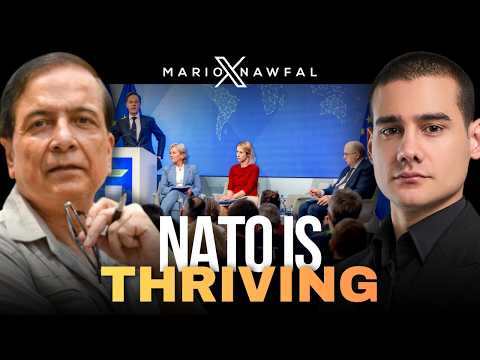
Defence analyst Pravin Sawhney discusses Turkey's strategic repositioning between NATO and a new West Asian security architecture. He argues Turkey under Erdogan is playing both sides — participating in NATO (which needs European funding to survive) while integrating into a regional framework with Pakistan, Iran, Saudi Arabia, and Egypt. The upcoming NATO summit in Ankara (July 6-7) with Trump attending is framed as pivotal. The conversation also covers the "middle corridor" trade route through Central Asia, Pakistan's evolution from facilitator to regional mediator, and dismisses speculation about Israeli assassination attempts in Pakistan.
Watch on YouTube ›Get the market thesis, key claims, assets, contradictions, and follow-up questions from any financial video — then unlock a version personalized to your portfolio, watchlist, and favorite speakers.
Defence analyst Pravin Sawhney joined Mario Nawfal to discuss Turkey's evolving geopolitical strategy at the intersection of NATO dynamics and a reconfigured West Asian order. Sawhney opens by framing NATO's existential dilemma: the alliance "has no business to exist at all" but persists because Mark Rutte is making the case that without American participation, "NATO is nothing." Europeans have committed roughly $1.3 trillion since Trump's first term, and the expectation is they will do more heavy lifting — essentially funding the alliance and buying American arms. This NATO dynamic forms the first of three factors shaping Turkey's position. The second factor is the emerging West Asian security architecture — a regional framework for regional solutions. …
Neutral to cautiously bullish on NATO cohesion ahead of the Ankara summit, with Trump's attendance signaling continued US commitment despite transactional rhetoric; Turkey's dual-track posture creates short-term uncertainty around alliance unity.
Bearish on NATO's southern-flank coherence as Turkey deepens its West Asia integration; the middle corridor and Islamabad MOU represent structural alternatives that could pull Ankara further from Atlantic alignment over months, especially if the Azerbaijan-Armenia truce holds and trade routes mature.
Structurally bullish on Eurasian integration outside Western-led frameworks — the convergence of South Asia, Central Asia, and West Asia into a single security-economic bloc, if realized, would represent a durable shift in the global order that diminishes NATO's relevance east of the Bosporus.
Turkey under Erdogan has concluded it must be a regional player in West Asia and extend influence into Central Asian republics.
Speaker infers Erdogan's strategic calculus based on Turkey's positioning across NATO, West Asia security architecture, and the South Caucasus/middle corridor.
Without America, NATO is nothing.
Speaker asserts that NATO has no independent capability or relevance without the United States.
Pakistan's role has escalated from facilitator to mediator to regional player, enabling it to bring together OIC countries in West Asia.
Speaker cites Pakistan's role in the Iran-US talks in Switzerland, the Islamabad summit, and Raisi's visit with a $10 billion trade deal as evidence.
Is Zang-Zang the corridor you're referring to?
The guest confirms yes, that's right, and continues explaining that Turkey sits in the middle of the corridor connecting Central Asia through Azerbaijan and either Armenia or Georgia.
Is Trump going to the NATO summit in Ankara as a favor for Erdogan?
The guest simply agrees 'Yeah' and continues his broader analysis about Turkey playing its cards well.
What is Israel going to do about the strengthening alignment of Turkey, Iran, and Pakistan?
The guest addresses two issues raised. First, he dismisses the assassination claim about Pakistani leadership, saying he doesn't believe it at all because the ISI is very good and as capable as Mossad. He notes the ISI handled two superpowers in Afghanistan. Second, he does not directly address what Israel will do geopolitically beyond rejecting the assassination theory.
Unlock the full claims, asset map, scores, related transcripts, follow-up questions, and AI chat — shaped around your portfolio, watchlist, favorite speakers, and risks.
