
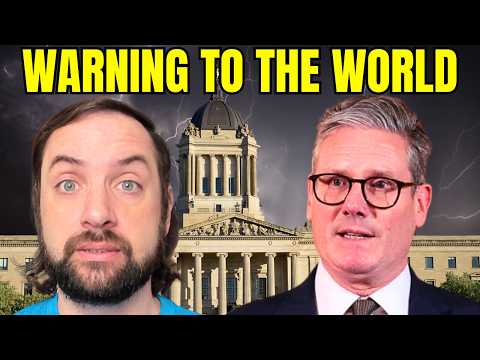
The speaker argues the UK Labour government's collapse — less than two years after a landslide win — is a global warning: political instability will keep accelerating because the economy hasn't genuinely improved for ordinary voters. He contends that GDP and stock markets are misleading indicators, that politicians on both sides make empty promises they cannot keep, and that the only honest path is admitting prices will never return to pre-pandemic levels and governments cannot fix what they broke.
Watch on YouTube ›Get the market thesis, key claims, assets, contradictions, and follow-up questions from any financial video — then unlock a version personalized to your portfolio, watchlist, and favorite speakers.
The speaker frames the current crisis engulfing UK Prime Minister Keir Starmer's Labour government as far more than a political scandal. The immediate trigger — an ill-advised ambassadorial appointment tied to the Jeffrey Epstein matter — is dismissed as the surface-level story. The real issue, he argues, is structural and global: voters everywhere are fed up because the economy has not genuinely improved for them, and they are now holding politicians to their promises with unprecedented intensity. He walks through the recent UK political timeline. Rishi Sunak took over from Liz Truss in 2022 promising to vanquish inflation, but voters interpreted that as bringing prices back down — something the speaker insists is economically impossible after the lockdown-induced supply shock. …
Near-term tactical bias is sharply risk-off on UK assets and political stability: accelerating payroll losses, rising unemployment to 5.1%, and potential Q4 GDP contraction create a deteriorating backdrop with no visible catalyst for reversal. The speaker implies continued political turmoil is nearly certain in the coming months.
Medium-term view is structurally bearish on incumbent political establishments globally, with the UK as the leading edge: the pattern of voters cycling through parties without economic improvement suggests Reform UK or similar anti-establishment forces will continue gaining, and this template could spread to US midterms and other elections through 2026–2027.
Long-term structural thesis: the post-2020 economy has entered a regime where traditional metrics (GDP, equities) are permanently decoupled from labor market health for median voters, and political systems will experience accelerating instability until either (a) politicians admit their limits honestly, or (b) something systemic breaks — the speaker leans toward (b) as the more likely path.
GDP has been positive for seven straight quarters in the UK but this positive GDP is meaningless — it does not reflect genuine economic growth because the country is still losing employment.
Points to the divergence between positive GDP prints and falling payrolls to argue GDP is a misleading metric.
Stock market levels (global equity indexes) have no relationship to economic reality — stocks have been soaring since 2022 while the global economy has only gotten worse.
Observational claim about the divergence between equity market performance and broad economic conditions since 2022.
The UK Labor government under Keir Starmer is even less popular than the previous Conservative government under Rishi Sunak was at its low point, with Starmer holding a 75-80% unfavorable rating.
Cites polling data showing Starmer's unfavorable rating and that the Labor government is viewed with similar hostility.
Unlock the full claims, asset map, scores, related transcripts, follow-up questions, and AI chat — shaped around your portfolio, watchlist, favorite speakers, and risks.
