TranscriptAgent
Try it free
TRANSCRIPTAGENT.AI · transcript analysis

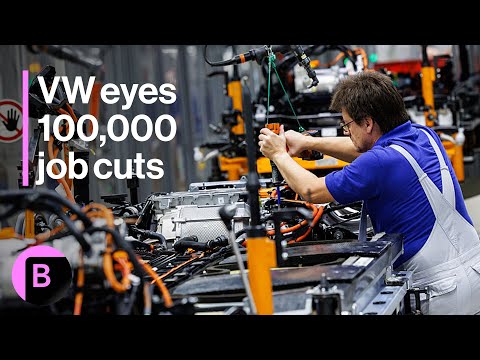
VW Eyes as Many as 100,000 Job Cuts

Channel: Bloomberg Television Published: 2026-06-26 04:53
Bloomberg Television

Bloomberg reports on Volkswagen's reported plan to cut up to 100,000 jobs and close plants, driven by a broken export business model. The Chinese market — VW's largest — is declining as local manufacturers take share, while Chinese carmakers simultaneously hit record 10%+ market share in Europe, led by hybrid vehicles that skirt EU EV tariffs. The EU is considering extending tariffs to hybrids and pushing "Made in Europe" production requirements under the Industrial Accelerator Act.

Watch on YouTube ›

Get the market thesis, key claims, assets, contradictions, and follow-up questions from any financial video — then unlock a version personalized to your portfolio, watchlist, and favorite speakers.

Detailed summary

Bloomberg Television anchors break down two converging stories around Volkswagen's deepening crisis. The first segment covers the reported plan for up to 100,000 job cuts and plant closures at VW. The anchor notes that CEO Oliver Blume has been signaling for weeks that VW's fundamental business model — developing and building cars in Germany for export worldwide — is no longer viable. Three structural pressures are cited: the Chinese market (VW's largest) is in structural decline as domestic manufacturers capture buying appetite; European consumers are weak ("on the back foot"); and regulatory burdens are mounting. VW has been trying to slim down since at least 2024, but those earlier efficiency plans are now acknowledged as insufficient to compete against export-focused Chinese manufacturers pushing into Europe. …

🔒 The full detailed summary continues — read all of it free with an account. Read the full summary →

Main takeaways

  1. VW is reportedly planning up to 100,000 job cuts and plant closures, with CEO Oliver Blume signaling the company's traditional export model is broken
  2. Chinese market — VW's largest — is in structural decline as local manufacturers dominate buying appetite
  3. Chinese carmakers hit record 10%+ European market share, led by hybrids that avoid EU EV tariffs
  4. EU considering extending tariffs to hybrid vehicles and pushing 'Made in Europe' production requirements under the Industrial Accelerator Act
  5. Some Chinese manufacturers (including BYD) have already pre-positioned with European production deals to get ahead of potential policy changes

Market read by horizon

Short term

Near-term: European auto sector faces headline risk from VW restructuring announcements and potential labor backlash; any EU tariff extension to hybrids would be a positive catalyst for European automakers but timing is uncertain.

  • VW job cut announcement faces immediate negotiation friction with German labor representatives — expect watered-down numbers in the near term
Show more
  • EU policy on extending tariffs to Chinese hybrid/plug-in vehicles is at the rumor stage; any formal proposal would be a catalyst for European auto stocks
  • Chinese manufacturers' shift to hybrids is a tactical adaptation to existing EV tariffs — watch whether EU moves fast enough to close this loophole
Mid term

Medium-term: European auto profitability path depends on whether policy (tariffs + local content rules) can slow Chinese market share gains faster than the structural cost disadvantage of European manufacturing erodes margins.

  • The 2024 VW efficiency plan has already been declared insufficient; the next restructuring round will determine whether VW can defend European share against Chinese imports
Show more
  • 'Made in Europe' production requirements under the Industrial Accelerator Act would reshape the competitive landscape — forcing Chinese manufacturers to build locally, changing the cost equation
  • If tariffs extend to hybrids, the competitive advantage Chinese manufacturers currently enjoy in that segment would narrow, potentially slowing their market share gains
Long term

Long-term: The European auto industry is undergoing a structural downsizing of its global footprint, consistent with a broader deindustrialization thesis for high-cost manufacturing economies facing capable Asian competition.

  • VW's crisis reflects a structural regime shift: the era of European automakers exporting globally from high-cost German manufacturing bases is ending
Show more
  • Chinese automakers are following the Japanese/Korean playbook — moving from exports to local production in target markets to neutralize political and tariff risk
  • European auto industry faces a permanent re-rating as it transitions from global exporter to regional player competing on home turf against well-capitalized Chinese entrants

Key claims (3)

BEARISH European auto industry competitiveness VOW3.DE

Volkswagen's business model of developing and building cars in Germany for worldwide export is no longer viable.

The CEO Oliver Blume has been emphasizing this, citing multiple headwinds.

BULLISH Chinese auto market share in Europe

Chinese car manufacturers achieved a record market share in Europe, surpassing 10% for the first time.

The speaker reports this as the latest data figure, with the surge led by hybrid cars.

BEARISH EU auto trade policy

The EU could impose tariffs on hybrid and plug-in vehicles or require manufacturers to make more vehicles in Europe.

The speaker notes this as a potential EU response, possibly being discussed already, as part of the Industrial Accelerator Act.

Assets discussed (3)

Volkswagen — VOW3.DE
BEARISH stock

Reported plan for up to 100,000 job cuts and plant closures; CEO says export business model is broken; facing Chinese competition in both China and Europe

BYD — 1211.HK
BULLISH stock

Among Chinese manufacturers striking European production deals to get ahead of potential Made in Europe requirements

Unlock the full asset map (1 more) See all assets mentioned, their directional bias, and the exact reasoning. Unlock asset map

Speakers

GUEST Various speakers (Bloomberg Television) INTERVIEWER Interviewer (Bloomberg Television)

Interview (1 Q&A)

VW model

Why does Volkswagen think its current business model is no longer working?

The company says the model of building cars in Europe, in Germany, for export worldwide is under pressure. The speaker points to declining demand in China, stronger local Chinese manufacturers, weak European consumers, and heavy regulatory burdens in Europe.

Where this transcript pushes against consensus

  • The report mentions VW 'eyes' up to 100,000 job cuts — but the anchor immediately notes these plans 'get watered down when the labor representatives get involved,' making the headline number potentially misleading as an actual outcome
  • The transcript contains a garbled passage ('Chinese menu five times in a tab because they're able') and an apparent transcription error ('70s' likely meaning BYD), making parts of the source material unreliable for precise claims
  • The segment presents the Chinese market as 'in decline' without distinguishing between overall market contraction vs. VW-specific market share loss — these are different problems with different implications
  • No distinction is made between VW brand specifically vs. the broader Volkswagen Group (Audi, Porsche, Skoda, SEAT), which have different China exposures and competitive positions

Topics

Volkswagen restructuring and job cutsChinese auto market decline for legacy OEMsChinese carmaker expansion into EuropeEU trade policy and tariffs on Chinese vehiclesEuropean auto industry competitivenessHybrid vehicle market dynamicsEU Industrial Accelerator Act and Made in Europe requirements

Create your free research agent

Unlock the full claims, asset map, scores, related transcripts, follow-up questions, and AI chat — shaped around your portfolio, watchlist, favorite speakers, and risks.

  • Full claims and asset map
  • Personalized relevance to your watchlist
  • Follow-up questions you can track
  • Related transcripts from your workspace
  • AI chat about this video
Create your free research agent
TRANSCRIPTAGENT.AI