TranscriptAgent
Try it free
TRANSCRIPTAGENT.AI · transcript analysis

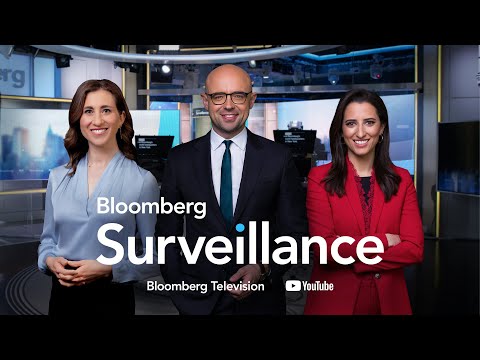
Bloomberg Surveillance 6/26/2026

Channel: Bloomberg Television Published: 2026-06-26 11:09
Bloomberg Television

Bloomberg Surveillance focused on a market rotation out of the most crowded AI/hyperscaler winners and into chipmakers, value, and other cyclical pockets, while also covering the Iran-Hormuz shipping story and its oil/inflation implications. The speakers repeatedly framed the current move as a messy but still mostly constructive reallocation of capital rather than a wholesale exit from equities, though they were more cautious on near-term tech leadership and on OpenAI’s IPO timing.

Watch on YouTube ›

Get the market thesis, key claims, assets, contradictions, and follow-up questions from any financial video — then unlock a version personalized to your portfolio, watchlist, and favorite speakers.

Detailed summary

The core thesis of the program was that the market is undergoing a messy but important rotation: the hyperscalers and Mag 7 names that powered the advance are being questioned because AI infrastructure spending is huge, capital intensive, and increasingly visible in lower multiples and weaker share prices, while chipmakers and some commodity-related names benefit from that spending. Jonathan Ferro, Dani Burger, and the guests repeatedly returned to the idea that the market is deciding whether hyperscaler capex can keep expanding fast enough to justify the returns, and whether the winners in the AI stack are shifting from the platforms to the suppliers of memory, optics, and other inputs. On the tech side, the transcript emphasized the same trade from multiple angles. …

🔒 The full detailed summary continues — read all of it free with an account. Read the full summary →

Main takeaways

  1. The dominant AI trade is being repriced from a broad Mag 7 leadership story into a more selective winners-and-losers regime.
  2. Micron, SK Hynix, Nvidia, and related suppliers are benefiting from hyperscaler capex, but the sustainability of that spend is the central question.
  3. OpenAI’s reported IPO delay was framed as both a company-specific valuation issue and a broader capital-markets timing problem.
  4. The Fed debate is shifting toward whether inflation stays sticky above 2% even as oil falls and growth remains decent.
  5. Iran’s ability to disrupt shipping through the Strait of Hormuz is being treated as a real geopolitical and market variable, even if crude has already retraced much of the wartime spike.
  6. Leverage, ETF flows, and technical positioning appear to be amplifying moves in tech and semis.
  7. Broad market participation is improving beneath the surface even as the index-level action remains dominated by large-cap tech weakness.
  8. Several guests argued the labor market is stable but not strong, with consumer spending likely to slow rather than collapse.

Market read by horizon

Short term

Near term, the setup is vulnerable in crowded AI and semiconductor names, especially if OpenAI’s IPO delay and the latest tech selloff keep pressuring sentiment. The immediate risk is that leverage and ETF flows amplify another leg down before payrolls and the next Fed signals arrive.

  • Tech remains the immediate pressure point: Nasdaq weakness, Micron down sharply, and Apple/Microsoft passing on higher costs are the day-to-day drivers.
Show more
  • Watch whether the recent selloff in hyperscaler and semiconductor names forces more de-risking from leveraged ETFs and options-heavy positions.
  • OpenAI’s potential IPO delay is a near-term sentiment hit for the whole AI complex, especially for adjacent names like Oracle and CoreWeave.
Mid term

Over the next few weeks and months, the market is likely to stay rotational rather than trendless: hyperscaler capex can still support the AI supply chain, but leadership should be narrower and more selective. The key confirmation is whether spend and earnings continue to outrun the valuation reset; if not, the trade can keep migrating toward quality, commodities, and non-tech cyclicals.

  • Over the next several weeks and months, the base case from most guests is a continued rotation within equities rather than a collapse in the whole market.
Show more
  • AI infrastructure spending likely remains a multi-quarter theme, but the market may become more selective about which parts of the value chain deserve premium multiples.
  • Confirmation would come from continued hyperscaler capex, strong revenue growth at memory/optics suppliers, and sustained enterprise adoption of AI services.
Long term

Structurally, the episode argues that AI is becoming a capital-intensive regime where the winners are not necessarily the obvious platform names. Over time, scarcity in compute, memory, networking, and physical infrastructure could matter more than the old Mag 7 narrative, while market structure itself becomes more volatile and more dispersed.

  • The transcript points to a structural shift from capital-light tech monopolies to capital-intensive AI infrastructure businesses.
Show more
  • AI may become the dividing line between winners and losers across technology, not a rising tide that lifts all boats.
  • If compute demand continues growing as forecast, semiconductors, memory, optics, networking, and physical infrastructure could remain scarce and strategically important for years.
Unlock the full horizon read See the full short-term, mid-term, and long-term implications with confirmation and invalidation signals. Unlock horizon read

Key claims (12)

BEARISH Market leverage and risk

Leverage in the market is at extreme levels, coming from record margin balances, surging options activity, and enormous leveraged ETF flows, and this leverage amplifies downside moves.

Cameron points to multiple sources of leverage — record margin balances, surging options activity, and enormous leveraged ETF flows, including from Taiwanese and South Korean investors — and argues leverage amplifies downside moves.

BEARISH Market structure / leverage / volatility

A huge surge in leverage across margin balances, options activity, and leveraged ETFs, including from Taiwanese and South Korean investors cashing in life insurance to buy semiconductor stocks, amplifies downside moves.

Cameron argues that elevated leverage across multiple sources (margin, options, leveraged ETFs, foreign retail) cuts both ways and is amplifying downside volatility.

NEUTRAL market structure / derivatives

The massive accumulation of assets under management in leveraged and single-stock ETFs, mostly in the tech/semiconductor sector, has created a short-volatility profile that exaggerates both up and down moves, increasing volatility.

Alex explains that $220B domestic and $50B Asia AUM in multiplier products concentrated in tech/semiconductors forces daily rebalancing that amplifies market moves in both directions.

Unlock 9 more claims See the full bullish, bearish, and counter-consensus argument map extracted from the transcript. Unlock all claims

Assets discussed (23)

S&P 500 — SPX
BEARISH index

Index futures were repeatedly described as down around 0.4% to 0.5% amid tech weakness.

Nasdaq — IXIC
BEARISH index

The Nasdaq was repeatedly said to be down about 1% to 1.35% on the tech selloff.

Unlock the full asset map (21 more) See all assets mentioned, their directional bias, and the exact reasoning. Unlock asset map

Speakers

GUEST Various speakers (Bloomberg Television) INTERVIEWER Interviewer (Bloomberg Television)

Interview (73 Q&A)

AI capex cycle

Is the AI capex cycle sustainable given hyperscaler stocks are getting punished while they keep spending?

AI capex sustainability

How sustainable is Apple and Microsoft's ability to pass on high costs and keep spending on AI infrastructure when their stocks are getting hammered?

OpenAI IPO

If Open AI delays its IPO, what does that mean for the rest of the market?

Unlock the full interview (70 more Q&A) Every question, answer summary, and YouTube timestamp. Unlock full Q&A

Where this transcript pushes against consensus

  • Cameron Dawson and Gregory Daco emphasized supply-side inflation and argued the Fed is more likely to wait than hike aggressively, while other segments of the show noted Bank of America, BNP, and others penciling in hikes.
  • Claudia Sahm was explicitly unconvinced inflation is returning to 2%, whereas Daco was more comfortable that inflation pressures would fade and that policy can hold steady.
  • Some guests treated the AI capex wave as a long secular cycle, while others warned the current price action and leverage look like a crowded, technically fragile trade.
  • Sarah Kunst framed the OpenAI IPO problem as mostly valuation/timing, while Ed Ludlow treated it more as part of a broader capital-markets sequencing issue with Anthropic and SpaceX.
  • Edward Fishman argued Iran’s chokepoint leverage is a durable warning to other countries, but the practical viability of that model was left unresolved and may face international pushback.
  • Jonathan Krinsky and Alex Altmann saw medium-term downside risk in tech and memory, but both still accepted that some parts of the market and some long-run AI beneficiaries could continue to do well.

Topics

AI capexhyperscalersMicron and memory chipsOpenAI IPO delayFed policy and inflationStrait of Hormuzoil pricesmarket rotationleverage and ETF flowsconsumer spending

Create your free research agent

Unlock the full claims, asset map, scores, related transcripts, follow-up questions, and AI chat — shaped around your portfolio, watchlist, favorite speakers, and risks.

  • Full claims and asset map
  • Personalized relevance to your watchlist
  • Follow-up questions you can track
  • Related transcripts from your workspace
  • AI chat about this video
Create your free research agent
TRANSCRIPTAGENT.AI