TranscriptAgent
Try it free
TRANSCRIPTAGENT.AI · transcript analysis

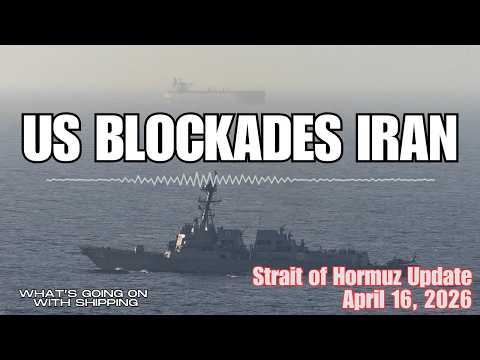
US Executes Blockade Against Iran | Turns Ships Around and Threatens to Board Iranian Ships Globally

Channel: What's Going on With Shipping? Published: 2026-04-17 12:35
What's Going on With Shipping?

The video argues that the U.S. has imposed and is actively enforcing a maritime blockade of Iranian ports and coastal waters, turning ships around and warning that vessels may be boarded and seized. The speaker frames this as a major escalation with global interdiction implications for Iranian-linked shipping and shadow fleet activity.

Watch on YouTube ›

Get the market thesis, key claims, assets, contradictions, and follow-up questions from any financial video — then unlock a version personalized to your portfolio, watchlist, and favorite speakers.

Detailed summary

Sal Mercogliano opens by identifying himself from the University of Michigan and then pivots to a breakdown of what he describes as a U.S. blockade of Iran. He says U.S. Central Command issued a warning over radio from a destroyer telling vessels to turn around, return to port, and prepare to be boarded if they try to breach the blockade. He then states that Secretary Hegseth, General Keane, and Admiral Brad Cooper briefed the Pentagon on the blockade’s initiation. The core of the video is a step-by-step explanation of how the blockade line runs from the Iran-Pakistan border to the northeast corner of Oman, effectively separating the Gulf of Oman from the Arabian Sea rather than closing the Strait of Hormuz itself. …

🔒 The full detailed summary continues — read all of it free with an account. Read the full summary →

Main takeaways

  1. The speaker treats the U.S. action as a formal blockade of Iranian ports and coastal waters, enforced by the Navy.
  2. He distinguishes the blockade zone from the Strait of Hormuz itself, saying the line runs east of the strait in the Gulf of Oman/Arabian Sea area.
  3. Ships that departed before the cutoff were allowed through; ships departing after were turned back.
  4. The enforcement posture is described as broad: boarding, seizure, and right of visit/search for Iranian-linked and suspected contraband vessels beyond the blockade zone.
  5. The speaker believes the action could materially disrupt Iranian oil exports and tighten tanker logistics.
  6. He frames the move as potentially global in scope, including pressure on shadow-fleet routes and ship-to-ship transfer hubs.
  7. He argues the situation could accelerate U.S. crude export strength and widen Middle East supply dislocations.

Market read by horizon

Short term

The immediate trade is a shipping-disruption headline regime: tanker traffic may stay suppressed and Iran-linked vessels face turn-back or boarding risk. Near-term volatility is highest around any confirmed seizure or retaliation against commercial shipping.

  • Immediate setup is an active naval enforcement event: vessels are being warned, turned around, and potentially boarded.
Show more
  • Watch for further confirmations from CENTCOM/JMEC and whether reported turn-backs continue to rise.
  • Near-term risk is escalation if U.S. forces seize tankers or if Iran responds against shipping lanes.
Mid term

Over the next few weeks, the market will likely price a narrower Iranian export window and higher friction costs for regional crude logistics if enforcement stays consistent. That view weakens if transit data normalizes or if the blockade proves more symbolic than operational.

  • Over the next several weeks, the key question is whether the blockade actually constrains Iranian exports enough to force policy concessions or a ceasefire extension.
Show more
  • A base case in the video is a continued sharp reduction in Iranian vessel movements and more operational friction around tanker traffic.
  • Confirmation would come from sustained low transit counts, more turn-backs, and materially weaker Iranian export volumes.
Long term

Structurally, the episode points to a world where naval enforcement becomes a recurring lever on energy trade and sanctions compliance. If this approach sticks, maritime risk premia and rerouting costs become a durable feature of crude markets.

  • Structurally, the video frames this as a shift toward maritime interdiction as a geopolitical tool, not just a local port closure.
Show more
  • If the U.S. really asserts right of visit/search globally against Iranian-linked shipping, that would change how sanctions enforcement works at sea.
  • The longer-run implication is a more securitized energy-shipping regime in which legal status, cargo type, and routing become central to market access.
Unlock the full horizon read See the full short-term, mid-term, and long-term implications with confirmation and invalidation signals. Unlock horizon read

Key claims (8)

BEARISH maritime security Iranian ports

The U.S. has announced and begun enforcing a formal blockade of Iranian ports and coastal areas.

Repeatedly stated as the central event and tied to CENTCOM warning language and the Pentagon briefing.

BEARISH shipping routes Strait of Hormuz

The blockade line runs from the Iran-Pakistan border to the northeast corner of Oman, not through the Strait of Hormuz itself.

He explicitly clarifies the geography using the chart shown in the video.

BEARISH maritime enforcement Iran-linked vessels

Ships that departed before the blockade were allowed to continue, while ships departing after it were turned back or challenged.

He uses several vessel examples to distinguish pre- and post-blockade departures.

Unlock 5 more claims See the full bullish, bearish, and counter-consensus argument map extracted from the transcript. Unlock all claims

Assets discussed (6)

Iranian ports and coastal areas
BEARISH other

He says the U.S. has imposed a blockade that halts vessel movements in and out of Iranian ports.

Strait of Hormuz
BEARISH other

He says traffic remains very limited and the blockade plus Iranian restrictions are choking transits near the strait.

Unlock the full asset map (4 more) See all assets mentioned, their directional bias, and the exact reasoning. Unlock asset map

Speakers

SPEAKER Sal Mercogliano

Where this transcript pushes against consensus

  • The speaker presents the blockade as a settled legal and operational fact, but the transcript does not independently verify the full legal basis or scope beyond cited advisories and news coverage.
  • He sometimes blurs distinctions between blockade, right of visit/search, and broader wartime maritime seizure powers, which are related but not identical authorities.
  • The claim that the U.S. can board Iranian-linked vessels 'regardless of location' is asserted from advisory language and press reports, but the operational limits are not fully demonstrated.
  • Some vessel examples are ambiguous: he notes uncertainty around why a ship such as Shabdis was allowed to depart.
  • The statement that the situation could push the U.S. toward net-exporter status is directionally plausible but mixes blockade effects with broader U.S. production/export dynamics.

Topics

Iran blockadeU.S. Navy enforcementStrait of Hormuzshipping interdictionoil exportstanker trafficshadow fleetcontraband and sanctionsBrent-WTI spreadglobal maritime security

Create your free research agent

Unlock the full claims, asset map, scores, related transcripts, follow-up questions, and AI chat — shaped around your portfolio, watchlist, favorite speakers, and risks.

  • Full claims and asset map
  • Personalized relevance to your watchlist
  • Follow-up questions you can track
  • Related transcripts from your workspace
  • AI chat about this video
Create your free research agent
TRANSCRIPTAGENT.AI