The ECB’s Next Move Will CRASH Markets!
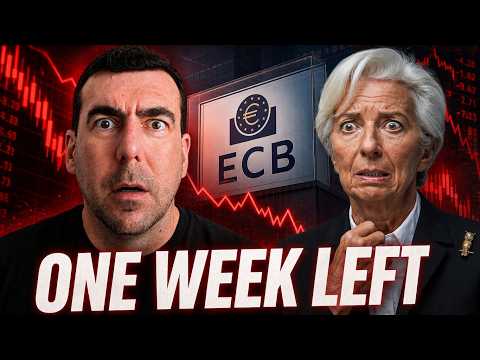
Steven Van Metre argues the ECB is about to make a major policy error by hiking rates into slowing wage growth and weakening demand, and that this could trigger a market selloff similar to past ECB tightening episodes in 2008 and 2011. He remains tactically bullish on US equities for another month or two, but says investors should hedge and start looking toward bonds if Friday’s payroll and wage data confirm slowing labor inflation.
Watch on YouTubeGet the market thesis, key claims, assets, contradictions, and follow-up questions from any financial video — then unlock a version personalized to your portfolio, watchlist, and favorite speakers.
Detailed summary
Van Metre’s core thesis is that the ECB’s expected June 11 rate hike is a mistake: inflation in the euro area is rising again, but wage growth and demand are weakening, so tightening now risks pushing Europe into recession and pressuring global markets. He frames the move as potentially the third time in history the ECB has “crash[ed] stocks,” arguing that the 2008 and 2011 hike episodes were badly timed and preceded major market declines. He repeatedly emphasizes that central banks are trying to solve an inflation problem by further suppressing demand, which he says is the wrong tool when consumers and businesses are already under strain. He supports that view with a chain of recession-style comparisons. …
Main takeaways
- ECB tightening into slowing wage growth is, in his view, a policy mistake.
- He thinks historical ECB hikes in 2008 and 2011 preceded major market weakness.
- Eurozone inflation is re-accelerating, but labor and manufacturing data look fragile.
- US equities may still have a short runway higher, but the upside is limited.
- Friday’s payroll and wage data are the key near-term confirmation point.
- He prefers hedges now and is looking at Treasuries if labor inflation keeps easing.
Market read by horizon
Near term, the market can still squeeze higher, but the setup is fragile: the key risk is that ECB hawkishness and Friday’s wage print flip sentiment fast. He is still constructive on US equities tactically, but recommends hedging and watching Treasuries for an early turn.
- ECB’s June 11 rate decision is the immediate catalyst he thinks matters most.
Show more
- Friday’s US non-farm payrolls and average hourly earnings are the key tactical data prints.
- He expects the S&P 500 and major indices can still drift higher, but only for roughly one to three months.
Over the next few weeks to months, he expects slowing wage growth and weaker demand to catch up with central banks, undermining the case for more hikes and supporting bonds. The bullish equity path only survives if labor data and consumption stay firmer than he expects.
- Over the next several weeks to months, he expects the ECB’s tightening cycle to collide with weakening demand and possibly tip Europe into recession.
Show more
- His base case is that wage growth continues to slow, which would undermine the case for further hikes in both Europe and the US.
- He thinks the US equity rally could morph into a blowoff top before vulnerability increases.
Structurally, he sees a recurring policy-error regime where central banks tighten into late-cycle weakness and amplify downturns. If that pattern persists, the lasting implication is a lower-growth, bond-friendlier environment with periodic equity drawdowns when policymakers overreact.
- He sees a recurring central-bank mistake regime: tightening into late-cycle weakness rather than supporting demand early enough.
Show more
- His broader structural thesis is that inflation scares can prompt policy errors that ultimately worsen recession and equity drawdowns.
- He suggests the labor market, not just headline inflation, is the decisive anchor for future rate policy and market direction.
Key claims (5)
The ECB raising rates in June 2025 will be a major policy mistake that crashes stocks, repeating the pattern of July 2008 and July 2011.
The speaker compares current conditions to July 2008 and July 2011 when ECB rate hikes preceded market crashes, arguing the ECB is raising rates into weakening demand.
The ECB will hike rates in June, then months later be forced to cut rates frantically as the economy enters recession, repeating the 2008 and 2011 pattern.
Speaker asserts that the ECB tightening into weakening demand will cause a recession that forces rapid rate cuts, as happened after the 2008 and 2011 hiking cycles.
Bonds are entering a bull market if average hourly earnings continue to weaken in the upcoming non-farm payroll report.
Speaker argues that weakening wage growth will validate a bond bull market ahead of new Fed chair Kevin Worsh's first address.
Assets discussed (4)

Where this transcript pushes against consensus
- The historical comparisons are selective: 2008 and 2011 were very different macro regimes, so the analogy may overstate causal similarity.
- He assumes wage growth will continue to slow, but offers limited forward-looking evidence beyond chart repetition and intuition about labor slack.
- The claim that the ECB is about to 'crash markets' is overstated relative to the more conditional evidence presented.
- He treats rising inflation and slowing wages as proof that hikes must be wrong, but does not fully address the ECB’s concern about second-round inflation persistence.
- His US equity upside window of one to three months is asserted with limited quantitative support beyond positioning and sentiment.
Topics
More from this channel
More transcripts from this channel (5 more) Your agent keeps reading new videos from this channel and flags the ones that matter. Create free agent
Create your free research agent
Unlock the full claims, asset map, scores, related transcripts, follow-up questions, and AI chat — shaped around your portfolio, watchlist, favorite speakers, and risks.
- Full claims and asset map
- Personalized relevance to your watchlist
- Follow-up questions you can track
- Related transcripts from your workspace
- AI chat about this video