TranscriptAgent
Try it free
TRANSCRIPTAGENT.AI · transcript analysis

Finances publiques : La France cancre de l’Europe !

Channel: Marc Touati Published: 2026-04-23 10:05
Marc Touati

Marc Touati argues that France’s public finances are deteriorating relative to the euro area, citing a 5.1% public deficit, 116.2% public debt-to-GDP, and a rising share of debt held by non-residents. His core warning is that France is losing financial sovereignty and could face higher rates if foreign investors pull back or rating agencies catch up to the fiscal reality.

Watch on YouTube ›

Get the market thesis, key claims, assets, contradictions, and follow-up questions from any financial video — then unlock a version personalized to your portfolio, watchlist, and favorite speakers.

Detailed summary

The speaker opens with France’s public deficit data, saying accounting “artifices” at year-end helped limit the reported number, but France is still at 5.1% of GDP and may be revised to 5.2% by INSEE. He compares France with other euro-area countries, noting Belgium at 5.2%, Slovakia next, while the euro-area average is 2.9%, and several countries are below 3% or even in surplus. He uses this comparison to argue that France is in a weak fiscal position and is struggling to restart activity because of that imbalance. He then shifts to public debt data for Q4 2025, saying Greece remains highest at 146%, Italy at 137%, and France at 116.2%, a figure revised up by Eurostat using consolidated debt. …

🔒 The full detailed summary continues — read all of it free with an account. Read the full summary →

Main takeaways

  1. France’s reported public deficit is still very high at 5.1% of GDP and may be revised up to 5.2%.
  2. France is being compared unfavorably with most euro-area peers, many of which are below 3% deficit or in surplus.
  3. French public debt is cited at 116.2% of GDP, far above Germany and most of the euro area.
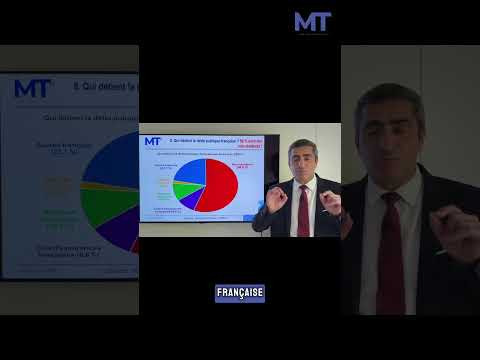
  4. Non-residents now hold 56% of French government debt, which the speaker treats as a sovereignty risk.
  5. The speaker believes foreign investor confidence could weaken and push French rates higher.
  6. Moody’s is viewed as lagging reality; a future downgrade is presented as a potential stress event.

Market read by horizon

Short term

Tactically, the setup is negative for French sovereign sentiment: the latest deficit/debt prints and rising non-resident ownership keep rate risk and downgrade chatter alive. The immediate watchpoints are any deficit revision and any market reaction in French borrowing costs.

  • Near term, the immediate risk is the market reacting to the latest deficit and debt statistics as further evidence of fiscal slippage in France.
Show more
  • Watch for any confirmation that INSEE revises the deficit up to 5.2%; that would reinforce the negative fiscal narrative.
  • The most immediate vulnerability the speaker highlights is investor perception of foreign ownership of French debt, which could matter if sentiment sours.
Mid term

Over the next few weeks to months, the likely path in this framing is continued scrutiny of France’s fiscal gap versus euro-area peers, with pressure building if the deficit stays near 5%+ and debt ownership remains foreign-heavy. The thesis weakens only if fiscal data improve materially or financing conditions stay calm despite the headline risk.

  • Over the next several weeks or months, the speaker’s base case is that France remains fiscally weaker than most euro-area peers and continues to underperform on deficit control.
Show more
  • The key confirmation signal would be persistent deficits near or above 5.2% and no meaningful improvement in the share of debt held by residents.
  • If foreign demand for French debt stays firm, the immediate fear of a sell-off is less likely; if not, the rate-risk thesis strengthens.
Long term

Structurally, the speaker is arguing that France is moving into a less sovereign financing regime, where persistent deficits and reliance on external creditors make the state more vulnerable to repricing. If that regime persists, France may carry a permanently higher risk premium than better-disciplined euro-area peers.

  • Structurally, the speaker argues that France’s fiscal model is becoming less resilient because it relies heavily on external financing.
Show more
  • The durable thesis is that persistent deficits plus high foreign ownership reduce sovereign flexibility and increase vulnerability to shocks.
  • He implies that once rating agencies or investors fully reprice that dependence, the cost of capital for France could remain structurally higher.
Unlock the full horizon read See the full short-term, mid-term, and long-term implications with confirmation and invalidation signals. Unlock horizon read

Key claims (7)

BEARISH public finances France

France’s deficit stands at 5.1% of GDP and may be revised to 5.2%.

Speaker cites current figure and expects an upward revision.

BEARISH eurozone comparison France

France is the second-worst euro-area country on deficit, behind Belgium, while the euro-area average is 2.9%.

He ranks France and Belgium and contrasts them with the euro-area average.

BEARISH public debt France

France’s public debt is 116.2% of GDP and was revised up by Eurostat using consolidated debt accounting.

He cites the latest debt number and the reason for the revision.

Unlock 4 more claims See the full bullish, bearish, and counter-consensus argument map extracted from the transcript. Unlock all claims

Assets discussed (4)

France public debt — FR sovereign debt
BEARISH bond

The speaker argues France’s debt burden and foreign ownership share are worsening and could pressure rates.

Eurostat
NEUTRAL other

Cited as the source for the debt revision and consolidation methodology.

Unlock the full asset map (2 more) See all assets mentioned, their directional bias, and the exact reasoning. Unlock asset map

Where this transcript pushes against consensus

  • The claim that the deficit is being hidden by a year-end accounting artifice is asserted without details or evidence in the transcript.
  • The statement that France ‘is losing sovereignty’ is more rhetorical than analytically demonstrated.
  • The speaker assumes non-resident holders may rapidly exit, but gives no concrete evidence of current selling pressure or imminent outflows.
  • The criticism of Moody’s as having ‘artificially’ maintained the rating is asserted, but no direct basis is provided.
  • He mentions Gulf-country investors and Macron as possible triggers, but the causal link is speculative rather than evidenced.

Topics

France public deficitFrench public debteuro area fiscal comparisonnon-resident debt holdersfinancial sovereigntyMoody's rating risk

Create your free research agent

Unlock the full claims, asset map, scores, related transcripts, follow-up questions, and AI chat — shaped around your portfolio, watchlist, favorite speakers, and risks.

  • Full claims and asset map
  • Personalized relevance to your watchlist
  • Follow-up questions you can track
  • Related transcripts from your workspace
  • AI chat about this video
Create your free research agent
TRANSCRIPTAGENT.AI