TranscriptAgent
Try it free
TRANSCRIPTAGENT.AI · transcript analysis

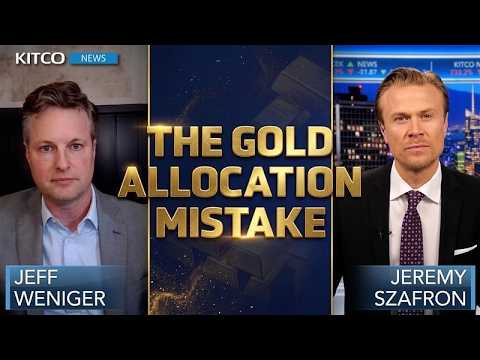
Copper Breaks $6: Why Recession Bears May Be Wrong | Jeff Weniger

Channel: Kitco NEWS Published: 2026-04-24 13:15
Kitco NEWS

Jeremy Saffron interviews Jeff Whitaker of WisdomTree about why gold, silver, and copper can still work even after their sharp pullback, arguing that most portfolios remain near-zero allocated to metals and that prior Fed easing still supports risk assets and precious metals with a lag.

Watch on YouTube ›

Get the market thesis, key claims, assets, contradictions, and follow-up questions from any financial video — then unlock a version personalized to your portfolio, watchlist, and favorite speakers.

Detailed summary

The segment opens with Jeremy Saffron framing the recent violent repricing in precious metals: gold has pulled back from a parabolic move above $5,300 and is consolidating near $4,700, while silver has fallen from around $80 to the mid-$70s but remains up year to date. He positions the discussion as a challenge to institutional portfolio assumptions and introduces Jeff Whitaker, head of equity strategy at WisdomTree, whose team argues that zero allocation to physical metals is no longer neutral because gold represents a meaningful share of the global investable universe. Whitaker’s core argument is that most investors still own no gold or silver, even after the rally, and that this underownership is the real bull case. He says financial advisors and their clients generally remain concentrated in S&P 500 tracker funds and have not meaningfully added bullion or miners, despite the move. …

🔒 The full detailed summary continues — read all of it free with an account. Read the full summary →

Main takeaways

  1. The guest’s central bull case is not price momentum alone; it is that institutional and advisor portfolios still have near-zero precious metals exposure.
  2. He argues the market is underestimating the lagged effects of 2024-2025 Fed easing on liquidity, borrowing, and risk assets.
  3. He sees the recent oil shock as less demand-destroying than past cycles because fuel efficiency and wages are much higher.
  4. Copper back above $6 is presented as evidence against an imminent recession.
  5. Gold, silver, and copper are framed as beneficiaries of a non-recessionary inflation/liquidity environment.
  6. He thinks modest gold allocations, often around 5%, are more realistic than trying to force institutions to match a 12.7% global-asset-base estimate.
  7. He is skeptical that higher nominal yields alone can end the metals thesis if bond volatility remains contained.

Market read by horizon

Short term

Tactically, the setup is a consolidation after a sharp metals run, so near-term risk is a volatility shakeout if rates or the dollar spike; the constructive trigger is continued strength in copper and stability in real yields.

  • Gold is consolidating after a sharp run and silver has pulled back from roughly $80 to the mid-$70s; the immediate question is whether the pullback is just a reset or the start of deeper de-risking.
Show more
  • The near-term catalyst is ongoing repricing around Fed policy and the market’s reaction to any new inflation or oil-shock headlines.
  • Copper reclaiming $6 is a live tactical signal for the speaker: continued strength would support the no-recession / soft-landing interpretation.
Mid term

Over the next few months, the base case is that delayed Fed easing and a non-recessionary growth backdrop keep metals supported, with the next leg depending on whether institutions start adding small allocations rather than sitting at zero.

  • Over the next several weeks to months, the base case is that prior Fed easing keeps working through credit channels and supports both risk assets and metals.
Show more
  • Validation would come from continued stability in the 10-year yield, a non-recessionary growth backdrop, and persistent strength in industrial metals like copper.
  • The guest expects gold and silver to benefit if investors gradually reassess portfolio construction and move from zero exposure toward small allocations.
Long term

Structurally, the interview argues that precious metals are re-entering the strategic portfolio conversation because 60/40 diversification has weakened and zero allocation is increasingly hard to defend in a world of policy uncertainty and persistent macro shocks.

  • Structurally, the interview argues that zero gold in a diversified portfolio is no longer neutral because the asset class is large enough to matter in global investable terms.
Show more
  • The long-term regime claim is that the classic 60/40 framework is less reliable than before, making room for hard assets in strategic allocation.
  • He suggests portfolio construction has evolved through the rise of private equity, private credit, floating-rate notes, and gold overlays, changing what “normal” risk budgeting looks like.
Unlock the full horizon read See the full short-term, mid-term, and long-term implications with confirmation and invalidation signals. Unlock horizon read

Key claims (8)

BULLISH portfolio allocation Gold

Most financial advisors and institutional portfolios still have 0% exposure to gold and gold miners.

Weniger repeatedly says advisors still do not own any gold or silver and that he sees many portfolios with zero gold and zero gold miners.

BULLISH portfolio allocation Gold

Zero allocation to precious metals is no longer a neutral portfolio position.

He frames zero gold as a structural underweight rather than a neutral stance because gold is a meaningful share of the global investable market.

BULLISH Federal Reserve policy Gold

The market is overly focused on current Fed leadership and not enough on the lagged effects of prior rate cuts.

He argues that cuts from late 2024 and late 2025 still support risk assets and metals with a long lag.

Unlock 5 more claims See the full bullish, bearish, and counter-consensus argument map extracted from the transcript. Unlock all claims

Assets discussed (9)

Gold
BULLISH commodity

Presented as structurally underowned, supported by past Fed cuts, geopolitical risk, inflation uncertainty, and portfolio diversification needs.

Silver
BULLISH commodity

Discussed as a higher-beta precious metal benefiting from the same allocation and macro forces as gold, while also having industrial exposure.

Unlock the full asset map (7 more) See all assets mentioned, their directional bias, and the exact reasoning. Unlock asset map

Speakers

HOST Jeremy Saffron GUEST Jeff Weniger

Interview (7 Q&A)

Silver demand and price action

What is happening with silver, and what is the market missing given the pullback and the surge in Chinese silver imports?

Weniger says investors were spoiled by the recent rally, that most Western portfolios own little or no silver, and that Chinese demand may reflect a broader rethink of portfolios as property no longer looks like a guaranteed path to wealth.

Investor flows

What are investors actually doing right now: are they adding gold and silver, or still sitting on the sidelines?

Weniger says ETF flows remain dominated by S&P 500 products, while gold bullion and gold miners still show surprisingly low creation activity and portfolio exposure.

Fed lag and liquidity

Why should investors still care about the liquidity effects of past easing when the curve is now pricing out rate cuts for 2026?

Weniger says the real issue is the cumulative effect of cuts already delivered, especially the late-2024 and late-2025 moves, which he believes still support risk assets and reduce opportunity cost for metals.

Unlock the full interview (4 more Q&A) Every question, answer summary, and YouTube timestamp. Unlock full Q&A

Where this transcript pushes against consensus

  • The estimate that gold equals 12.7% of the global investable asset base is treated as a portfolio anchor, but the transcript does not rigorously explain methodology or why that benchmark should translate into actual institutional weights.
  • The claim that the oil shock will not cause major demand destruction is asserted through analogies, but the evidence is largely directional and not empirically demonstrated in the conversation.
  • The argument that the Fed’s 19-month-lagged cuts are still the dominant support for metals competes with the simultaneous claim that the market is repricing toward a more hawkish curve; the transcript does not fully reconcile those forces.
  • The statement that a 5% gold allocation is broadly reasonable is persuasive as portfolio rhetoric, but the discussion does not address liquidity, implementation costs, or tax/mandate constraints in detail.
  • The claim that copper at $6 implies no recession is a useful heuristic, but it is not presented with a broader cross-asset or earnings-based confirmation set.

Topics

gold allocationsilver volatilityFed easing lagliquidity conditionsinflation and yieldsoil shockcopper rallyportfolio construction60/40 diversificationinstitutional underownership

Create your free research agent

Unlock the full claims, asset map, scores, related transcripts, follow-up questions, and AI chat — shaped around your portfolio, watchlist, favorite speakers, and risks.

  • Full claims and asset map
  • Personalized relevance to your watchlist
  • Follow-up questions you can track
  • Related transcripts from your workspace
  • AI chat about this video
Create your free research agent
TRANSCRIPTAGENT.AI