
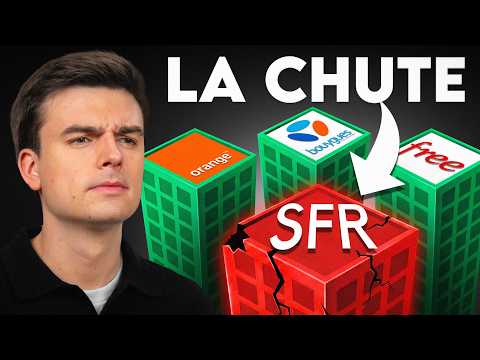
The video’s main segment argues that SFR is likely heading toward a historic breakup/sale, with Orange, Free, and Bouygues set to split its assets and customers, which could reshape French telecom pricing, competition, and jobs. The rest of the video is a news roundup covering Iran-U.S. tensions, a U.S. mass shooting, a Japan earthquake/tsunami alert, French politics, Bulgaria’s election, and student poverty.
Watch on YouTube ›Get the market thesis, key claims, assets, contradictions, and follow-up questions from any financial video — then unlock a version personalized to your portfolio, watchlist, and favorite speakers.
This episode of HugoDécrypte opens with a sponsored Revolut ad, then centers on the possible sale of SFR, described as a major French telecom reshuffle that could have broad consequences for consumers and workers. Hugo explains SFR’s history as a major competitor to France Télécom/Orange, its 2014 acquisition by Patrick Drahi’s Altice France, and how the company was burdened by debt after the purchase. He argues that the low-price war triggered by Free Mobile eroded SFR’s revenues and margins, leading to underinvestment, layoffs, and service deterioration, and now pushing Altice to seek a sale. The video says Orange, Free, and Bouygues are negotiating exclusively with Altice France to acquire SFR, with a reported offer around 20.35 billion euros and a provisional exclusivity period until May 15. …
Near term, the tradeable setup is the negotiation headline flow: any confirmation of exclusive talks, pricing, or antitrust progress can move telecom names and sentiment around competition. The immediate risk is that uncertainty over customer allocation or regulatory pushback keeps the situation unstable.
Over the next few months, the likely path is a negotiated redistribution of SFR assets if regulators allow it, which would shift the French telecom narrative toward a de facto three-player market. The key validation signal is a clean transfer plan; the key invalidation is a blocked or heavily modified transaction.
If this closes, it would be a durable consolidation event for French telecom and a case study in how leveraged ownership can end in asset sales and sector concentration. The long-run regime implication is less competition, higher barriers, and a stronger role for regulators in protecting consumers and employment.
SFR is likely to be sold soon, with Orange, Free and Bouygues dividing the business.
This is the central thesis of the first segment.
Patrick Drahi financed the SFR acquisition with debt and then used SFR’s own cash flow to repay that debt.
Explains the financing structure and why SFR was under pressure.
SFR suffered quality deterioration, job cuts, and store closures as debt repayment took priority over investment.
The speaker links the debt burden to operational decline.
Unlock the full claims, asset map, scores, related transcripts, follow-up questions, and AI chat — shaped around your portfolio, watchlist, favorite speakers, and risks.
