
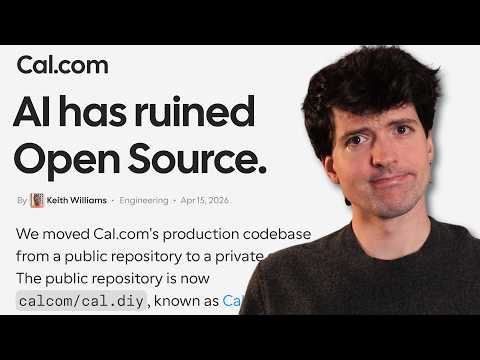
Theo argues that Cal.com going closed-source is a bad sign for open source, but he frames the decision as a security response to AI-driven exploit discovery rather than a simple anti-open-source move.
Watch on YouTube ›Get the market thesis, key claims, assets, contradictions, and follow-up questions from any financial video — then unlock a version personalized to your portfolio, watchlist, and favorite speakers.
This video is a strong opinionated monologue about open source, AI security, and Cal.com’s decision to close its core codebase. Theo says he has become more pro-open-source recently and is alarmed by a future where software gets harder to inspect, fix, and improve. He focuses on Cal.com because it was a flagship open-source TypeScript app and a showcase for the T3 stack, and he says the company’s move “terrifies” him. He also says he had private conversations with the Cal team ahead of the announcement and had hoped public pressure might prevent it. The core thesis is that AI changes the economics of security. Theo argues that large language models now make it much easier for attackers to understand codebases, especially when source code is public. …
Near term, the setup is reputational: Cal.com’s move will likely intensify debate about whether public source is now a security liability. The immediate risk is narrative contagion, where other teams interpret AI-driven exploits as a reason to restrict access rather than harden faster.
Over the next several weeks or months, the likely path is more projects adopting explicit AI-assisted hardening and review workflows, while some companies revisit open-source defaults for sensitive code. The view is validated if security tooling becomes a standard budget line; it is weakened if the community shows that public code plus stronger patching remains the better defense.
Structurally, the video argues that software security is entering a compute-arms-race era where the cost to defend must outspend the cost to attack. If that holds, open source survives only where communities and companies can fund continuous hardening at scale; otherwise more software drifts toward closed or restricted models.
Cal.com’s decision to close its source is a major setback for open source.
He says Cal was a flagship example of an open-source full-stack TypeScript app and that losing it 'sucks' and 'terrifies' him.
AI has lowered the barrier for finding real software exploits by reducing the need for domain-specific knowledge.
He argues attackers no longer need to be deep experts in both the codebase domain and security to find bugs.
Open-source code is more exposed to AI-assisted attack because models can directly read and navigate the source.
He says source code gives models the tools they need to parse systems better than deobfuscation/reverse engineering.
Unlock the full claims, asset map, scores, related transcripts, follow-up questions, and AI chat — shaped around your portfolio, watchlist, favorite speakers, and risks.
