TranscriptAgent
Try it free
TRANSCRIPTAGENT.AI · transcript analysis

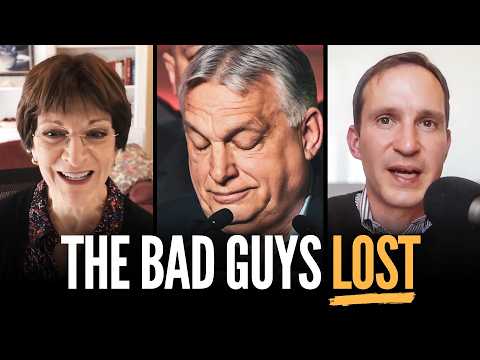
Orbán Rigged the Game—and Still Lost! (w/ Dalibor Rohac) | Mona Charen Show

Channel: The Bulwark Published: 2026-04-27 12:01
The Bulwark

A Mona Charen interview with Dalibor Rohac argues that Viktor Orbán’s Hungary was an anti-liberal, Russia-leaning system that rigged institutions yet still lost when Peter Magyar built a more local, issue-focused challenge. The discussion frames the result as important for EU unity, Ukraine, and the broader post-liberal right.

Watch on YouTube ›

Get the market thesis, key claims, assets, contradictions, and follow-up questions from any financial video — then unlock a version personalized to your portfolio, watchlist, and favorite speakers.

Detailed summary

This transcript is an interview on The Bulwark’s Mona Charen Show with Dalibor Rohac of the American Enterprise Institute about Hungary’s recent election and what it means for European politics. The conversation centers on why Hungary mattered under Viktor Orbán: as a weak link in EU unity, a vehicle for Russian influence, and a live experiment for post-liberal governance admired by parts of the US right. Rohac argues Orbán consolidated power after 2010 by using a constitutional majority to rewrite the constitution, alter electoral rules, dominate media, pressure NGOs, and run propaganda campaigns, including anti-Soros messaging. …

🔒 The full detailed summary continues — read all of it free with an account. Read the full summary →

Main takeaways

  1. Orbán’s Hungary is presented as a cautionary case of democratic backsliding, not a model of successful conservative governance.
  2. Hungary’s election mattered beyond its size because it affected EU cohesion, Ukraine aid, and the credibility of the post-liberal right.
  3. Peter Magyar won traction by campaigning on corruption, stagnation, and local engagement rather than ideological culture-war politics.
  4. Orbán’s foreign policy posture is described as pro-Russia and unusually accommodating to China and Iran, contradicting his sovereignty rhetoric.
  5. Institutional capture makes democratic cleanup difficult even after an opposition victory.

Market read by horizon

Short term

Near term, the actionable angle is political risk reduction in Hungary and possibly less friction in EU decision-making on Ukraine and sanctions. The main tactical uncertainty is how quickly the new camp can govern given Orbán’s embedded networks.

  • The immediate market-relevant setup is political, not financial: Hungary’s new direction may reduce near-term EU friction over Ukraine funding and sanctions.
Show more
  • Brussels is expected to unfreeze some of the roughly 20 billion euros in suspended EU money quickly, which would support Hungary’s fiscal position.
  • The main tactical risk is that Orbán’s entrenched appointees can still slow or dilute reforms even after the election result.
Mid term

Over the next few months, the base case is partial normalization: some EU funds likely resume, Hungary becomes less obstructive, and market pressure shifts toward execution risk rather than election risk. The view weakens if Magyar cannot translate popularity into bureaucratic control.

  • Over the next several weeks or months, the key question is whether Magyar can convert an electoral win into durable control over state institutions and policy execution.
Show more
  • If EU funds resume and economic relief follows, the new government could gain room to address inflation, debt, and stagnation more credibly.
  • The base case in the discussion is that Hungary becomes less obstructive inside the EU, especially on Ukraine-related decisions, but not instantly transformed.
Long term

Longer term, the transcript argues that illiberal governance inside EU institutions has hard limits and can lose legitimacy even after years of captured institutions. The durable lesson is that regime models imported from one country do not necessarily survive once external funding, elections, and social realities reassert themselves.

  • Structurally, the transcript treats Hungary as evidence that post-liberal governance can entrench power for a long time but still fail to deliver broad legitimacy.
Show more
  • The longer-run implication is that authoritarian-leaning populism inside EU institutions faces hard constraints: elections, funding leverage, and external alliances all matter.
  • Orbán’s loss is framed as a warning to the international right that copying his style does not guarantee durable political success.
Unlock the full horizon read See the full short-term, mid-term, and long-term implications with confirmation and invalidation signals. Unlock horizon read

Key claims (10)

BEARISH European politics and energy security

Hungary matters to Europe because it has been the weakest link in EU unity, especially on Russia and energy dependence.

Rohac says Hungary is important because of its role in blocking coherent EU responses to Russia and energy policy.

BEARISH Governance and political risk Hungary

Orbán built an authoritarian-leaning system by rewriting the constitution, changing electoral rules, and capturing media and institutions after 2010.

He describes a structural consolidation of power through legal and institutional redesign.

BEARISH Media control and political risk Hungary

Orbán’s media environment was heavily skewed against opposition parties and NGOs.

He says opposition figures struggled to get TV airtime or advertising, while media holdings were moved into a foundation close to Fidesz.

Unlock 7 more claims See the full bullish, bearish, and counter-consensus argument map extracted from the transcript. Unlock all claims

Assets discussed (4)

Hungary
MIXED other

Discussed as a political-economy case affecting EU funds, sovereign governance, and Ukraine policy; not a tradable asset but a country-risk exposure.

European Union funds
BULLISH other

Expected unfreezing of roughly 20 billion euros would support Hungary’s fiscal position and reduce near-term strain.

Unlock the full asset map (2 more) See all assets mentioned, their directional bias, and the exact reasoning. Unlock asset map

Speakers

UNKNOWN J.D. Vance UNKNOWN Donald Trump HOST Mona Charen UNKNOWN George Soros GUEST Dalibor Rohac UNKNOWN Victor Orbán UNKNOWN Péter Magyar UNKNOWN Peter Szijjarto UNKNOWN Vladimir Putin UNKNOWN Miklós Horthy

Interview (13 Q&A)

Hungary election importance

Why was Hungary's election so important?

Hungary matters because it was the weakest link in European unity on Russia's war in Ukraine and energy independence, and because under Orban's 16-year rule it served as a living experiment of post-liberal governance that the MAGA movement and intellectually sophisticated circles on America's post-liberal right could point to. The short version is that Hungarian voters ultimately were not very impressed with the result.

Orban consolidation of power

Initially, how did Orban consolidate his power?

Orban was elected in 2010 against the backdrop of the financial crisis and socialist corruption scandals. He used his constitutional majority to pass a new constitution written by party loyalists on a purely partisan line, changed the electoral law to reward parties with small pluralities, consolidated control over media (media owners donated holdings to a foundation governed by Fidesz allies), made life difficult for NGOs, launched nasty propaganda campaigns against George Soros using taxpayer-funded posters, and created an unlevel playing field for the opposition.

campaign strategy

Did Peter Magyar really campaign by going online and visiting almost every village in Hungary?

Yes. The guest says Magyar moved his campaign online, but more importantly he went to every last Hungarian village, knocking on doors and holding multiple rallies a day. The point is framed as proof that personal leadership mattered.

Unlock the full interview (10 more Q&A) Every question, answer summary, and YouTube timestamp. Unlock full Q&A

Where this transcript pushes against consensus

  • The claim that Orbán was clearly an authoritarian is asserted strongly, but the transcript gives limited granular evidence beyond institutional manipulation and propaganda.
  • The explanation for Magyar’s success leans heavily on personal energy and ground campaigning; it underweights other possible factors such as elite defections or broader dissatisfaction.
  • The suggestion that EU funding will be unfrozen very quickly is plausible but not evidenced in the transcript with specific conditions or timing.
  • The host and guest imply Magyar’s coalition can reverse Orbán’s capture, but they acknowledge institutional entrenchment without clearly explaining a workable unwind strategy.
  • The comparison with Poland is useful but only partially analogous, since constitutional, institutional, and political starting points differ.

Topics

Hungary electionViktor OrbánPeter MagyarEU unity and fundingUkraine aidauthoritarian capturepost-liberal rightRussia-China-Iran tiesmedia and judicial controldemocratic reversal

Create your free research agent

Unlock the full claims, asset map, scores, related transcripts, follow-up questions, and AI chat — shaped around your portfolio, watchlist, favorite speakers, and risks.
  • Full claims and asset map
  • Personalized relevance to your watchlist
  • Follow-up questions you can track
  • Related transcripts from your workspace
  • AI chat about this video
Create your free research agent
TRANSCRIPTAGENT.AI