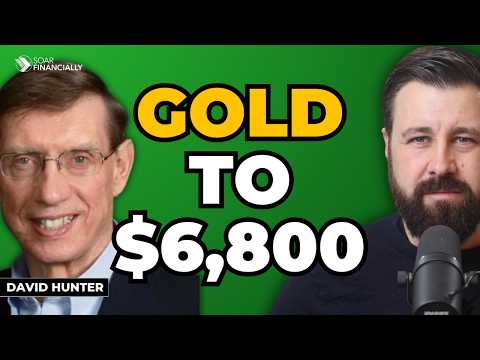
David Hunter argues the market is in a late-cycle parabolic melt-up that can still extend into summer, with the S&P 500 potentially reaching 9,500 and precious metals making another major leg higher after a correction. Beneath the near-term volatility, he sees a mixed but still resilient U.S. economy, an eventual rollover in rates and inflation, and ultimately a global bust that would force aggressive monetary easing.
Watch on YouTube ›Get the market thesis, key claims, assets, contradictions, and follow-up questions from any financial video — then unlock a version personalized to your portfolio, watchlist, and favorite speakers.
This is a macro interview with David Hunter of Contrarian Macro Advisors, framed around his long-running call for a final melt-up across equities and metals before a broader bust. Hunter says his equity target was raised to 9,500 on the S&P 500 and that he still expects that level to be reached this summer. He describes the economy as mixed: strong in industrial/reshoring/defense-related areas and among higher-income consumers, but weak in lower-income consumers, travel-related discretionary spending, and parts of retail. He views the current environment as early recessionary stress rather than a full recession, with affordability the key consumer issue. A major part of the discussion centers on the Iran conflict and oil. Hunter argues the U.S. is comparatively insulated because it has ample energy supply, while much of the world is more exposed. …
Near term, the tape looks tactically vulnerable to event risk but still constructive if Iran de-escalates and the Fed stays on hold; Hunter expects the current pullback in metals to resolve upward.
Over the next few months, the base case is a continuation of the late-cycle rally in equities and metals, followed by weakening rates and softer inflation if the geopolitical shock fades. The setup would be invalidated by a prolonged oil shock or a broader growth break sooner than he expects.
The structural read is that this cycle ends in a credit-led bust, after which policymakers flood the system with liquidity and nominal rates eventually collapse. That implies the current bull market may have one last powerful extension, but it is aging and eventually gives way to a disinflationary/deflationary regime.
We are in the final parabolic melt-up phase and the S&P 500 could reach 9,500 this summer.
He says he raised equity targets and expects them to be reached by summer.
The economy is mixed rather than uniformly strong: high-end consumers and industrial sectors are doing well while the lower half of consumers is struggling.
He distinguishes between strong industrial output and weak lower-income spending.
The U.S. is comparatively insulated from the Iran/oil shock because it has enough energy supply, even though gasoline and oil prices still pressure consumers.
He argues U.S. energy self-sufficiency limits the damage versus the rest of the world.
Has your meltup thesis changed at all in recent months?
David says his targets have been raised substantially in metals and also raised in equities. He raised equity targets to 9500 on the S&P back in October and believes they are in the final parabolic meltup phase, expecting targets reached this summer.
Is the economy actually way stronger than we're all expecting?
David says the economy is mixed. Industrial sectors like reshoring, defense spending, and heavy industries are doing very well, but the consumer is split — the top half with equity portfolios and good jobs is fine while the bottom half is really struggling with cost of living. He says we're not in recession but some parts are in recession.
How does the Iranian situation affect the US economy specifically, since the US is insulated by its own energy supply?
David agrees the US has supply that much of the world lacks and won't be short of energy, but oil has still gone from $65 to $103/104 in two months and gas is up. This pressures those already tight on finances. He sees the US in the best shape of any country due to its energy situation, and is optimistic that if Iran diplomacy works, it could turn out very well for the US and bring peace in the Middle East.
Unlock the full claims, asset map, scores, related transcripts, follow-up questions, and AI chat — shaped around your portfolio, watchlist, favorite speakers, and risks.