TranscriptAgent
Try it free
TRANSCRIPTAGENT.AI · transcript analysis

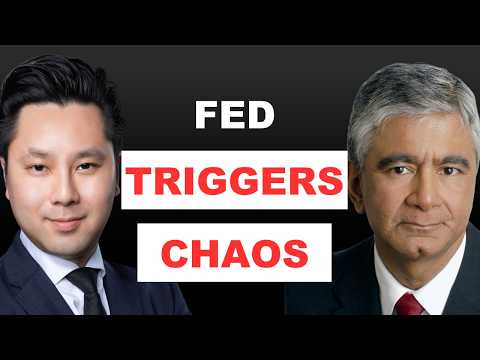
Will Fed Hike Rates This Year, Crash Markets? Economist Reveals Next Move | Komal Sri-Kumar

Channel: David Lin Published: 2026-04-29 22:15
David Lin

Economist Komal Sri-Kumar argues the Fed is not truly hawkish and may be trapped between inflation pressure, political pressure, and balance-sheet easing. He expects rate cuts would steepen the yield curve and could backfire by lifting inflation expectations, while AI/data-center spending supports the market but may not justify current exuberance.

Watch on YouTube ›

Get the market thesis, key claims, assets, contradictions, and follow-up questions from any financial video — then unlock a version personalized to your portfolio, watchlist, and favorite speakers.

Detailed summary

This interview centers on the April FOMC decision to hold rates steady and the unusually high number of dissents. Komal Sri-Kumar says the dissent pattern matters less as a signal of a broadly hawkish Fed and more as evidence that a future chair like Kevin Warsh would face serious internal resistance if he tried to cut rates under presidential pressure. He argues the next chair should not be thinking about cuts at all; in his view, policy should have been tighter already because inflation has not reached the 2% target in years and is still running closer to 3%+. Sri-Kumar emphasizes that the Fed is not just about the policy rate: balance-sheet expansion is, in his view, still an easing tool, and the Fed is effectively adding reserves to avoid another cash shortage or banking stress episode like September 2019 or March 2023. …

🔒 The full detailed summary continues — read all of it free with an account. Read the full summary →

Main takeaways

  1. The key issue is not just rate direction, but whether the Fed can control inflation while avoiding another cash/liquidity problem.
  2. Sri-Kumar thinks the Fed is still easing in practice because balance-sheet growth offsets the optics of unchanged rates.
  3. He sees inflation as the bigger problem than employment and says the 2% target has effectively been missed for years.
  4. He believes rate cuts would likely steepen the curve and may push inflation expectations higher.
  5. He views labor weakness as partly structural, with AI and tariffs reducing the effectiveness of rate cuts.
  6. He thinks AI/data-center spending supports equities, but the market may be vulnerable to dot-com-style excess.

Market read by horizon

Short term

Near term, the actionable setup is around whether the next Fed chair signals cuts too early; that would likely pressure the long end higher and keep inflation fears alive. If the Fed stays firm, bonds may stabilize and gold could lose some bid.

  • Watch the next Fed chair narrative, especially whether Kevin Warsh is seen as willing to cut at his first meeting.
Show more
  • The immediate tactical risk is a move higher in long-end yields if markets price in aggressive rate cuts.
  • If the Fed sounds dovish despite sticky inflation and higher oil, bond yields could back up and gold could weaken.
Mid term

Over the next few months, the likely path is slower growth with persistent inflation pressure, which keeps the Fed boxed in. A credible anti-inflation stance would support rates and the dollar, while a dovish pivot risks a steeper curve and more volatile fixed income.

  • Over the next several weeks to months, the base case in this interview is slower growth with sticky inflation rather than a clean disinflation path.
Show more
  • If inflation stays near 3% and labor weakness deepens only at the margin, the Fed may face rising pressure to keep policy restrictive.
  • Sri-Kumar expects the curve to steepen if the market believes rate cuts are coming while long-end inflation risk remains elevated.
Long term

Structurally, this is a late-cycle policy regime where central-bank credibility on inflation is at risk and balance-sheet policy remains a hidden form of easing. If AI-driven capex dominates growth while rate cuts fail to revive broad labor demand, markets may stay supported for a while but with bubble-like fragility.

  • The structural thesis is that the Fed may be trapped by its own balance-sheet dependence and cannot normalize policy cleanly.
Show more
  • Sri-Kumar’s regime view is that inflation control, not employment, should dominate policy after years of target misses.
  • He believes AI and tariffs may permanently weaken the pass-through from rate cuts to employment gains.
Unlock the full horizon read See the full short-term, mid-term, and long-term implications with confirmation and invalidation signals. Unlock horizon read

Key claims (10)

NEUTRAL monetary policy Fed policy

The Fed held rates steady, but the unusually high number of dissents is a rare signal of internal division.

He explicitly says there have not been this many dissents since October 1992 and calls it a very rare event.

BEARISH Fed independence Fed policy

The dissents matter because future Fed chairs will face resistance if they try to cut rates.

He frames the dissenters as signaling that the next chair cannot assume support for easing.

BEARISH inflation US inflation

The Fed has missed its 2% inflation target for the last five years and inflation is still running closer to 3% to 3.5%.

This is the core of his argument against easing.

Unlock 7 more claims See the full bullish, bearish, and counter-consensus argument map extracted from the transcript. Unlock all claims

Assets discussed (10)

S&P 500 — SPX
MIXED index

Cited as rallying during the press conference and later as having recovered to all-time highs; Sri-Kumar is cautious on the sustainability of the rally.

QQQ — QQQ
MIXED etf

Mentioned as rising during the press conference; used as a proxy for growth-tech sentiment.

Unlock the full asset map (8 more) See all assets mentioned, their directional bias, and the exact reasoning. Unlock asset map

Speakers

HOST David Lin UNKNOWN Donald Trump SPEAKER Jerome Powell UNKNOWN Lisa Cook UNKNOWN Kevin Walsh GUEST Komal Sri-Kumar UNKNOWN Steve Myron UNKNOWN Beth Hammack UNKNOWN Neel Kashkari UNKNOWN Lorie Logan

Interview (19 Q&A)

FOMC dissents

What does an 8-to-4 vote with four dissents at the FOMC signal to you?

Sri Kumar says two things: first, this many dissents is very rare (since October 1992). Second, one of the dissenters (Steven Myan) will soon leave, making way for Kevin Walsh. The three regional bank presidents who dissented are signaling to Walsh that they won't simply go along with cutting rates as Trump wants. Walsh faces opposition from at least three regional presidents.

Fed hawkishness

Does the fact that the dissenting regional presidents agreed with the hold but opposed the easing bias mean the Fed will remain very hawkish?

Sri Kumar says it signals not that the Fed will remain hawkish, but rather that Kevin Walsh will face a lot of opposition to cutting rates. He notes Lisa Cook is still on the board and will likely vote against Walsh, making it difficult for him to get a majority to cut rates.

Walsh rate cut motives

Why would Kevin Walsh want to cut rates? Are economic conditions calling for it?

Sri Kumar explains that Kevin Walsh has repeatedly said since last September that he wants to cut rates, and Trump chose him specifically because he wants to cut rates. If Walsh changes his tune, Trump will use epithets against him. Walsh is in an unsafe situation whether he abides by Trump's wishes or sides with the remaining board members.

Unlock the full interview (16 more Q&A) Every question, answer summary, and YouTube timestamp. Unlock full Q&A

Where this transcript pushes against consensus

  • He treats balance-sheet expansion as QE/easing, but the transcript offers no direct Fed confirmation that the current purchases are intended as stimulus rather than reserve management.
  • He argues the Fed should have raised rates before the Iran war, yet most of his inflation argument relies on broad assertions rather than a clear causal decomposition.
  • He says consumer spending is strong while sentiment is extremely weak, but his explanation rests on an income split without quantitative evidence.
  • His 1999 dot-com analogy for AI/data centers is suggestive, but he does not specify what the equivalent bubble signal would be today.
  • He implies a Warsh-led Fed would face difficulty cutting, but that outcome depends heavily on political appointments and confirmations not established here.

Topics

FOMC decisionFed dissentsKevin Warshinflation outlookbalance sheet / QElabor markettariffsMiddle East / oilTreasuries and yield curveAI and data centers

Create your free research agent

Unlock the full claims, asset map, scores, related transcripts, follow-up questions, and AI chat — shaped around your portfolio, watchlist, favorite speakers, and risks.

  • Full claims and asset map
  • Personalized relevance to your watchlist
  • Follow-up questions you can track
  • Related transcripts from your workspace
  • AI chat about this video
Create your free research agent
TRANSCRIPTAGENT.AI