
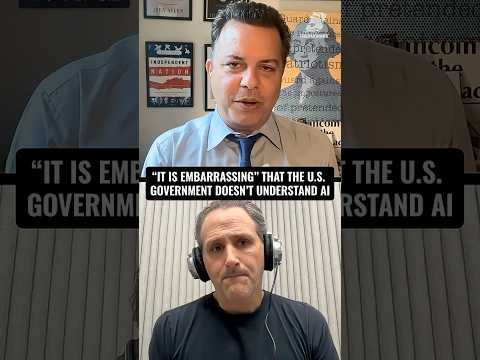
A speaker argues that a future Democratic president should use AI first to improve government service delivery, starting with basic tech fluency and proof-of-concept demonstrations rather than ideological zeal. The core political point is that Democrats should not keep defending obsolete federal jobs if AI can lower costs and improve efficiency without sacrificing the broader goal of employment.
Watch on YouTube ›Get the market thesis, key claims, assets, contradictions, and follow-up questions from any financial video — then unlock a version personalized to your portfolio, watchlist, and favorite speakers.
The transcript is a short, policy-focused monologue about how a future Democratic administration should approach AI in government. The speaker says the first requirement is that leaders actually understand AI well enough to speak credibly about its capabilities and limits, because current government fluency is poor and embarrassing. The emphasis is not on sweeping automation for its own sake, but on using AI to improve service delivery for citizens who are also customers of the U.S. government. The speaker recommends starting with practical proof-of-concept applications that show people how AI works and broaden acceptance. A second major theme is fiscal and organizational realism. The speaker explicitly says AI is very good at productivity and that government should not be afraid to save money. …
Near term, the actionable setup is political messaging: AI reform works best if introduced as a service-delivery upgrade with visible pilots, not as blanket job elimination. The immediate risk is credibility loss if cost-cutting is foregrounded before benefits are proven.
Over the next few months, the key question is whether AI deployments can show concrete gains in efficiency and user experience. If they do, a pro-modernization Democrat can build a credible reform narrative; if not, the issue likely becomes another partisan flashpoint.
Structurally, the transcript points to a broader shift in public-sector politics toward productivity, automation, and institutional modernization. The lasting implication is that defending every legacy role may become less politically viable than proving that government can do more with less.
A future Democratic president should understand AI well enough to explain what it can and cannot do credibly.
The speaker says leaders need AI understanding to speak credibly to the public about what is coming.
Government currently lacks adequate tech fluency, which is described as shocking and embarrassing.
The speaker directly criticizes current government knowledge of AI.
AI should be introduced through proof-of-concept service improvements rather than zealotry or overinvestment.
The speaker advises demonstration and practical adoption, not conversion narratives.
What could the next Democratic president do to bring in AI to actually improve service delivery and make government more effective and efficient?
The answer is that leaders must understand AI, use it to improve service delivery, start with proof-of-concept demonstrations, and not shy away from cost savings or from acknowledging that some federal jobs may become obsolete.
Unlock the full claims, asset map, scores, related transcripts, follow-up questions, and AI chat — shaped around your portfolio, watchlist, favorite speakers, and risks.
