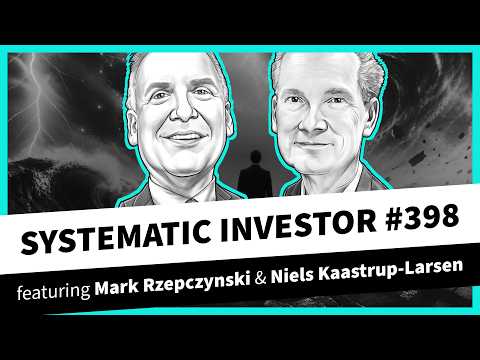
A Top Traders Unplugged systematic-investor episode centered on VUCA conditions, the persistence of geopolitical supply shocks, and why that environment has been favorable for trend following/CTAs even amid strong equity markets.
Watch on YouTube ›Get the market thesis, key claims, assets, contradictions, and follow-up questions from any financial video — then unlock a version personalized to your portfolio, watchlist, and favorite speakers.
This episode is framed as a conversation between the host, Neils Castro Rasen, and guest/co-host Mark Raspinski about how a rules-based investor should navigate a VUCA world: volatility, uncertainty, complexity, and ambiguity. The discussion begins with a series of current-world examples that illustrate “uncharted territory” — record marathon performance, robots outrunning humans, a massive hedge-fund redemption, Jerome Powell’s unusual continuation on the Fed board, and the UAE leaving OPEC. Those examples are mostly used to set the tone: the world feels more unstable and less conventional than normal. The core market discussion is about trend following and CTAs in the context of a prolonged geopolitical shock in the Middle East. …
Near term, the actionable setup is still in energy, rates, and other shock-sensitive markets; the risk is that volatility cools before trends fully develop, but if the conflict persists, CTAs may keep benefiting.
Over the next few weeks to months, the base case is a continuation of cross-asset trends driven by supply-shock uncertainty and sticky inflation. The view would weaken if markets rapidly reprice the macro impact as temporary.
Structurally, the episode argues for a VUCA regime where slow, rules-based systematic strategies have an edge because uncertainty and policy ambiguity create longer-lasting trends. If that regime lasts, it supports trend following as a core portfolio tool rather than a niche crisis trade.
We are living in a VUCA world—volatility, uncertainty, complexity, and ambiguity—and that is the key environment shaping the discussion.
Mark explicitly frames the market backdrop in VUCA terms and says this is what will drive the episode.
Trend following performs better when crises last longer because longer dislocations create more durable price trends.
Mark argues that the duration of a crisis matters more than just the initial shock for trend-following performance.
The current Middle East situation is a supply shock, which is harder for central banks to address than a demand shock.
He contrasts demand-shock policy playbooks with the difficulty of responding to supply-side disruptions.
What has been on your radar and caught your attention in the last few weeks?
Mark says they're living in a VUCA world—volatility, uncertainty, complexity, ambiguity—and that's the focus: how to navigate uncharted territories, especially as a quant investor.
What kind of Fed chairman will Warsh be and how will that affect markets?
Mark notes that it makes a huge difference whether Warsh follows a Trump lead of lowering interest rates or continues the past approach of being negative about quantitative easing and believing the Fed balance sheet should be shrunk, which would significantly impact how markets behave.
What have been your observations on the April performance for trend followers and CTAs?
Mark discusses that the longer a crisis lasts, the better for trend followers—contrasting the short-lived March 2020 pandemic crash with the current prolonged crisis environment that allows price trends to develop and be captured.
Unlock the full claims, asset map, scores, related transcripts, follow-up questions, and AI chat — shaped around your portfolio, watchlist, favorite speakers, and risks.