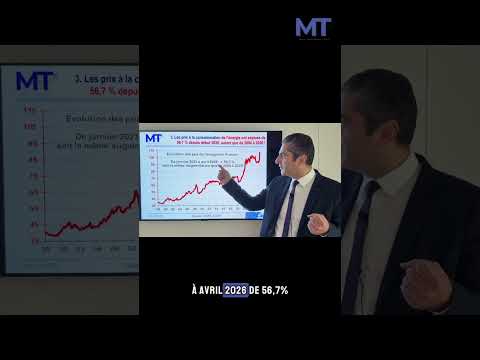
The speaker argues France is facing a renewed and severe inflation shock, with consumer prices up sharply over the last 3 months and energy, food, and broader commodities accelerating again. He frames this as the second major inflation wave since 2021, driven first by excess liquidity and then by the Ukraine war and commodity prices, with harmful consequences for households.
Watch on YouTube ›Get the market thesis, key claims, assets, contradictions, and follow-up questions from any financial video — then unlock a version personalized to your portfolio, watchlist, and favorite speakers.
The transcript is a one-speaker macro commentary focused on French inflation data. The speaker says that when using harmonized European inflation figures, consumer prices in France rose 3% over the last 3 months, with a 2.5% annualized rate over that short window, which he presents as worse than the yearly pace. He argues this confirms a renewed inflation shock after an earlier one that began in 2021. In his framing, the first inflation surge came from excess liquidity and money creation, then the Ukraine war and raw-material inflation, then a temporary easing in 2024-2025, and now another acceleration. He emphasizes three main pressure points: energy prices, food prices, and the broader CRB commodity index. …
Near term, the risk is that the latest inflation prints keep surprising higher and reinforce a renewed inflation narrative in France. The immediate tactical focus is on energy and broad commodity follow-through rather than on relief from a modest oil pullback.
Over the next few months, the base case in the transcript is continued inflation pressure if commodity pass-through reaches food and other consumer categories. The thesis weakens only if energy and raw materials reverse enough to break the second-wave setup.
Structurally, the speaker is arguing that France has shifted into a recurring inflation regime rather than a single transient spike. If true, households face ongoing purchasing-power erosion and policymakers cannot assume the 2021-2025 inflation episode is finished.
Consumer prices in France increased by 3% over three months, with inflation starting in February before the oil shock.
The speaker explicitly says that in three months consumer prices rose 3% and that the increase started in February, before the oil shock.
French consumer prices are up 20.4% from January 2021 to April 2026, which he calls evidence of two inflation shocks.
He gives the cumulative figure and frames it as two separate inflation waves.
The first inflation shock from 2021 to 2023 was driven by excess liquidity and money creation, not only by the Ukraine war.
The speaker says inflation started in 2021 due to excess liquidity from money printing, and that it was not born solely with the war in Ukraine.
Unlock the full claims, asset map, scores, related transcripts, follow-up questions, and AI chat — shaped around your portfolio, watchlist, favorite speakers, and risks.