
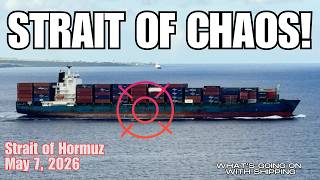
The host argues that the U.S. attempted a phased shipping escort operation in the Strait of Hormuz, but it collapsed after Iranian pressure, fresh attacks on commercial vessels, and a U.S. strike on an Iranian tanker. He frames the area as a dangerous, highly militarized maritime corridor where commercial shipping is now caught between U.S.-Iran escalation and unclear ceasefire constraints.
Watch on YouTube ›Get the market thesis, key claims, assets, contradictions, and follow-up questions from any financial video — then unlock a version personalized to your portfolio, watchlist, and favorite speakers.
This episode is a detailed update on shipping risk in and around the Strait of Hormuz, Persian Gulf, Gulf of Oman, and Arabian Sea. The host, Sal Mccaglano, says the U.S. initiated what he calls 'Project Freedom' to escort U.S.-flag vessels out of the region, naming the MV Alliance Fairfax and CS Anthem as the first two ships to leave under escort. He describes the operation as having tactical support from U.S. destroyers, embarked shipping advisers, Marines, and air cover, and says it was intended as phase one of a larger effort to move more ships out. He then says the operation stalled or was called off after the transit of those vessels, citing a burst of attacks on shipping, including an attack on the CMA CGM San Antonio and possible mine-related incidents. …
Near term, the Strait of Hormuz remains a high-risk transit zone with active incident risk and a chance of further escalation if convoying or blockade enforcement continues. Traders should assume route disruption and headline-driven volatility stay elevated.
Over the coming weeks, shipping likely remains fragmented: occasional escorted transits may succeed, but a stable commercial corridor looks hard to sustain unless attacks fade and military rules of engagement broaden. If incidents keep appearing, insurers and operators will keep treating the passage as a war-risk lane.
Structurally, the episode argues that Hormuz is a permanent geopolitical choke point where state conflict can repeatedly reprice global shipping risk. The lasting regime implication is that merchant flow through the Gulf is vulnerable to rapid security shocks, legal contestation, and de facto militarization.
The US initiated a limited escort operation to move two US-flag vessels out of the Strait of Hormuz.
The speaker says the US escorted Alliance Fairfax and CS Anthem out of the Strait of Hormuz.
Project Freedom appears to have been paused or called off after the initial transits.
He explicitly says Trump called off Project Freedom as Iran talks advanced.
Escorts alone cannot solve the problem if the US cannot strike or suppress shore-based missile and drone launchers.
He argues that without hitting launchers ashore, ships remain vulnerable.
Unlock the full claims, asset map, scores, related transcripts, follow-up questions, and AI chat — shaped around your portfolio, watchlist, favorite speakers, and risks.
