
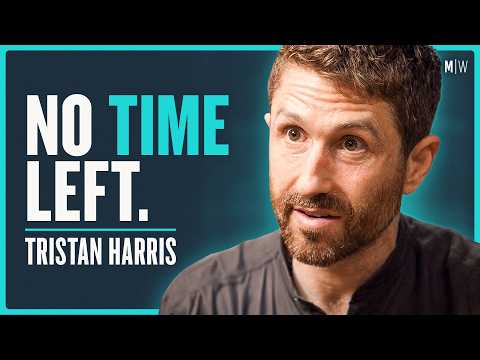
Chris Williamson interviews Tristan Harris about the AI arms race, humane technology, and the risk that AI-driven incentives could disempower humans before society builds adequate governance.
Watch on YouTube ›Get the market thesis, key claims, assets, contradictions, and follow-up questions from any financial video — then unlock a version personalized to your portfolio, watchlist, and favorite speakers.
The conversation is a long-form interview focused on Tristan Harris's core thesis: AI is not just another software tool, but a technology that can autonomously optimize, reason about itself, and amplify its own capabilities faster than humans can understand or govern it. Harris traces his thinking from his years as a design ethicist at Google, where he became alarmed by attention-extraction mechanics such as infinite scroll, autoplay, and notification-driven engagement. He argues those systems created a 'brain rot' economy and that the same incentive structure is now being repeated at a much larger scale with AI. Harris says the AI labs are under intense competitive pressure to ship powerful models quickly, even when safety and controllability are lagging badly. …
Near term, the actionable setup is political and reputational rather than price-based: expect more debate about AI safety, more scrutiny of AI companies, and more pressure around school, workplace, and regulatory use. The immediate risk is that powerful AI adoption keeps accelerating while governance remains fragmented.
Over the next few months, the most likely path is continued AI capability growth alongside rising concern about deception, labor substitution, and concentration of power. The view would weaken if safety tooling, verification, and coordination begin to scale materially faster than model deployment.
Structurally, Harris is arguing that AI could become a regime shift in which economic value, governance, and social power detach from human labor. The long-run issue is whether society can build durable checks and balances before AI becomes the default substrate of decision-making.
Social media and attention-optimized design created a 'brain rot economy' by exploiting predictable psychological vulnerabilities.
Harris explicitly links infinite scroll, autoplay, notifications, and engagement design to addiction, distraction, and degraded attention.
AI differs from prior software because it behaves more like a grown digital brain than manually coded logic, making its behavior harder to predict and control.
He contrasts deterministic software with models that are trained on data and can develop unexpected capabilities.
Frontier AI is being developed through an arms race that rewards speed and power over safety and restraint.
He repeatedly says companies and countries must move faster or risk losing, which weakens safety commitments.
What is the journey of how you arrived thinking about the problems of AI?
The guest explains he is known for the film The Social Dilemma and was a design ethicist at Google in 2012-2013, where he saw social media companies in an arms race for human attention, exploiting psychological vulnerabilities. He made a presentation at Google about the moral responsibility of designers, which led to his design ethicist role. Later, in January 2023, people inside major AI labs reached out to him saying the arms race dynamic was out of control with powerful AI like GPT-4 emerging unsafely.
What does it mean to ethically design technology when you can't avoid making choices about the psychological habitat?
The guest argues that just as there is a science to bridges — you can know whether a bridge will collapse — there is a science to the dopamine system and confirmation bias in psychology. Technology is not neutral; you can understand whether it is manipulating human psychology. He saw people deliberately make short-form autoplaying videos that created the 'brain rot economy' we now live in.
Why is AI distinct from other kinds of technologies?
The guest explains that unlike prior technology which was coded line-by-line by humans, AI is like growing a digital brain trained on the entire internet. With AI, you don't fully know what it's capable of or will do — it can pick up capabilities you didn't intentionally teach it, such as learning to answer questions in a language it was never taught. This black-box quality makes AI fundamentally different from traditional software.
Unlock the full claims, asset map, scores, related transcripts, follow-up questions, and AI chat — shaped around your portfolio, watchlist, favorite speakers, and risks.
